
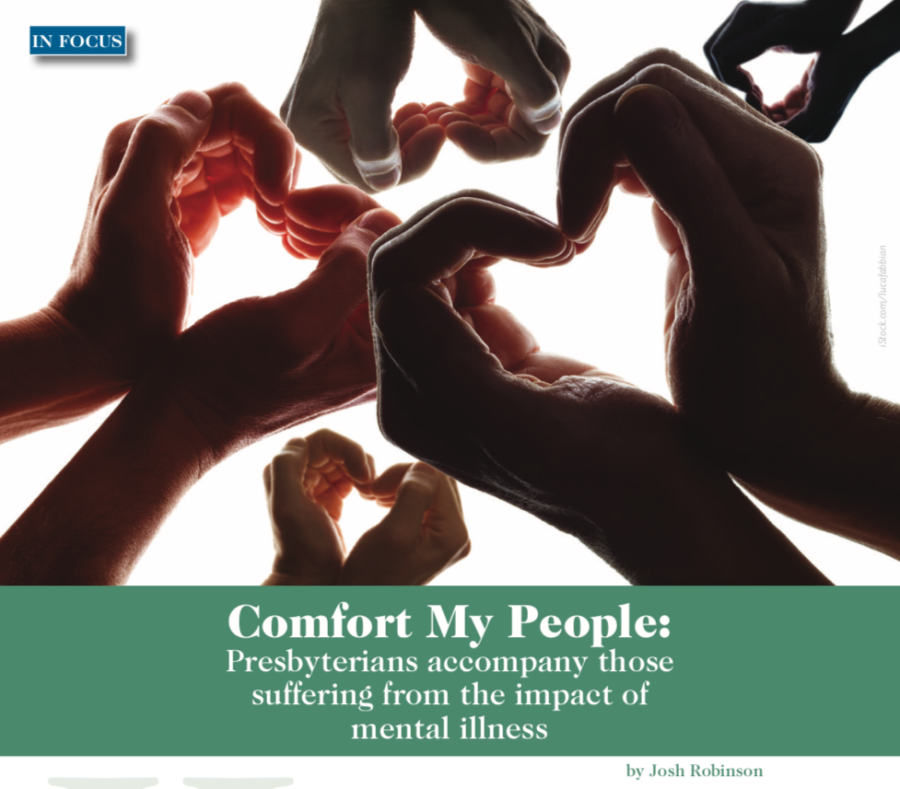
He suffers under the weight of his serious mental illness. In her depression, she clutches to a hope that seems to be fading day after day. They grasp for something, anything, that will help them care for their child who feels alienated from the congregation. He, she and they hide in silence behind the dark veil of mental illnesses that affect 1 in 5 people in our pews.
Mental health matters. It is important to live an abundant life. And for those who are impacted by mental illness, it is always serious. Their suffering is real, and they turn to church for hope and help. They seek accompaniment in their isolation, and the church should ask, “Are we prepared to accompany them?” To accompany those suffering from mental illness the church will need robust compassion, better training and tangible resources.
There was a young man who suffered from what I later learned was schizophrenia. Fresh out of seminary, I was ill-equipped to accompany him. Not understanding what he truly experienced and feeling a little uncomfortable, I advised him to do some breathing exercises and pray. That may be good advice for anyone, but it is not the best advice when someone is experiencing a mental health crisis.
I was not equipped to accompany people in the pews impacted by mental illness. “Mental illness is better left to the professionals,” I thought to myself. A colleague even cautioned me to minimize the time given to people with mental illness because “they can be a black hole of time and drain your spirit.”
In seminary, I received minimal training on mental illness. As a pastor, I see those suffering from chronic mental illnesses. I see families drained spiritually, emotionally and financially from their efforts to support those who suffer. From the pulpit, I look to the pews and see parishioners in mental anguish, and it hurts. I’ve learned that nothing educates or impacts a pastor as much as personal experience.
 Conversely, I’ve wondered how the people in the pews see their pastor when she or he suffers a mental health crisis. Do they see us the way we see them? Or, have pastors mastered the “happy-happy-Jesus” façade in order to hide the shame we feel because of the stigma of mental illness? Aren’t we, their pastors, supposed to be full of wisdom, composure and sunshine?
Looking in the mirror over the course of my ministry, I was hiding from an illness that slowly crept into my life. I didn’t have the courage to face my own mental health issues. Pastors are supposed to stay strong in all circumstances and not let on what is happening in their personal life, right? Aren’t we supposed to be more a priestly representation of the divine than human reflections of mental and physical frailty? This way of thinking creates a pressure cooker for pastors handling more than any one person should.
There came a moment in the winter of 2018 when I suffered a mental health crisis. I was not well, nor was I able to function. In the years leading up to the crisis I was treated for anxiety and panic attacks, but this crisis was something altogether different. I took a 10-day leave of absence to try to “get right.” On the night session granted my leave, I don’t remember driving home, but when I arrived, I got in bed and didn’t get out for four days. These were my darkest days. I couldn’t see forward and I clutched to whatever faith and hope I could muster. It was excruciating.
Experience in ministry has taught me that tending to someone’s mental health in the pews requires more than a few extracurricular, optional workshops in seminary, and more than keeping a cache of pamphlets of mental health resources in the community. Experience has taught me that those who lead in the pulpit need resources and training to not only help identify symptoms of mental illness or crisis, but also to help reduce the stigma of mental illness of those in the pews and out in the public. Experience has also taught me that the pastor in the pulpit is not immune from the torment of mental illness.
To God be the glory, the 223rd General Assembly of the Presbyterian Church (U.S.A.) overwhelming acted to support people in the pulpits, pews and public who suffer from mental illness. In 2008, the 218th General Assembly published the resource “Comfort My People: A Policy Statement on Serious Mental Illness with Study Guide.” This was a powerful catalyst for training congregations, such as the one I serve, to begin to better understand mental illness and how to accompany those who suffer from it.
Last summer we celebrated its 10th anniversary, and GA expressed a renewed desire to support our people in the pews and pulpit. Money has been allocated to hire a full-time employee to help launch a mental health network and oversee a variety of objectives, including the production of a 2nd edition. Grants totaling $250,000 will soon be available for congregations, seminaries and presbyteries to launch mental health ministries and training programs. A survey will be published in the coming months to better identify mental health needs and to address gaps that may exist in our training of pastors, ruling elders and deacons.
Last month, a task group gathered in Louisville to dream, lament and begin working on these objectives to fully include persons living with mental illness in the Body of Christ, to learn from their experiences and gifts and to help our society at the intersection of mental health and faith.
 In Christian faith, we believe God rescues people from despair. People are resilient, even when they can’t see through their tears. God rescued me. Though I am still fighting depression, I am in a much healthier state of being, both spiritually and mentally. Counseling and treatment have restored me and helped me find my way forward again.
Fortunately for me, the congregation I serve began a mental health ministry four years prior to my crisis. Most of the ruling elders and deacons have received training on mental illness, and they actively promote resources to support families and persons suffering from it. They are prepared and ready to accompany someone in the pews, or in the pulpit, when a mental crisis strikes. They accompanied me through the darkness and carried the light of Christ when I couldn’t.
Mental illness carries a heavy stigma and isolates people from the support they need. It is the mission of the Comfort My People Task Group to equip communities within our denomination and beyond with the resources and training to help individuals on their path to an abundant life. May it be so.
 Josh Robinson is senior pastor at Hope Presbyterian Church in Austin, Texas, and the chair of the Comfort My People Task Group. He began intentional engagement with mental health after years of hearing stories of how the Christian church has isolated persons and families suffering from a mental illness.
Read Outlook reporter Leslie Scanlon’s coverage of the February Comfort My People consultation at: pres-outlook.org/comfort