 When our church was asked to provide transitional housing for transgender women recently granted asylum or temporary release, my initial thought was: “We just might be able to do it.” We already decided to use our building’s adjacent apartment to host asylum candidates released from the Cibola Detention Center, 80 miles west of Albuquerque.
Our first guest, Ezekiel (not his real name), was from the Democratic Republic of Congo. The DRC government killed his father for speaking out against corruption. Ezekiel, a Christian rock artist back home, walked with a limp because the government tortured him in response to his outspokenness. His arduous journey from Africa took him to South America, and then north through Central America, before turning himself in to U.S. border patrol agents at the border in Mexico. The United States granted him asylum.
Ezekiel stayed with our congregation for 10 days. The congregation showered him with gifts and love and Ezekiel expressed his gratitude. His appreciation was evident the Sunday morning he participated in worship, singing a passionate praise song in four different languages. But the initial experience of hosting Ezekiel was difficult for the church. Appropriately addressing his needs and providing him entry to the building during off-hours was too great of a time demand on the leadership. Our hosting program stalled.
Until, that is, our partner organizations proposed a new idea. The New Mexico Faith Coalition for Immigrant Justice, the Trans Latin@ Coalition and the Trans Liberation Coalition pointed out that the Cibola Detention Center has the only pod for transgender female asylum-seekers in the country — and finding temporary housing for them upon release was a challenge. It was suggested that our church allow a transgender woman, already granted release, to be a “resident” to help take in other women as they are released. In the few days these women would stay with us, they would have safety, comfort, counseling and general support as arrangements were made for them to fly to their new sponsors around the country.
The chasm that often exists between theory and practice was on my mind as our session considered the request. The open disposition of a community is tested when boundaries are challenged. Our church is multicultural and bilingual, so many in the community have a heightened sociocultural awareness — but no one in the community openly identifies as transgender.
When I shared with my 10-year-old son that the church was considering hosting transgendered immigrants in the asylum process, to my surprise he responded, “That’s awesome!”
“Why?” I asked.
 “Because when someone seems different, those are the kids at school who people don’t spend time with. And it makes them feel bad. But when the church welcomes them, it shows them that they are cared for by God.” I was simultaneously proud of his concise, Christian ethical analysis, and perplexed knowing the world is not a simple place and the church is not a simple institution. Our session thoughtfully wrestled with the proposal for three months, and after considering the implications, approved the program. It was decided that hosting immigrants fleeing for their lives, whether or not they are transgender is consistent with God’s unequivocal call in Scripture to engage “the foreigner who resides with you … as the citizen among you; you shall love the foreigner as yourself, for you were foreigners in the land of Egypt” (Leviticus 19:34).
The first “resident” from Mexico fittingly arrived to the church during our Christmas Eve service when we heard Scripture about there being no room for Jesus in the inn. In a full sanctuary, she unknowingly sat in a pew next to a mother whose son is exploring his gender identity. In that moment, communion was concluding. One of the servers saw the new guest come in and signaled another server to go with him to bring her communion elements.
A few weeks later, our new resident spoke in front of the congregation and with the session, and we learned from her testimony that she “had it easy,” compared to most of the other “chicas/young women.” Years before, she had a visa permitting her to cross into the United States to visit family in California. She had some familiarity with her new country, but still felt culture shock. Had she stayed in Mexico, however, her life would be at risk, so she presented herself to border security to request asylum. She had grown up active in a church, and felt blessed to help other chicas whose life situations “were more dire.”
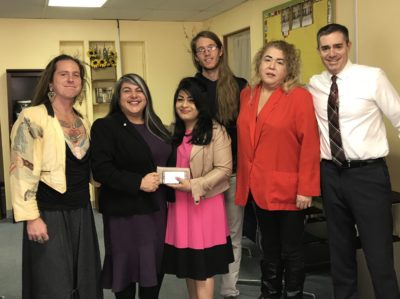
We are now on our second resident who, though she had lived in the United States for 20 years, was detained and held in detention for 15 months at Cibola County Detention Center in New Mexico. She became the first transgender woman to go through the Texas court system and be granted asylum along with protections under the Torture Act, keeping her safe from ever being sent back to her country of origin. To date, more than 20 women have lived in our church apartment. Some have met with our session or come to fellowship hour, where they were offered support by members and friends of the congregation. Though their heart-wrenching testimonies are distinct, common threads include inhumane treatment, displacement and fear. Transgender individuals statistically face high rates of violence and murder —a consistent reality for all of our transgender, asylum-seeking guests.
When I share with someone in the Albuquerque community what our church is doing, the response is often surprise and delight: “That is amazing that your church is willing to take that on.” The underlying sentiment is: Hosting transgender women seeking asylum is something a church wouldn’t do — and yet, somehow, your church is doing it!
Ours is a genuinely loving congregation, but we are not an issue-driven church. Our worshippers represent varying theological perspectives. And to most, transgender issues are unfamiliar territory. To help the congregation better understand our guests, our community partners in this endeavor scheduled “Transgender Asylum-Seeker 101” adult education classes. The classes demythologized assumptions and stereotypes about gender. They provided up-to-date understandings and terminologies. But most of all, they humanized a group of human beings that God created and helped us to embrace with love. I am proud of the congregation and its willingness to move beyond discomfort in order to straightforwardly express Christ’s love in a complicated world. As we began considering the program, much of the discussion was about how hosting would affect us. But now that we are getting to know sisters from other parts of the world and carrying out God’s service, we are focusing more upon those whom we serve.
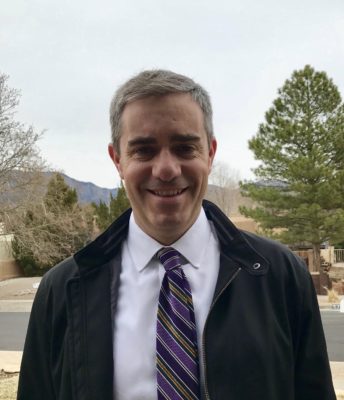 Robert Woodruff is pastor at Second Presbyterian Church in Albuquerque, New Mexico.