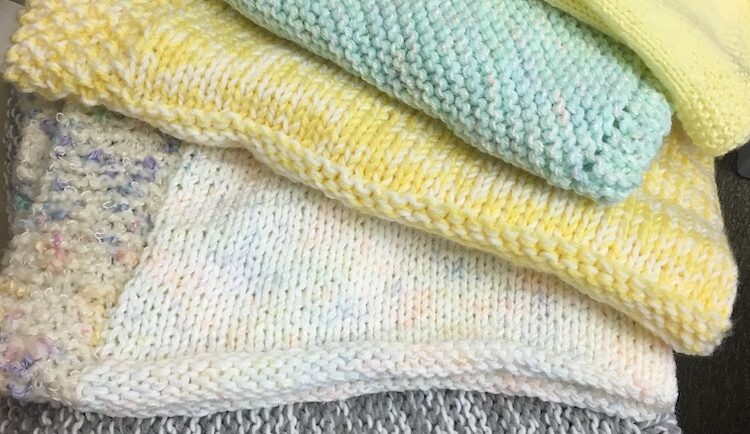
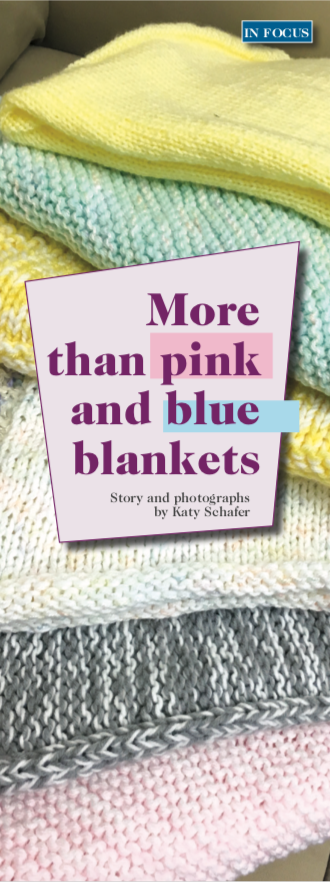
“Oh, I love this gray blanket!” said the new young mother. As the newly hired director of children and family ministries, I was paying a visit to a family with a newborn. I had brought a selection of blankets that had been lovingly created by the church knitting group, and I intentionally had brought along this recently completed gray-and-white blanket in addition to the selection of traditional pinks and blues. The new mother continued: “This is perfect. We did the nursery in neutrals.” I smiled inside and then outwardly as I handed her this handmade gift from the church.
As the parent of a transgender child, my own vision and sense of compassion has broadened even in the simplest of ways as I am drawn to honor the diversity of all human beings. This even includes newborn babies. I cannot in good conscience show up to visit a newborn with only a choice of pink or blue blankets from the church. There must be more, whether it’s creamy off-white, or gray-and-white (by far the current favorite) or soft yellow stripes. There must be more choices than pink or blue, and I love that the church I serve is setting up that first impression, that first communication, of inclusivity, regardless of whether the birth family notices.
I remember having my first child in 1998, who was wrapped in swaddling blankets at the hospital for two days, and how absurd it seemed when it was time to put our baby in the going-home outfit. Our beautiful child with silky, smooth skin got wrapped from head to toe in a blue-checkered cotton outfit with a matching hat. This was what we were supposed to do — we had a biologically male child. The world had already told us to put our baby in blue and start buying toy cars and trucks. We toed the line and fell into place without wondering about what our own child would prefer someday. How could we have known that by age 2, when this child was able to articulate preferences, those preferences would always be for traditionally female clothing, toys, hobbies, activities, friends and well … everything? Those preferences never wavered. Hence my decision to make small inroads and baby steps in the ministry to children at First Presbyterian Church Raleigh. Starting with babies, I aspired to stop making assumptions. It was time for me to set the tone for children’s ministry at this church to take place in a faithfully inclusive way.
Bringing a baby into the world in all its glory is an amazing miracle. I personally experienced that four times in five-and-a-half years. Babies’ whole lives are ahead of them from the moment they enter our world. As a representative of the Presbyterian Church (U.S.A.), I do not need to be another one of many who begins the celebration of a new life with a congratulations of a baby girl or a baby boy. How about we celebrate with love and joy the arrival of a baby — a remarkable, helpless, tiny human being who is going to grow to be whoever God has created them to be? What an exciting and unpredictable life new parents are about to embark upon as they are entrusted to care for and nurture their precious child. Regardless of what my own expectations as a new parent had been, I learned within the first 18 months that my first child was going to broaden my scope of loving. Parenting this child also brought that same type of awareness to each of the three children who followed. As a parent, I found myself wondering who each of these little people would turn out to be, each wired a different way, each in their own unique way exactly who God had created them to be.
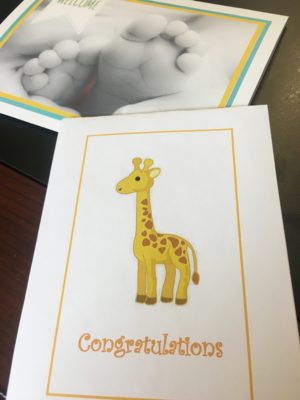 One puzzling trend that I believe robs us of the beauty of the mystery of God is the current phenomenon of having hyped-up gender reveal parties. The idea that a child’s biology will always match their gender identity leaves me worried that parents are already boxing in their child, and themselves, before there is even a birth. Celebrating the miracle of a baby, not a gender, more fully honors our Creator God. I am often drawn to Psalm 139 as a beautiful reminder that we humans are fearfully and wonderfully made and that we have been knit together precisely the way we are supposed to be. God does not make mistakes, and the diversity and beauty of the human family should be celebrated by the church. To lead with inclusivity from the beginning of life is important. In this very first sign of inclusivity, the first communication from our church to a member with a new baby has a yellow giraffe on the front of the card. A yellow giraffe, congratulatory words for the birth of a healthy child and a prayer are included in this first acknowledgement of a life that is born into this church community.
However, these babies quickly grow up to become children of the church and age out of the church nursery, where there are giraffes and plenty of toys for all. As a church, we now have a responsibility to pay attention to what programs are offered next (such as vacation Bible school, craft projects, movie nights and Sunday school curriculum choices). Are inclusive-language Bibles used? How do we communicate with members? How may we need to adjust and tweak existing programs to be more inclusive? Discussing these ideas can form a healthy framework that supports what I hope reflects the compassion of Christ. Any child who is old enough to speak is already expressing preferences. As they grow up in a church community, we must look upon them with compassion and inclusion for all children, but especially for gender-nonconforming children and their families.
Consider, for example, the season of Advent. Do we celebrate diversity and inclusion in our Christmas pageants? Pageants should include any child as a shepherd or an angel, any child representing magi, any child helping and participating in telling the Christmas story. We must make it clear in church newsletters and pageant planning that children can choose who they want to be in the pageant. They already know what they prefer. Just ask them. This year we had a little boy who did not want to be an animal and did not want to be a shepherd or an angel. He wanted to be a banana. So we let him. He walked in with the animals and he was beaming. The preschoolers could be animals of any kind: tigers, flamingos or turtles — so, why not a banana? Our live baby Jesus was a female child, the angel Gabriel was a female senior high student. It’s really about the story of the birth of the baby Christ. I encourage you to truly believe there is room in the story for all.
Opening the lines of communication to all parents, and especially to the parents of gender-nonconforming children, will provide opportunities to minister to parents who are struggling with embedded expectations that the world has already placed on their children. I was so grateful as a young parent when church was the place that my gender-nonconforming child was loved and accepted, even and especially when the elementary school and middle school years were becoming more difficult.
 During the teenage years when our middle school child was beginning to publicly identify as female, our youth group went to a weekend camp at a regional PC(USA) property. We were thrilled that our child would get a weekend away with church friends and lots of love and acceptance from youth group leaders. Imagine how hard it was to hear the sadness in our child’s voice upon returning home when we were told of painful language used by the camp director concerning camp rules. To drive home the point that the camp did not want girls near boys’ cabins or boys near girls’ cabins, the rules were explained by saying that “pinks need to stay with pinks, blues need to stay with blues … and no purple is allowed.” My heart sank as our child cried. Our child was “purple.” My child’s best friends were in the girls’ cabin. And as it poured rain outside all weekend and outdoor activities were cancelled, all students had to spend hours and hours in their respective cabins. No purple. My child sat in the boys’ cabin like a foreigner.
As a parent, and as a children’s minister, I know we can do better than this. I can be reasonably sure that no one on the camp staff intentionally chose those words to isolate my child. But what we can do, which is why I am sharing this story, is strive to be one step ahead as we choose our words. Those of us in positions of ministry and church leadership must choose our words carefully. Words matter, and I believe that when we serve God from a position of compassion, we truly live the gospel and love people the way God wants us to love them.
So how do we learn and equip ourselves to live out the gospel through word and deed to all, but also uniquely to children and families that fall into the LGBTQIA category or are gender-nonconforming/gender-queer? I know it to be true that choosing words carefully, affirming that every child is loved and accepted, honoring chosen pronouns, providing a gender-neutral bathroom, placing a “safe space” triangle sticker on your office door, thinking through how rules are articulated and offering more choices than pink or blue are all important and tangible ways to display the gospel in action. As a parent I was always looking for signs that my child would be loved and included: big, obvious signs; subtle signs; phrasing on brochures; and anything that helped me know my child would be OK. These became my lifelines and signaled to me that my child was in a safe space with people who cared.
The child of whom I have spoken in this article was born and raised in the PC(USA), baptized, confirmed and loved by congregations in New Jersey, Arizona and North Carolina. My husband and I are both seminary graduates with M.Div. degrees, and he also has a D.Min. Besides all the parenting we have done as we have raised all our children in a Christian home, he has spent almost two decades in the pulpit reminding adults, children and our own children every Sunday through his benediction that “God loves you beyond your wildest imagination.” Not just some of us, but all of us.
At First Presbyterian Church Raleigh, I like to think that baby congratulations cards with yellow giraffes, neutral-color choices of baby blankets, inclusive flyers for church events and intentional language in emails are all important. Sometimes it’s the little things. Signs and signals of programs provided by the church community that include all children and families of all types are essential. As you look to communicate the love of Christ in your own respective worshipping communities, I encourage you to assess your ministries with new eyes. Be encouraged to broaden your vision to be inclusive, as Christ includes, and for your own church to be one of the first to welcome a child into the world. And maybe this year I will ask the ladies in the knitting group to please give me blankets that include the color purple.
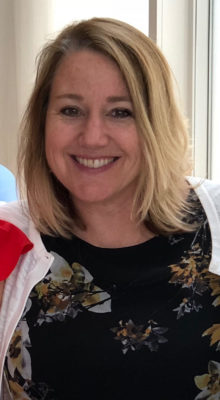 Katy Schafer is the director of children and family ministries at First Presbyterian Church in Raleigh, North Carolina. She and her husband Mac are the parents of four children, one of whom was the only teenage plaintiff in the HB2 (“Bathroom Bill”) in North Carolina.