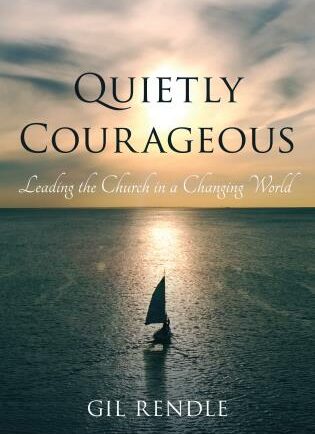
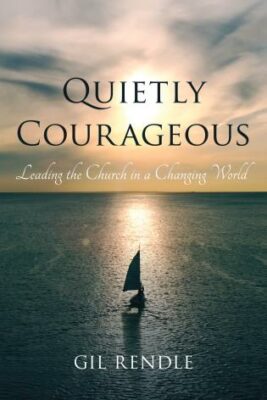
 Gil Rendle
Rowman & Littlefield, 304 pages
Reviewed by Allen D. Timm
A pastor introduced herself to the principal of the high school, who asked if she knew of any opportunities for her students to serve the community. A local imam asked the same of his congregants. The church was hosting an overnight shelter, and they joined the project. The church became a catalyst for change in her community.
This story illustrates Gil Rendle’s “Quietly Courageous.” It picks up where “Doing the Math of Mission” leaves off. Rendle builds on his work for the Texas Methodist Foundation to provide leadership for the church.
So what is his contribution? Here is his central point: Churches pay their pastors to serve their own church, not to find ways to lift and serve their community. Rendle says that while providing leadership inside the church to nurture its members, pastors must also serve quietly outside the church. They must build relationships with others who want to change their community and show the love of Christ to the world in word and in deed.
Society has become unbundled and fractured. People can choose any number of channels, record their favorite shows and worship God as they drive to work. Communities distrust each other and are angry. Rendle believes Christ needs pastors who will be courageous enough to find the others in the community who hear the same call to make this world reflect the ethics and morality of the rule of God.
Rendle says we are in the wilderness, like the Israelites whom God freed from slavery. God promises to lead us out, but not back to where we were. The church will feel different if we follow God out of our sanctuaries and into our neighborhoods. The people we serve may never darken the door. But Rendle calls us to be “quietly courageous.”
Citing studies out of Harvard (howwegather.org), Rendle shows that people who don’t go to church still seek support for their journey. Leadership traditionally offered by the church can be found in these communities: the gatherer, the elder, the steward, the seer, the venture, the tracker, the healer, the anointer and the maker. Rendle challenges pastors and leaders to create new communities where we can provide these skills. We need to meet folks where they are, and help them make sense out of life.
Rendle says we are tempted to look back in nostalgia. We are too tired to meet new people and to find new ways to serve in our community. We say we don’t have enough resources. We are tempted to treat everyone the same way, instead of providing leadership where it is welcomed and respected. Rendle hopes seminaries will see that a new type of education is needed. Our community isn’t looking for theology and worship first. They want a better life. When we demonstrate the kingdom, we have the hope of introducing them to the gospel that sets them free. We hope they will see our good works, the light set on the hill, so that they give glory to our God who is in heaven. As “quietly courageous” leaders, God can use us to lead the church to show the love of Christ to a changing world.
Allen D. Timm is executive presbyter of Detroit Presbytery.