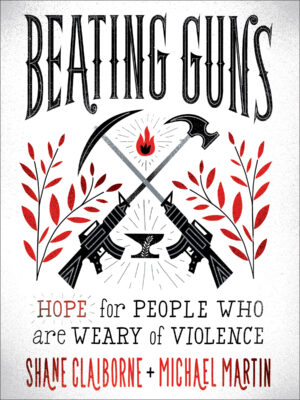
 Shane Claiborne and Michael Martin
Brazos Press, 288 pages
Reviewed by David Ensign
The General Assembly of the Presbyterian Church offered its first advice to the church and the culture about gun violence in America in 1968, calling for control of the sale and possession of fire arms of all kinds. Some 50 years later, the church keeps speaking, but it cannot be heard above the cracks of gunfire and the wails of lamentation.
That sad state of affairs left me with slim hope that I would encounter anything new in the pages of yet another faith-based call to address the epidemic of gun violence that plagues the United States. What, I wondered, is left to say on the subject after the Jim Atwood’s work earlier this decade (“America and Its Guns” in 2012, and “Gundamentalism” in 2017), among other notable recent works on gun violence?
Thus I was surprised to find myself surprised as I read Shane Claiborne and Michael Martin’s “Beating Guns.” Claiborne and Martin do recite the by-now familiar litany of gun violence statistics as necessary context for understanding the depth of the problem confronting American society.
“Beating Guns” weaves several overlapping narratives including the early days of gun manufacturing and marketing, contemporary gun violence in schools, the role of guns in violence against women, the toxic role of guns in hyper-masculinity and the use of guns in suicide.
Moreover, “Beating Guns” pays particular and helpful attention to the role of firearm executives in perfecting the marketing of weapons to American consumers, noting, for example, that Samuel Colt is credited with coining the phrase “new and improved.” The book reminds the reader about the iconography of guns in so many of the most troubling and violence-prone aspects of American culture historically.
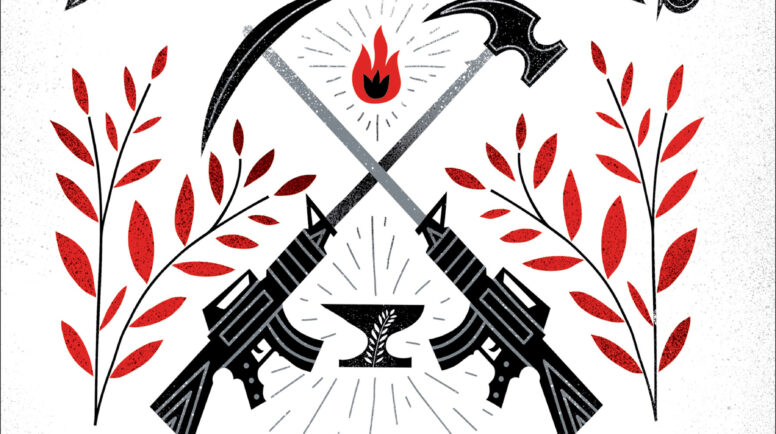
To some extent, “Beating Guns” is a work of history. Moreover, the history of gun manufacturing reminds that the gun is, itself, an artifact. Taking literally the prophetic call to “beat swords into plowshares,” the authors lift up the act of turning guns into artistic expressions as a path into the deep conversations necessary for the country, as a whole, to address the problem of gun violence. The images of guns beaten into musical instruments, tools or works of art complement and occasionally interrupt the narrative throughout the book. Pull-outs and sidebars tell stories of this creative work and offer compelling suggestions for using such stories and work as new tools for community conversation.
In the introduction, the authors visit a blacksmith shop and, in conclusion, they return to “the place every tool can trace its origin to.” In the heat they forge this conclusion: “Turning swords to plows brings us away from the immediate, instant, and fatal consequences of empire and toward the patient, seasonal, and creative consequences of Jesus’ kingdom.” This book is a useful tool in the inbreaking work of that kingdom.
David Ensign is pastor of Clarendon Presbyterian Church in Arlington, Virginia, and member of the activist council of the Presbyterian Peace Fellowship.