FORT WORTH, Texas – The Special Committee on Per-Capita Based Funding and National Church Financial Sustainability is starting to identify next steps — including developing a list of questions about finances in the Presbyterian Church (U.S.A.) it wants to ask, and arranging a schedule of meetings with mid council leaders to talk about finances.

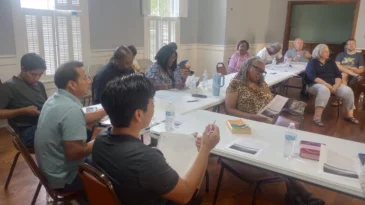
The committee held its first in-person meeting May 13-15 in Fort Worth — well-aware of pending deadlines (Dec. 31 for the financial sustainability report and Feb. 21 for per capita). As the gathering came to a close, committee members voiced feelings of excitement, trepidation, of making progress and feeling a little in the fog.
Part of the final morning of the meeting was spent with committee members divided into two work teams: one on per capita and one on financial sustainability.
The per capita team is scheduling listening sessions with presbytery and synod leaders in the coming months.
And the financial sustainability team worked on a list of questions, seeking more information from denominational leaders beyond the financial reports that the six agencies have already provided.
Among the questions:
- What programs at the Presbyterian Mission Agency and the Office of the General Assembly are mandated by the General Assembly, and which are not?
- What’s the process of evaluating programs and assessing whether the church should pay for them, or not?
- What’s the balance of restricted and unrestricted funding for PC(USA) mission? Who decides when and how those restrictions apply?
It’s still emerging exactly what “financial sustainability” in the PC(USA) might mean to the committee — potentially including everything from income projections, given a declining membership in the denomination, to how decisions are made about what programs to fund or how to structure the national church.

But there’s also a sense that committee members want to know more than what documents such as budgets or audited financial statements reveal.
“There’s a huge amount of accountability disconnect,” and possibly an overlap of similar work being done in more than one place, said Debi Davis, a committee member from the Presbytery of Florida.
“This process needs to be totally transparent,” Davis said. “They try to be, they think they are, I don’t think they are intentionally deceitful. But it is far from transparent,” with questions remaining about many of the details. “The beginning of sustainability starts with operational structure and accountability,” she said.
And Davis said the committee’s report to the 2020 General Assembly “really needs to state the challenge of evaluating sustainability when there is such an incredible amount of disconnect” in understanding how funds are used, and when the national church is organized with six agencies, plus the PC(USA), A Corporation, the corporate expression of the Presbyterian Mission Agency and the Office of the General Assembly.
Part of the reason for the difficulty “is just the confusing nature of it” — the complicated structure of the national church, said Mathew Eardley, who was attending the meeting as a liaison from the Moving Forward Implementation Commission.
“It’s so complex. How do you begin to tell a story that makes sense to the average person in the pew?” And the challenges of doing that, Eardley said, can lead to issues of trust.
Committee members may also be interested in not just assessing the way things are now, but considering whether other models or approaches would be beneficial.
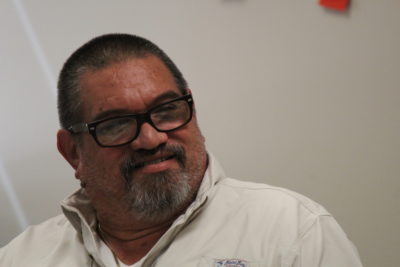
For example, committee member Scott Lumsden, co-executive presbyter of Seattle Presbytery, asked whether it makes sense to have the 1001 New Worshipping Communities program and the Vital Congregations program housed in the Presbyterian Mission Agency rather than with a council of the church.
For example, a presbytery effort at redevelopment would be lodged in the presbytery, Lumsden said, “and it would be accountable to the presbytery and the board in ways that are very clear. … The presbytery would be looking at it to see if it’s actually working.”
And if the program wasn’t successful or was losing money, “I’m responsible (as a presbytery executive) and I would expect they would hold me accountable,” Lumsden said. “Financial sustainability is about the organization for mission, as well as the mission and money. It’s about how we organize ourselves to do things.”