
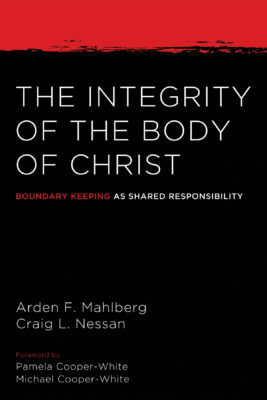
 Arden F. Mahlberg and Craig L. Nessan
Cascade Books, 236 pages
Reviewed by John Wimberly
Airplane pilots are taught to ignore their “gut instincts.” Instead, for each and every problem that may occur while they are flying, they are trained to disregard their initial reactions and use well-defined protocols developed over decades. Why? Because, in the air, instincts may be fatally misleading while protocols walk pilots methodically through crises. In their book on boundaries, Arden Mahlberg and Craig Nessan argue that the same is true in ministry. Good decision-makers understand that decision-making is more about process than outcomes, even when the process involves intuition. Research reveals that our instincts advise us to “give more weight to events that we have experienced personally rather than those experienced by others” and “if a bad thing has not happened to us, we tend to make decisions as if it never will.”
Such are the revelatory insights offered in a book definitely worth reading. Nessan, a professor of theology at Wartburg Theological Seminary, and Mahlberg, a psychologist, combine to produce insights grounded in both theology and psychological research. They start with theology, move to psychology’s teachings and back again to theology — exactly the priority we should have when using the social sciences.
The book starts by noting the progress the church has made as we stress the importance of boundaries when it comes to sexuality. Mainline denominations today require pastors to undergo boundary training. The authors contend that such training should lead us to question how pastors and church members approach other key boundary issues including the use of social media, gossip, relationships between a congregation’s governing board and its staff and visitation in homes. “Boundaries protect the essential nature of persons and things, while at the same time contributing to their definition,” write the authors.
The second chapter on entrustment is absolutely brilliant. The authors define entrustment as “a process of placing something in another’s care.” But, they insist: “What I tell you does not become yours to do with as you please. Entrustment carries conditions.” Their discussion of entrustment as an issue involving boundaries is extremely clarifying. If congregations begin to manifest the key characteristics of entrustment, they will be far more appealing to the world than they are today.
The book contains a lot of very practical advice, grounded in good theology and psychological research. The authors talk about some basic pastoral “practices” that have lost their importance in too many ministries today: “visiting the shut-ins, making hospital calls, ministering to the grieving, teaching confirmation, showing up at congregational events, preparing well for worship, preaching solid sermons and giving generously of one’s time and resources to the life of the church.” If such practices were more visible today in the life of the church, data points such as worship attendance, membership and giving would be more positive.
This is a great book for people entering the ministry. However, it is an even better book for people already serving congregations. There is a strong recommendation for pastors to develop a clearly defined boundary between their personal and professional lives. The reality-based discussions of important topics will ring true to experienced pastors and remind us of where we need to be more disciplined in our work.
 John Wimberly is a congregational consultant living in Washington, D.C., and San Miguel de Allende, Mexico.