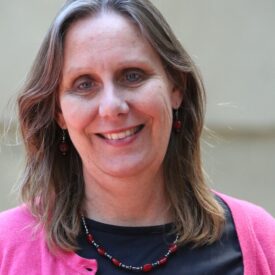
Diane Moffett, president and executive director of the Presbyterian Mission Agency, wants all Presbyterians to hear of the Matthew 25 vision in the next two years – “to make sure it gets down to every level” of the Presbyterian Church (U.S.A.).

And she told members of the Presbyterian Mission Agency Board during a June 17 conference call meeting that “I’d like you to be an advocate and a cheerleader on every level” for the Matthew 25 vision, which the agency unrolled April 1.
So far, “people are very open to this,” she said. “We have not gotten a lot of push back at all,” but Presbyterians seem eager for something that unites and connects the denomination.
Moffett is careful to describe Matthew 25 as a “vision” and not an initiative – with board member Marci Glass of Idaho saying she’s heard people asking questions about what’s the difference, for example, between Matthew 25 and other PC(USA) endeavors, such as Hands and Feetor 1001 New Worshipping Communities. (The short answer: one vision, many initiatives).
And Moffett outlined how the Matthew 25 vision supports the three emphases of her agency’s mission work plan.
Congregational vitality. That matters no matter how big or small a congregation is, she said. What that means is “we’re not just in the church talking about Jesus,” but being the incarnation in the streets of what Jesus stood for. It’s not a matter of “how big your church is” or how large its budget is. “We’re talking about how faithful you are to the gospel – how the gospel gets lived out in your community.”
Confronting structural racism. The hope is that Presbyterians will recognize that “we swim in racist waters” in the United States, Moffett said. That produces a call to Presbyterians to work for changes in laws, policies and practices that perpetuate discrimination and bias on issues such as mass incarceration or disparities in access to health care and education.
Eradicating systemic poverty. This involves laws and policies that keep people living in poverty. So a congregation can offer a food pantry or hand out clothing, “but if that’s all we do, we allow the system to stay in place,” Moffett said.
She also offered suggestions for Bible study around the 25thchapter of Matthew’s Gospel – saying Jesus used parables to essentially ask, “How will you treat one another?”
The urgent questions in Jesus’ time, and the questions now, involve issues such as access to land and clean water, with how to welcome the stranger and support those on the margins, “the people kind of pressed to the edge,” Moffett said. How we show love and treat one another is “what it means to be a Christian,” she said. “As you have done it to the least of these, you have done it to me. What we do matters to God.”
For congregations, she also stressed the importance of picking specific ways to respond – these are huge issues, so maybe pick one or two ways to make an impact. Find out what others in the community are doing. Build relationships; work in partnership. “That’s how we make a big footprint” on the issues that matter most.