In August, the Moving Forward Implementation Commission wants to make a progress report of sorts to the Presbyterian Church (U.S.A.) at Big Tent.
And the work the commission is doing – including at a June 17-18 meeting in Texas – shows how leaders involved at the national levels of the denomination are trying to sort through complex issues that are hard to squish into a headline, but are the types of things that rise up over and over as concerns in the PC(USA).
For example: How well is the PC(USA) doing with issues of inclusion and diversity – and who’s responsible for assessing that?
How well is the denomination doing financially?
What’s being done to make sure that Presbyterians for whom English is not their first language have access to resources and consequently to having a voice and power in the PC(USA)?
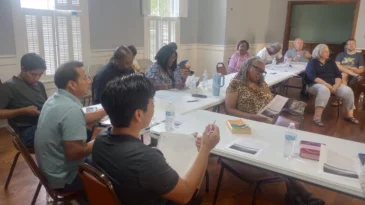
Here’s some of what the commission did and discussed this week.
Financial sustainability
The commission took action at this meeting to try to clarify some of the work being done to analyze financial issues facing the PC(USA).
The commission’s actions are an effort to make more clear the responsibilities of the PC(USA)’s Special Committee on Per-Capita Based Funding and National Church Financial Sustainability – a committee the 2018 General Assembly created in response to deep concerns about financial pressures in the denomination.
The Office of the General Assembly reported that it’s running through its reserves. The stated clerk, J. Herbert Nelson, had to scale back a request for a significant per capita increase after presbytery leaders resisted, saying that congregations with declining memberships can’t afford to pay that much. An overture from the Presbytery of Newton lit up conversation by asking for an overall review of the per capita funding system.
The commission – which the 2018 General Assembly gave significant power to act on its own – took two actions June 17 related to that special committee.
First, it specifically assigned to that committee responsibility for following up on an action of the 2018 General Assembly. The assembly, in approving the recommendations of the All Agency Review Committee, took this action: to “instruct the six agencies of the Presbyterian Church (U.S.A.) to engage in a collaborative self-study of the per capita model and its’ ability to adequately fund the Office of the General Assembly and the Presbyterian Mission Agency in the immediate and longer-term future and to explore alternative and creative funding resources for both.”
The commission’s action gives that work explicitly to the special committee – giving it responsibility for coordinating the conversations, collating the feedback received and reporting the results to the 2020 General Assembly.
Second, the commission expanded the mandate of the special committee on per capita and financial sustainability to include analysis of the spending side of things as well as the sources of revenue. The language states that the mandate will include “analysis of allocations and expenses” in addition to the General Assembly mandate to do a resource projection analysis and conduct a financial sustainability review for the denomination.
The rationale for the commission’s action states that “understanding that Assets and Review is only a portion of the budget and financial system, we believe it is important to also understand the expense side including, but not limited to, budgeting process, program analysis, and expense’s relationship to restricted fund. This does not include analyzing or determining specific program validity, but seeks to understand the full cycle of fund acquisition and use.”
The commission members discussed ideas such as these:
- What programs take the most dollars in the PC(USA)?
- How do those allocations match the priorities that General Assemblies have set?
- How is a balance struck between the mission priorities of the Presbyterian Mission Agency and the funding needs of the Office of the General Assembly – and who makes those decisions?
How does the Presbyterian Mission Agency make its own determinations of what funding priorities ought to be (and perhaps what programs need to end) when “there are all these things they are being told to do?” asked commission member Eric Beene, a pastor from Georgia.
A Corporation
The commission spoke for about an hour by conference call with Chris Mason, co-chair of the 11-member board of the Presbyterian Church (U.S.A.), A Corporation, the corporate entity for the Office of the General Assembly and the Presbyterian Mission Agency.
Mason described the board’s recent decision to call Kathy Lueckert for a four-year term as the A Corporation president as finding someone with the “right mix” of experience with the church, management and finance skills, and ability to navigate PC(USA) politics.
He spoke of some of the challenges facing the A Corporation – including selecting financial leadership following the unexpected death in March of Mike Miller, the acting chief financial officer, and choosing a new general counsel following the retirement in December 2018 of Martha Clark.
The A Corporation board is reviewing policies and employment manuals, finding there are some differences between agencies — for example, in how accrued vacation time is handled, even though workers of the Office of the General Assembly, the Presbyterian Mission Agency and the Administrative Services Group are all technically employed by the A Corporation. The A Corporation leadership team is working on a new, easier-to-understand system for determining how costs are allocated for administrative services provided.
Commission members have questions as well – including about how things are working during a time of significant transition for the A Corporation.
The commission also is working on questions to include in a survey of employees to assess culture at the agencies — trying to get a sense of what’s working well and where concerns lie, with the possibility of recommending that a consultant be hired who could work with the staff to try to make improvements.
Another question: Is agency culture one of the standards on which PC(USA) agencies should be reviewed?