
 The tension in the congregation is high after the pastor announces a change in call. Questions abound: Can’t we just elect a pastor nominating committee and start searching for our next pastor? Why do we need an interim pastor anyway? Isn’t an interim pastor just a space holder? This is when I take a deep breath, count to 10, and begin the hard – but important – explanation of interim ministry.
In the Presbytery of Scioto Valley (serving parts of Ohio), the Committee on Ministry is divided into two commissions: the Commission for Church Professionals and the Commission for Congregational Life. I serve as the chair of the Commission for Congregational Life, which provides support for the congregations in the presbytery — including assisting churches in transition. This season of transition is the in-between time. It is a sacred space and one of our tasks is to guide and support congregations as they discern what God has in store for them next.
I have walked with congregations many times now as a presbytery representative, as well as an interim pastor. Each time it is a privilege and a challenge. In every church – big or small, healthy or challenged, rich or poor, urban or rural – there is always a sense of urgency to find the next pastor and rush through the search process. It is my job to help congregations take a deep breath, count to 10 and then understand the benefits of intentional interim ministry.
Benefits of interim ministry
The benefits to this sort of ministry are plentiful. Interim pastors provide the opportunity for churches to discern who they are as a congregation without their former pastor, and who God is calling to minister with them in the future. Every church can benefit from interim ministry. But congregations who have experienced extreme conflict with the last pastor, the death of a former pastor or the end of a relationship with a long-tenured pastor especially benefit from leadership that walks them through conflict resolution, healing, grieving, restoration and change. Giving an interim pastor time to help the congregation come to terms with these issues will lead to a healthier beginning with their new installed pastor. Most sessions understand this and embrace time with an interim pastor. Even for churches that haven’t gone through a harsh transition – and that is most of them – interim ministry is still useful.
 As an interim pastor, my primary task is to meaningfully fill the in-between time, allowing the congregation to reflect on who they are. Every pastoral change creates a void and often that space will unintentionally be filled by a strong, trusted member who may or may not represent who the congregation is. Interims step in and impartially fill that spot. Siding with no one, supporting all. The way in which the in-between space is filled is intentional: preparing the congregation for new spiritual leadership.
Vision and identity
It is sometimes difficult to convince a congregation that re-visioning and re-visiting who they are can be the most valuable part of their search process. Bob Anderson, an instructor of interim ministry and interim senior pastor at Wyoming Presbyterian Church in Wyoming, Ohio, shared: “A common theme in almost all the churches I’ve served as an interim is the difficulty congregations have articulating their sense of identity as the people of God.”
Yet that seems to be exactly what my colleagues leaving healthy congregations hope the interim pastor will facilitate. Being clear about who they are will help the congregation create a solid beginning with a new pastor. New ways of being the church in this new season are possible!
“Having served a church for 10 years, I’m sure we settled into some comfortable ruts that we weren’t aware of,” said Allison Bauer, recipient of The Fred McFeeley Rogers Award for Creative Ministry and pastor at Second Presbyterian Church in Portsmouth, Ohio. “I hope any transitional pastor following a long-term pastor would help a congregation to see where they’ve perhaps gotten a little too comfortable and challenge them to re-imagine new ways of doing things even if they continue to do the same things they’ve been doing.”
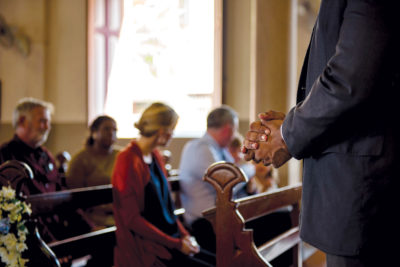 Other times, an interim provides an affirming, outside perspective on the current life, mission and ministry of a church. “I hope the interim pastor will take the time to observe the congregation, to see the good things they are doing in ministry, help them to recognize this and give them encouragement,” stated Tracy Keenan, who just received a call as the mission presbyter in New Castle Presbytery (serving Delaware and parts of Maryland) after serving 14 years as the senior pastor at Covenant Presbyterian Church in Upper Arlington, Ohio.
Most the time, though, there’s a need to clear old brush to make room for new growth.
“I hope they clean up any major issues I left behind,” said Clint Cottrell about any interim that follows him into the service of a congregation. Cottrell is transitioning to a new call after a 14-year pastorate at Cypress Lake Presbyterian Church in Fort Myers, Florida, where he also served as the stated clerk of Peace River Presbytery. He said he hopes the interim who follows him will “ensure Reformed worship and leadership is in place (if not already there), break any molds created by me where I did more than I should have, help it create a vision for their new future and ensure that it is financially healthy.”
Reflect, correct, protect and resurrect
 Interims take time to reflect (what was), correct (change what isn’t working), protect (maintain what is working) and resurrect (revitalize the ministry). Why an interim pastor? Reflection, correction, encouragement and hope. What if these things don’t happen? Cottrell’s greatest concern about leaving a congregation is “that it will lose the momentum that was created over the last 14 years! Also, that it will make bad decisions for future leadership. I am terrified that it will make bad choices that could lead to decline.” And this certainly can happen if there is no intentional transitional ministry in place to guide the congregation in self-reflection and action. If the congregation is unaware of who they are and where they are going, they can expect that the pastor they call will be at a disadvantage, perhaps feeling called to an illusion of the church.
In smaller congregations the concern is understandably different. In such churches the pastor is central to the ministry and when the pastor leaves the hopelessness can be overwhelming. This was the case for Bauer. “In a small church, so much of their identity revolves around the pastor and his/her interests, for better and for worse,” she said. “And when that pastor leaves, it can really feel like the bottom has dropped out of everything.”
 It is very important for a pastor of a small congregation to cultivate the congregation’s interests and share less of theirs, so the congregation feels like they still have a ministry even without a minister. “The message from Colossians 1:17 – that in Christ, all things hold together – was what I tried to leave behind with my former congregation as well as bring to my new congregation,” Bauer said.
Some of the most important work in interim ministry, though, is introducing change — even at the exact time when many congregants may feel that too much change has already happened. “I think the most important thing a transitional pastor does is to get the congregation to the understanding that things are changing. And to help them see into a future that is different from their recent past. Sometimes this is made extremely difficult because the pastor is beloved or is still physically in the area. It is even more important for the transitional pastor to help the congregation understand the ‘end of an era,’ whether positive or negative,” said Brenda Barnes, the interim pastor of NuValley Presbyterian Church in Rural Valley, Pennsylvania.
 The interim must lead the congregation through “change at a rate they can absorb,” as a former congregant often reminded me. Effecting change is not easy! My colleague Brian Harroff describes this well. He formerly served as a transitional pastor before accepting a call as pastor of Royster Presbyterian Church in Norfolk, Virginia.
“You can’t do the job without ruffling feathers,” he said. “But if you make them hate you, they stop working with you.” Some of these changes are going to be “heavy lifting.” It seems the heaviest lifting addresses problems in staffing that church leadership has been afraid to touch. Pastors following interims report that this task is too often left undone. Interims admit that staffing issues are predictable during transitions and they are also the most difficult, but the most necessary, to resolve.
Skilled interim ministers fill the in-between time not with a space holder, but an intentional space filler. After I share these insights with sessions, instead of asking why they need an interim pastor they ask, “How long will all this take?” I simply hold back a sigh and say: “I don’t know. God’s timing is God’s timing.”
 Jeri-Lynne Bouterse is the transitional pastor at Covenant Presbyterian Church in Upper Arlington, Ohio. She began serving as an interim/transitional pastor in 2013 after two prior installed positions. She found that assisting churches through their time of transition was her passion. Jeri-Lynne also chairs the Commission for Congregational Life in the Scioto Valley Presbytery and works with the transition team to guide congregations in transition through the pastoral search process.