 Brian S. Powers
Eerdmans, 200 pages
Reviewed by Martha Moore-Keish
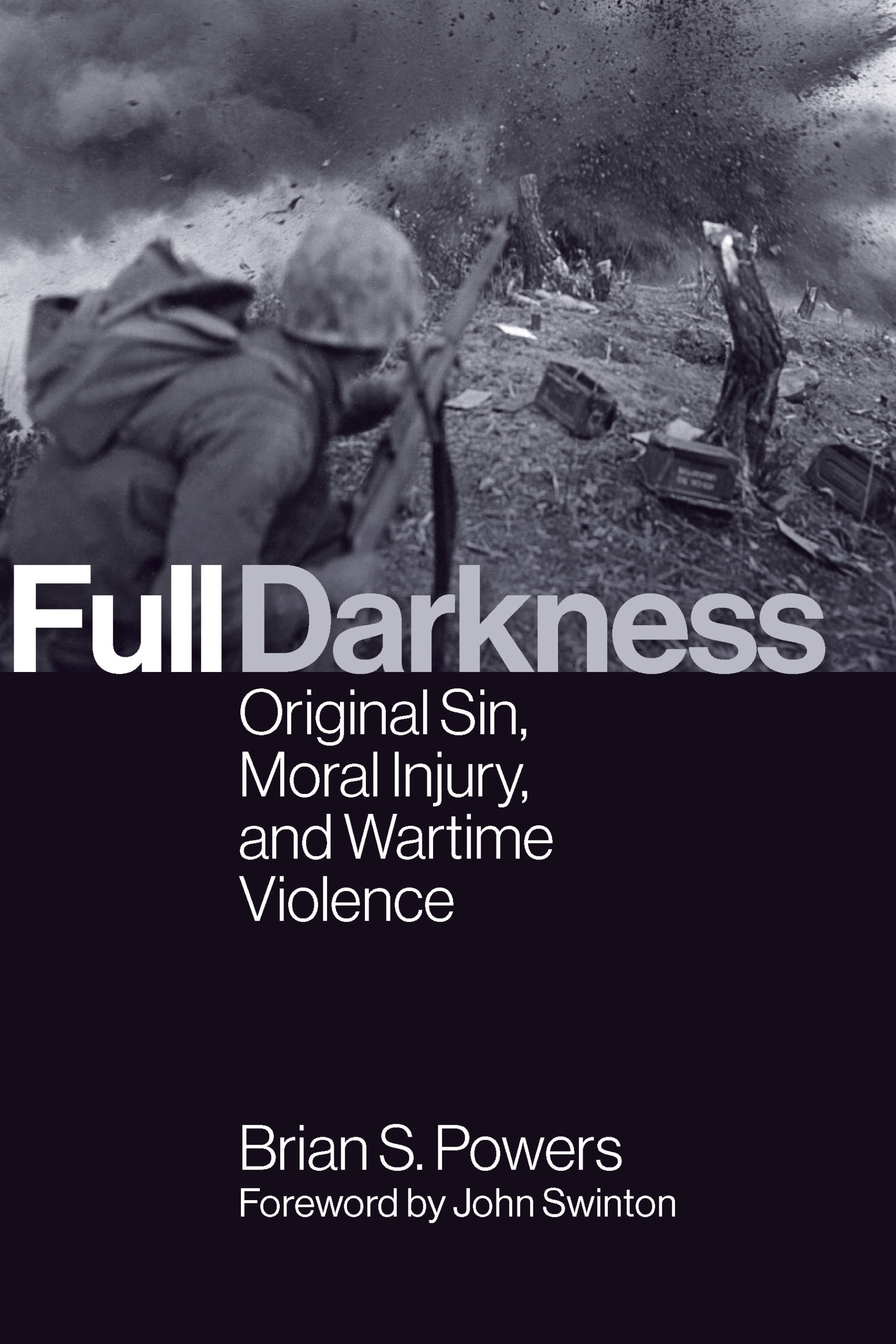
This “present project is my argument against the comfortable and simplistic understandings of morality that died to me in the deserts of Iraq and the mountains of Afghanistan.” So writes Brian Powers in the opening pages of “Full Darkness,” a compelling work of theology by a young scholar whose experience of war drove him to reexamine his Christian faith to make sense of the trauma he witnessed. It is a book worthy of attention of anyone who seeks honest acknowledgment of human violence in our world and who cares about the redemption of real, wounded human beings.
Throughout, Powers offers fresh appreciation of the ancient doctrine of original sin, as developed by Augustine and interpreted recently by Alistair McFadyen (in “Bound to Sin”) for its “explanatory power” of the human condition. Original sin, as Powers shows, offers a compelling description of the way our wills are distorted by external forces, so that we are “not able not to sin” (non posse non peccare, to use Augustine’s famous phrase). While McFadyen explores the distorting forces of the Holocaust and child abuse, Powers takes the conversation into the realm of wartime violence and the emerging field of moral injury.
Based on his investigation of the effects of wartime trauma on soldiers, Powers concludes that people in such conditions simply do not have “free will” in a simple straightforward way. For combat veterans, the will is disoriented (indeed, in a deliberate way, as Powers chillingly describes in his account of combat training), unable to choose the good on its own. Soldiers are caught in a terrible paradox: responsible for their actions, and yet unable to step outside of the patterns of destruction in which they are participating. Like Augustine and McFadyen, Powers argues that this situation is ably described as original sin, which is so “powerful, infectious, distorting, and ubiquitous that apart from God’s active grace, humanity has no hope for redemption.”
Powers does not argue against war, but he does present a clear-eyed account of the costs of war for those who participate in it. With the help of recent work in moral injury, he argues that humans simply cannot participate in such violence without doing damage to our moral being. In doing so, he seeks to hold up a mirror to all human societies, to show the ways that we are all complicit in and affected by the power of sin and violence. He also holds up a critical mirror to American society in particular, “unmasking” the false narrative of American exceptionalism that makes violence necessary in service of the “greater good.”
The book is not for the faint of heart. Some readers may reach the end with despair in the face of Powers’ portrait of the inescapability of human sin. Yet Powers reassures us that this book is but the necessary first part of a projected two-volume series, the second of which will explore the power of resurrection to offer hope to this broken world.
In a world saturated with wartime violence, we need this work of public theology by a military veteran who brings together his mature Christian faith with the lived experience of war and its consequences. Anyone who tries to teach, preach or simply live in light of Jesus’ cross and resurrection needs this book, because in order to have any realistic hope for redemption, we need to face unflinchingly the full darkness of the world that needs redeeming.
Martha Moore-Keish is the J.B. Green Professor of Theology at Columbia Theological Seminary in Decatur, Georgia.