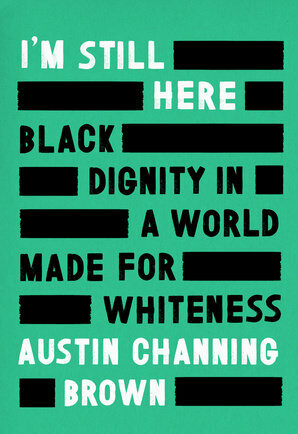
 Austin Channing Brown
Convergent Books, 192 pages
Reviewed by MaryAnn McKibben Dana
I’m so thankful to former PC(USA) co-moderators Denise Anderson and Jan Edmiston for instituting a denomination-wide read-along of Debby Irving’s “Waking Up White” as part of their “One Church, One Book” initiative. “Waking Up White” chronicles Irving’s journey into awareness of the ways white supremacy is woven into the fabric of the American experience. As much as I appreciated the book – my jaw dropped to learn about the countless thousands of African American service members from World War II who were excluded from the GI Bill – I also found myself longing for more on this topic.
Enter Austin Channing Brown’s bracing reflection, “I’m Still Here.” Whereas Irving’s work is eye-opening about the ways structural racism is all around us, Channing Brown’s book illuminates the ways that those racist structures influence individual white people’s behavior and the impact that behavior has on people of color every day. Channing Brown is a sought-after speaker and educator on race, and it is easy to see why — her prose is clear, direct and frequently beautiful, with an urgency and authenticity that keeps the reader turning the page.
Reading Channing Brown’s work, and other memoirs dealing with race, is an act of empathy, but not in the gauzy, florid way that word is often inflected. This kind of empathy is hard, because not only can I never fully appreciate the experience of people of color, I must acknowledge that a lot of what she and others go through is a direct result of the actions of people who look a lot like me. In a chapter called “Whiteness at work,” Channing Brown details the tiny microaggressions that come her way, minute by minute, over the course of a workday. It was exhausting to read — until I did the math on how tiring it would be to live it.
Books like this are best read not for information, but for transformation. It is one thing for me to be appalled by stories of strangers touching Channing Brown’s hair (who does that?), or to cringe when a white woman confidently mistakes her for another black woman in the office (I’ve personally seen the same thing happen to black colleagues in our own denomination). It is another thing to be reading along and recognize myself on the page. When a co-worker advises Channing Brown to tone down her “aggressiveness” in the face of a racially-tinged slight, I felt myself nodding along in spite of myself: This isn’t helping your case. Why’ve you gotta be so angry? Why, indeed? Because this stuff’s exhausting, and requests for marginalized people to “calm down” are rarely about suggesting helpful tactics, and more about preserving the comfort of those in power.
It would be easy to read this book and get mired in guilt. But guilt isn’t the goal; the goal is awareness and change. Channing Brown describes what happens after her workshops when white people come up to her and confess all kinds of problematic behaviors or attitudes. At first, Channing Brown would assume the emotional burden of carrying those stories. Now she has learned not to take on that weight, instead turning it back to the individuals: “What are you going to do now? What will you do with this knowledge you’ve received?” It’s the question for us as readers too.
 MaryAnn McKibben Dana is an entrepreneur, writer and public speaker living in Virginia. Her most recent book is “God, Improv, and the Art of Living.”