BALTIMORE – In a time of intense partisanship and a dangerous moment for the country politically, “there’s no more important time to be a pastor in a local church.”
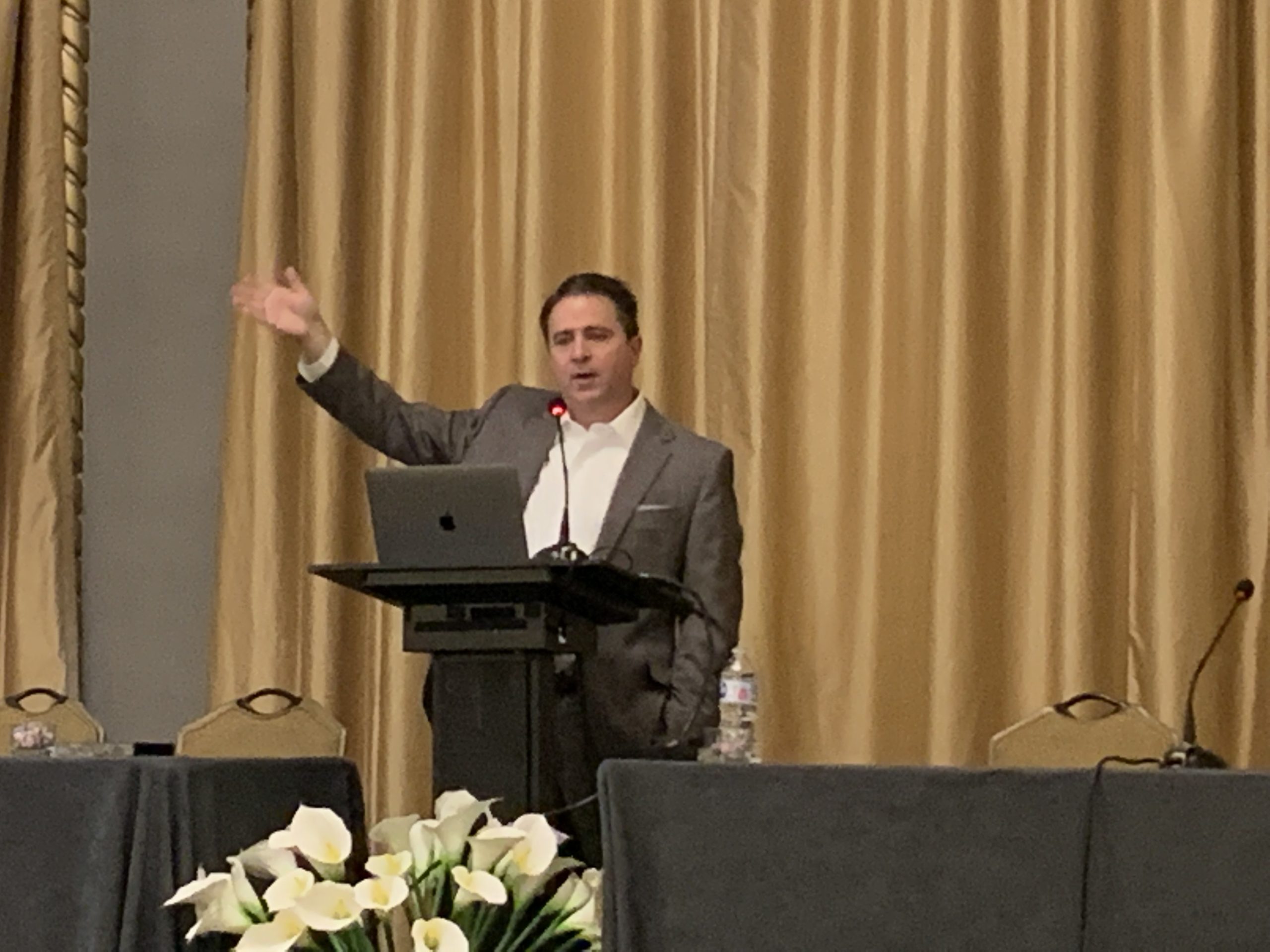
That’s part of the message that Robert P. Jones – a researcher in religion and trends in American political life, and the founder and chief executive officer of the nonpartisan Public Religion Research Institute – delivered Aug. 2 at a breakfast at Big Tent 2019 sponsored by the Presbyterian Foundation.
Jones won the 2019 Grawemeyer Award in Religion for his book “The End of White Christian America.” Journalists from around the country call him for his take on the influence of religion on elections and American political life — particularly the role that white Christians played in electing Donald Trump as president in 2016, and the prospects for what might happen in 2020.
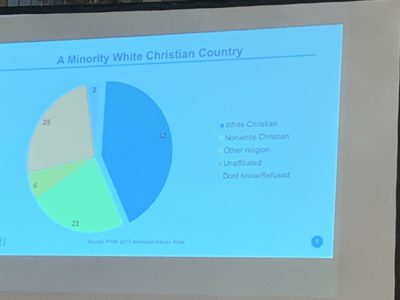
For example, Jones wrote in the Atlantic this summer about how white Christians are no longer the majority in America (just 41% in 2018), but they influence elections disproportionately because they turn out enthusiastically to vote. In 2016, white evangelical Christians made up only 17% of the population, but accounted for 26% of the voters. And 81 percent of them voted for Trump.
That produces what Jones calls a “time machine” influence, where the country is becoming more diverse but less religious — yet white Christians, the majority of whom voted for Trump in 2016, still wield a power greater than their numbers.
In his remarks at the Foundation breakfast, Jones said “we’re in a dangerous time right now,” when partisanship has become “very, very personal” – with fights in families and on social media – and where “there’s a kind of desperation” among those who want to hold onto power, so the normal rules get suspended.
Jones grew up Southern Baptist in Mississippi — he understands the role of religion in public life.
Pastors can play an important role in helping people navigate this journey of cultural and demographic change, in creating a new theological narrative when white supremacy is evident in the public sphere and when a shift is coming away from “white Protestants in particular assuming, well of course we’re running the country.”
With that changing, “there has to be a narrative of why that’s OK” for things to change, Jones said,” and why that was never OK” for white Christians to dominate so thoroughly for so long.
Polls show divergence of views on whether American culture and way of life has shifted for the better or the worse since the 1950s, Jones said, with:
- Those saying yes: White Americans overall, white mainline Protestants, white Catholics, whites without a college degree, white evangelical Protestants.
- Those saying no: Democrats, Latino Catholics, the religiously unaffiliated, young people, blacks, whites with college degrees.
Trump tapped into that nostalgia for the way things used to be – for that desire to hold onto control – with his slogan “Make America Great Again,”Jones said. He described a shift among white Christians from being “values voters” to being “nostalgia voters,” and said Trump essentially said to them with his red hats, “Look folks, I’m your last chance” to hold onto power. “He put that straight.”
Jones joked about who wants to come to a data-driven talk at 7 a.m. (“Presbyterians.”)
And then he flipped to the numbers, to the trends. The statistics show that:
- Over the past decade, from 2008 to 2018, the percentage of Americans who are white Christians dropped from 54% to 41%. White Christians are no longer the majority.
- There’s been a “sea change” in the percentage of Americans supporting same gender marriage – from 4 in 10 who supported it in 2008 to only 4 in 10 who opposed it in 2018.
- About a quarter of U.S. adults claim no religious affiliation – including about 40% of those under age 30.
- This is not a bicoastal phenomenon – these changes are evident all over the country. There was a gasp in the room – “Wow,” someone said out loud – when Jones showed a slide showing the decreasing proportions of white Christians by state, all across the country. “It’s heartland,” he said. “It’s everywhere.”
For more unpacking of the numbers, read this Presbyterian Outlook story from April, when Jones spoke at Louisville Presbyterian Theological Seminary.
All this has implications for where we go from here as a country, Jones said.
We’re becoming increasingly partisan and divided – with 35% of Republicans saying they’d be unhappy if their son or daughter married a Democrat, and 45% of Democrats saying they’d be unhappy if their son or daughter married a Republican.
If things continue this way, “we’re going to end up with one party that is essentially a white Christian party, and another party that is essentially everyone else,” Jones said.
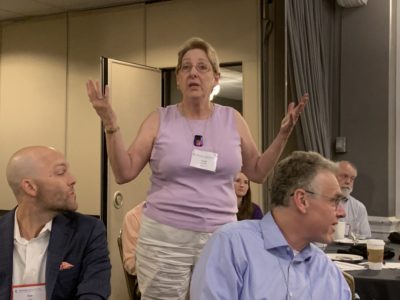
During a question-and-answer time, one woman said her daughter laments that things will only get better when her parents’ and grandparents’ generations – those in power now – die off. The woman asked: “What can I do” to make things better before then?
Jones said young people who leave the church typically do so in high school, before they hit age 20. When asked if they are looking for a congregation that’s a better fit, 93% say no. Their top three reasons for going: churches are hypocritical, judgmental, unwelcoming to LBGTQ people.
“That’s the public brand of religion they know,” Jones said. “I’m not sure I’ve got a great solution. Part of the problem is the brand” – the brand of white Christianity – “has been tarnished for young people.”