 STONY POINT, New York – Work is underway to develop a Presbyterian Mission Agency mission budget for 2021 and 2022 – with the initial look at that to be presented when the board meets in Baltimore in February.
An update on that was on the dance card of business items the board considered Sept. 27 during its fall meeting, taking place at Stony Point Center outside New York.
The board discussed feedback it received following a two-day consultation with mid council leaders convened in Baltimore just after Big Tent in August – an attempt to hear from synod leaders (and about a half-dozen presbytery leaders) what they wanted to see in PMA budget priorities for the next two years.
Some responses: Talk to more presbytery folks in future consultations. Figure out ways to have a particular mission focus – such as PMA’s Matthew 25 vision. Guide the budget for more than just one or two years.
Barry Creech, director of policy, administration and board support for PMA, said the plan is for PMA, the Office of the General Assembly (OGA) and the PC(USA), A Corporation to jointly present a budget to the 2020 General Assembly.

Board member Marci Glass of Idaho asked: What does that mean? For example, how would the per capita rate that the 2020 General Assembly approves affect a consolidated budget?
That’s still being worked out, Creech said. While the presentation to the General Assembly is consolidated – “we’re funding one thing,” the work of the PC(USA), Creech said – the agencies still develop their budgets separately. That’s been an issue raised by the Special Committee on Per Capita Based Funding and National Church Financial Sustainability, which is considering whether to initiate a process of denominational restructuring.
Social media trolls
Board member Shannan Vance-Ocampo asked how PMA handles online trolls – saying she’s noted a spike in disrespectful comments or even hate speech, particularly when something is posted to the PC(USA) Facebook page involving immigration.
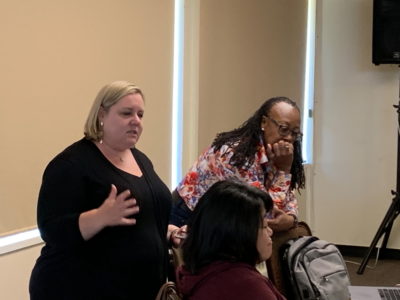
Vance-Ocampo said the amount of hate speech and disparaging comments she’s seen, particularly involving immigration and posts from women and people of color, is “worrisome and concerning. I am distressed.” And she said she’s heard from others in private forums, particular women ministers, that they share that concern as well.
“It’s been a work in progress,” said Mari Graham Evans, a social media strategist for PMA, saying she tries to strike a balance between “letting all members of the church express themselves” – some of whom disagree with PC(USA) policy – and removing comments that stray into hate speech, attacks or something unacceptably offensive. “There’s a lot of grey area, especially in terms of hate speech,” she said.
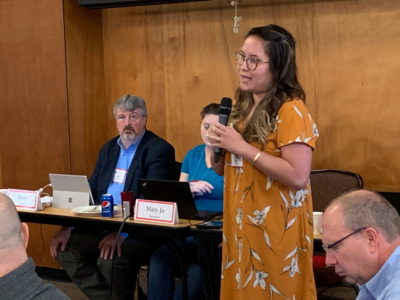
Evans said she routinely blocks people from commenting, but “people are very creative” in seeking ways to try to avoid getting blocked. Part of her task is “making sure the diverse voices of the entire community are heard,” without crossing the lines. The guidelines say “people are allowed to express themselves, as long as they do it in a respectful manner. A lot of that is interpretation.”
Budget revision
The board approved a revised Presbyterian Mission Agency (PMA) mission budget (A.103 2020 PMA Budget) for 2020, with an increase of just over $908,000 – increasing the budget from the $71.4 million approved last spring to $72.3 million.
That increase includes nearly $369,000 that will be used to support the office of the president of the Presbyterian Church (U.S.A.), A Corporation and the Mid Council Leadership Network.
“Our budget is quite healthy,” said Jeffrey Joe, acting chair of the board’s Resource Allocation and Stewardship Committee, with an unrestricted, undesignated balance of $14.6 million.
Denise Hampton, the PC(USA)’s controller, told the board’s Resource Allocation and Stewardship committee that the A Corporation’s president is a new position – Kathy Lueckert was named to that role last summer – and consequently no funds for the work of that office had been included in the budget. Hampton said PMA and the Office of the General Assembly (OGA) will split the costs of the A Corporation president’s office (salary, benefits and all expenses) – with PMA paying 81% and OGA 19% in 2020.
Presbyterian Youth Triennium
Paid attendance at the 2019 Youth Triennium, held last July at Purdue University, fell under projections – with the original budget developed with the hope of drawing 4,300 participants, and actual paid attendance coming in at 3,900.
In response to that, the planning team was able to cut back on expenses as well – so the expectation is that Presbyterian Youth Triennium will break even. (F.202 Report on Presbyterian Youth Triennium_Sept 2019.doc)
Reproductive health
The board voted to give the Committee on Mission Responsibility Through Investment (MRTI) authority to take action in a new area: interacting with corporations on reproductive freedom and access to reproductive health.
A report to the board (G.103 Reproductive Justice Resolution Authorization Request) states that “in light of recent efforts across the country to curtail access to reproductive health care, a group of faith- and values-based investors with whom MRTI closely partners is organizing a campaign to engage large U.S. corporations about their policies and practices regarding reproductive health and reproductive rights.”
The board voted to give MRTI authorization to file a shareholder resolution on reproductive heath issues, although it’s not clear when MRTI might do that.
That ecumenical strategy is still being crafted, and MRTI won’t present its recommendations to the 2020 General Assembly until February. The report states that the Presbyterian Mission Agency Board must initially authorize MRTI to file or co-file a shareholder resolution in a particular area of concern – and MRTI has never before filed an action regarding reproductive health.
The report includes a letter the coalition group is sending to companies – asking for a dialogue on reproductive health care and also the companies’ policies related to insurance for sexual and reproductive health care and also parental and family leave.
Rob Fohr, the PC(USA)’s director of Faith Based Investing and Corporate Engagement, told the board’s Outreach to the World committee that a coalition of 39 institutional investors, some of them faith based, sent the letter to 26 companies earlier this month, and said the response from those companies will help determine whether shareholder resolutions are filed.
Fohr also said what’s being considered is in line with policy statements on reproductive health from previous General Assemblies.
Climate change
The board also took a first look at the outline (G.201 Outline of 2020 MRTI report to GA) of what MRTI is likely to recommend to the 2020 assembly, although a formal vote won’t come until the board’s meeting in Baltimore Feb. 12-14. MRTI has set up a set of metrics by which it is measuring the environmental records of companies.
The 2018 General Assembly approved those metrics, choosing continuing engagement over divestment from fossil fuel companies. An initial evaluation of the performance of nine companies, using those metrics, found that auto makers were doing better – with Ford and General Motors scoring in the “blue” category of the metrics, indicating “a good track record of shareholder engagement.”

Three petroleum companies – Marathon Petroleum, Phillips 66, and Valero Energy – scored in the “red” category, indicating a “poor record of shareholder engagement,” which puts them under added scrutiny from MRTI, but does not necessarily mean MRTI will recommend divestment
Fohr said MRTI will go through a second round of evaluation of the companies in December.
Through this process, MRTI is working in collaboration with Climate Action 100+, an initiative by investor groups working to make sure that “the world’s largest corporate greenhouse gas emitters take necessary action on climate change, its website states. More than 360 investor groups managing $34 trillion in assets have signed on since Climate Action 100+ was launched in 2017,” according to the website.
Given the intensity of concerns around climate change – as evidenced by the recent #ClimateStrike actions and Greta Thunberg’s fiery remarks at the United Nations Climate Action Summit – the question of how the PC(USA) should respond is certain to rise up at the 2020 General Assembly.
World Mission
Sara Lisherness, acting director of PC(US) World Mission, told the Outreach to the World committee that World Mission has in recent months experienced transitions (with the retirement of director José Luis Casal) and some anxiety about what new directions might emerge from an intense series of World Missoin consultations.
The board received an update (G.206 World Mission Strategy Process Update) on the World Mission strategy process.

“There were no conclusive responses to all the questions that were asked, but there was definitely a need to dig deeper, to make sure we are listening to all the voices that need to be heard,” Lishernenss said. “So finalizing the strategic plan was put on pause to understand where are the spaces where we need to dig deeper” – including theological work, the question of what it means to be in partnership, and the implications of PMA’s Matthew 25 initiative for global ministry.
“It continues to be an organic process,” said Philip Woods, World Mission’s associate director for strategy, program and recruitment. “With that openness goes a lot of uncertainty. That’s not an easy journey.”
Liturgical dates
Among the dates the board approved for inclusion in the 2021 Presbyterian Planning Calendar: Mr. Rogers Day, on March 20, 2021.