 J. Herbert Nelson, stated clerk of the Presbyterian Church (U.S.A.), is stressing the urgency of coming up with a new funding system for the denomination that ensures that the Office of the General Assembly has enough money to do the ecclesiastical work of the church.
There also is a call emerging to quickly pull together some sort of high level work group – either a per capita table of the Committee on the Office of the General Assembly and the Presbyterian Mission Agency Board, or some less formal configuration – to consider possible structural changes in the PC(USA), to work through financial issues and to present a unified budget to the 2020 General Assembly.
Nelson joined an Oct. 2 video conference call of the Financial Sustainability work team of the Special Committee on Per Capita Based Funding and National Church Financial Sustainability — a committee that the 2018 General Assembly created.
That work team has already been discussing the possibility of denominational restructuring, and Nelson made it clear he thinks the time has come to talk about changing the PC(USA) funding system.
Nelson referred to “the urgency of this matter and also the broadness of the matter” – the importance of developing some new funding model for the denomination to allow the necessary work to continue.
He described the hit or “downward spiral” that per capita funding has taken in recent years with disagreements over the PC(USA)’s decision to ordain gays and lesbians who have partners and to allow its ministers to perform same-sex marriages.
Hundreds of conservative congregations left in disagreement over that, and for the congregations that stayed, “I’m not sure we are in a position right now to begin to really press individuals much more,” Nelson said — in other words, to push for a big increase in per capita, the per-member rate that congregations are asked to pay to support the work of the broader church.
Yet the work of the Office of the General Assembly – the ecclesiastical work of the church – goes on, everything from handling judicial cases in the church courts to overseeing the call process for ministers to paying for amicus curiae briefs the denomination files in cases involving issues on which the General Assembly has spoken.
Nelson suggested that per capita funding may be a system “whose day is gone,” and said the PC(USA) needs a revised funding system that will “ensure that we can continue to do this work.”
The Committee on the Office of the General Assembly (COGA) met in late September, and this issue came up as a matter of some urgency. Wilson Kennedy, who serves on COGA, said during the conference call that “this need for a reimagined understanding of what it means to be the church” and the need for some sort of revision of the funding system “is really acute” —likely requiring changes in the Organization for Mission to find ways to financially sustain the denomination.
COGA wants to work with the Presbyterian Mission Agency Board (PMAB) and the PC(USA), A Corporation to come up with a joint budget proposal to present to the 2020 General Assembly, Kennedy said. “We really do see this as a team effort” and a chance to work together “to propose to the assembly some real substantive and effectual change” that will provide “for creative mission and ministry into the future.”
Kennedy said COGA wants to do “real substantive work” on proposing possible changes to the Organization for Mission, and “any way we can be partners in that would be a healthy and helpful way” for the PC(USA) to move forward.
There also were nods to the difficulty of that work.
Valerie Young, who serves as co-moderator of the special committee, along with Laura Cheifetz, gave an update from conversations that the per capita work team has been holding with mid council leaders (conversations that are still underway).
Synod and presbytery leaders appreciate the connection nature of the per capita system and “the way they see the system being equitable,” because Presbyterians across the denomination share in the funding of the national church, Young said.
At the same time, “mid council leaders feel like they are in a vice,” she said. “Presbyteries are the ones responsible on both ends” – collecting per capita from congregations and sending payments to the synods and national church – “and they very much want some kind of release. … Some folks have suggested they want some teeth in the funding model. There are a lot of imaginative ideas stemming from these conversations,” but one theme is “they want release. They want per capita to have teeth in it.”
One possibility, said Scott Lumsden, a member of the special committee, would be for COGA, the Presbyterian Mission Agency Board and representatives from the special committee and the Moving Forward Commission to sit down together and discuss ways to approach the work.
 The Organization for Mission does have provisions for convening a Per Capita Table — that usually happens when COGA and PMAB can’t agree on a proposed per capita budget, Kennedy said. Perhaps there’s a way to initiate that process before a budget is voted on, he said — and with the PC(USA), A Corporation also at the table.
Or, considering the sometimes “tenuous relationships” between COGA and the PMA board, Kennedy said, perhaps there’s another, less formal way to go about it “that’s not constitutional and litigious in nature.”
Scott Lumsden, a member of the special committee, said: “There are formal ways we can get together, or there are voluntary ways. … I don’t care how we get together. I think there’s urgency.”
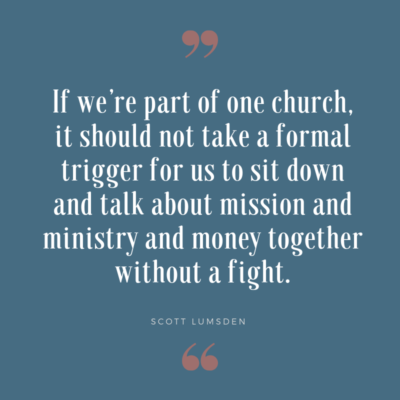
Lumsden also said: “If we’re part of one church, it should not take a formal trigger for us to sit down and talk about mission and ministry and money together without a fight.”
Committee member Debi Davis asked: How might the PMA board feel about that?
Kennedy said, “It’s a mixed bag, to be honest,” with members of both boards caring deeply about the mission and ministry of the PC(USA) and about church finances. But Nelson said there’s also the difficulty of dividing per capita finances between OGA and PMA – PMA currently gets about 14.5% of per capita income to cover ecclesial and administrative costs – and “I don’t want to minimize some of the tension that does create,” when money is tight.
Lumsden asked Kathy Lueckert, the new president of the A Corporation, whether this kind of conversation might be possible without “a formal mandate or ask” from the special committee or Moving Forward Commission.
 “I think it can happen,” Lueckert said. “Some encouragement from all parties involved … would probably not be unwelcome” — in other words, some attempt from Moving Forward and the special committee to lay out the expectations for what might happen and guidelines for the work that needs to be done.
Often, “we’re not on the same page, and at times I feel like we’re working in opposite directions,” Lumsden said. “We have not felt the urgency to get together to address these issues.”
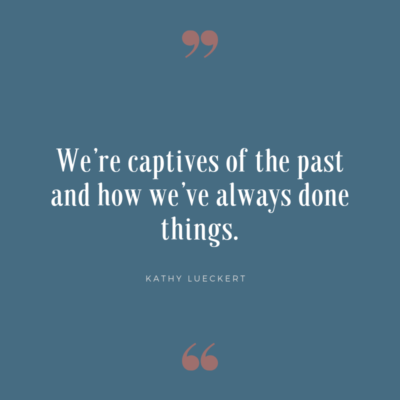
Lueckert responded: “I think you’re right about that. … We’re captives of the past and how we’ve always done things,” so “we need you all who have new eyes and new ears to jolt us into a new way of thinking.”
Davis put it this way: “Everybody thinks it’s a good idea until it touches their own budget. That’s where it gets difficult and political.”
The special committee’s work teams are continuing to move ahead with their tasks. The full committee plans to meet in Louisville Nov. 4-6.