SEATTLE – What is the role of creativity in worship? How can music and art and poetry be gateways for connection to the sacred — particularly for people who would never show up to sit in a church pew on a Sunday morning?
That’s part of what Coastland Commons, a new worshipping community in Seattle, is exploring — and a question that organizers think has implications for life in more traditional congregations as well.
Coastland Commons was born of a conviction: “We believe that everyone has the capacity to be creative,” said Zac Calvo, a minister who Seattle Presbytery ordained to be the organizing pastor of Coastland Commons.
Dani Forbess is pastor of Northminster Presbyterian Church in the Ballard neighborhood, and leads Seattle Presbytery’s New Worshipping Communities task force. With Kyle Turver, director of worship ministries at Bethany Presbyterian Church, she is co-director of Coastland Commons. Calvo also serves as director of community and youth engagement at Northminster.
So these church leaders have a foot in both settings – in a new worshipping community and in more traditional churches – and a heart for thinking about how creativity can be a means of exploring what Christianity means and of expressing faith.
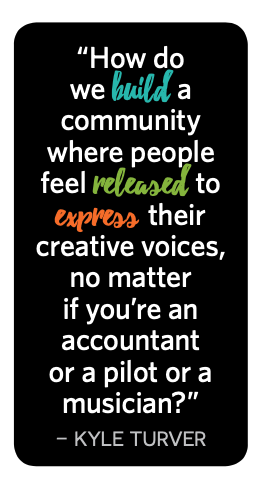
Turver asked, “How do we build a community where people feel released to express their creative voices, no matter if you’re an accountant or a pilot or a musician?”
Creativity as holy ground
“We all have something to contribute to creative community,” Forbess said. While she deeply loves the church she pastors, she also sees that in many traditional churches “the congregation comes and sort of plays the part of the audience” on Sunday mornings. Too often, “the congregation consumes the worship service, or bears witness, but doesn’t engage in the work” of creating the worship itself.
She wants more than that — to recognize that discipleship can involve cultivating creative energy. “As folks who are made in the image of God, we all have something to bring — that is what worship is all about,” Forbess said. “And when we bring it, it’s better for everybody.”
Coastland Commons was born from that understanding — from a commitment to find a “third space” for people to explore creativity, and the sacred connections that emerge when a community does so together. Also this: the understanding that worshipping at 11 o’clock on Sunday morning isn’t the only way to create sacred space.
That’s what Eliana Maxim, co-executive presbyter of Seattle Presbytery sees at Coastland Commons. When she has visited, people have said to her essentially: “I wouldn’t ever go to church, but I come to this. This is a sacred time. … The time they spend in community creating feels like holy ground to them.”
A third space for questions
The concept of a “third space” – language that’s part of the new worshipping communities conversation in the Presbyterian Church (U.S.A.) and elsewhere – is the idea of someplace that’s not work and not home, but where community emerges, relationships flourish and something people want and need is brought to life.
 According to Forbess, many who come to Coastland Commons want a place to bring their questions and doubts. Some no longer feel safe or welcome in the institutional church — they’ve been alienated by what they see as hypocrisy or a lack of welcome or something else.
“We have people who are atheists” or agnostic or unsure, LGBTQ+ people who don’t feel welcome at many churches, and others “who are really interested in spirituality, but are not so sure about the institution anymore,” Calvo said.
“Really what we’re trying to do is say out loud all the questions that everyone’s afraid to ask.” And he adds: “This is not a young person thing, by the way. It’s not. …We have people who are older adults and later in life, and they’re asking the same questions.”
An important question at Coastland Commons, Forbess said, is: “How would Jesus live?”
At its heart, “discipleship is the process of becoming more like Jesus, which is becoming more human,” she said. Creating together, “we deepen and enrich our humanity.”
Creating together
The Coastland Commons community gathers once a month for a meal and for creative practices that embody faith. People write music and poetry together, sharing ideas and collaborating to make something new.
Food is important. The participants always gather around a meal. The organizers have learned “it’s real important for us to put a little bit of liturgy around that meal,” as a way of welcoming and inviting all, Forbess said.
Turver wrote a song for that dinner gathering — a call to the table, a call to worship.
“Come to the table all who are able, bring all your weary, your sick and your poor. Come to the table as you are able, there is eternally a place for you. Come taste the feast of heaven made new. Come to the table. Come to the table. Come taste the depth of God’s love for you.”
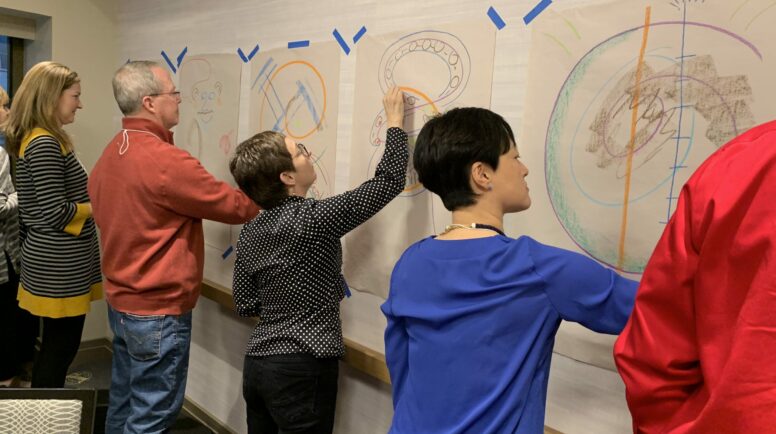
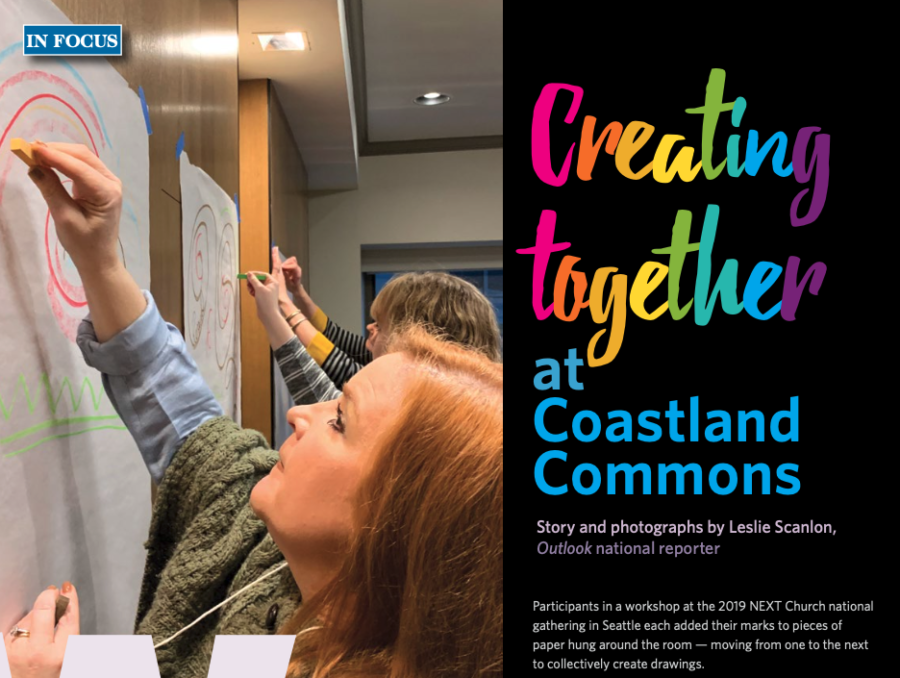
During a workshop last spring at the NEXT Church national gathering in Seattle, the Coastland Commons team introduced people to the kinds of collaborative approaches they might use: taping sheets of white paper to the walls and asking people to walk around, using charcoal or pastel sticks to draw something on each, making a mark, collectively making something new.
In small groups, the participants wrote collaborative poems together. They listened to the Old Testament story of Jonah getting sucked into the belly of the whale. Then each person wrote their reactions — responding to the passage, something private, that no one else would read.
After that, they circled words or phrases from what they’d written that stood out for them — among them: hurled into the pit, slime, discomfort, recognizing the rescue. Using those words, they worked together to write poems.
What did people think of these exercises?
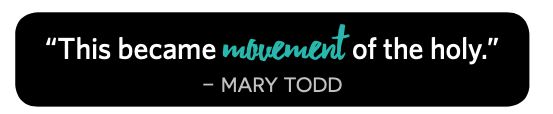
Mary Todd, pastor of a small church in North Carolina, said she loved that “this became movement of the holy. I love the waves of redemption. I like the dynamism of it.”
Other responses: fun, surprising, trust-building, freeing, “just consumed by this sense of being.”
Exercises like these always start with some anxiety and the fear that you don’t know how to get started or what to do, Turver said. At the end, “every time there’s beauty that comes from someplace.”
Beyond Sunday mornings
Coastland Commons has a rhythm: gathering once a month on a Monday night for a meal and an evening of creative work, sometimes with a theme for conversation. Every three or four months the Commons presents an art show, typically at someone’s house. The art shows take some work to curate — there’s typically live music, local artists are invited to present and sell their work and tickets sold so the artists are paid for their time.
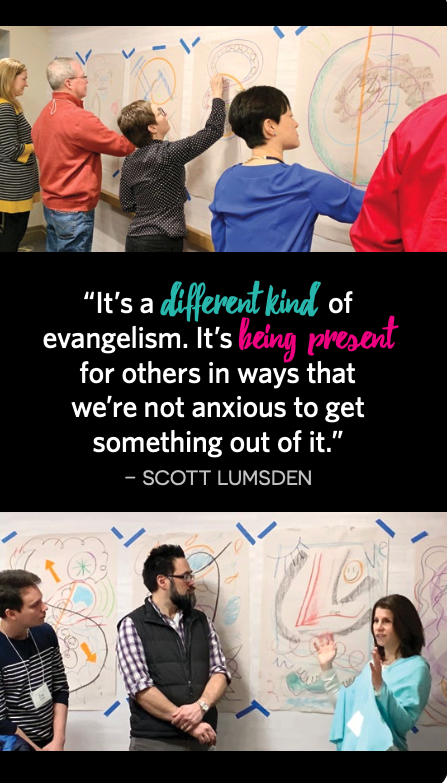
in Seattle each added their marks to pieces of paper hung around the room — moving from one to the next to collectively create drawings, bottom: Zac Calvo (left), founding pastor of Coastland Commons, and Jason Brian Santos, mission coordinator for Christian formation with the Presbyterian Mission Agency, listen as Becca Messman, a pastor from Virginia, describes her reaction to the process. Behind them are some of the drawings the group created.
What’s not happening is any sort of move towards a weekly worship service.
“What we’re trying to recognize and acknowledge is that in places like Seattle, which I really believe is a testing ground for the rest of the country in the next 20 or 30 years, maybe sooner, many people really don’t care about Sunday morning church,” Calvo said. “It’s true in the Pacific Northwest, definitely,” which is considered one of the most secular parts of the nation.
“I find that to be kind of freeing, actually. It’s a bit of a gift. You don’t get to rely on what’s always been done” in trying new forms of what church can be.
Coastland Commons is part of the PC(USA)’s 1001 New Worshipping Communities program, and “we have a Christian identity,” Calvo said. But “we don’t look like a church. We don’t meet on Sunday mornings. We meet once a month. We have a meal which we consider to be sort of Eucharistic practice,” although it’s not a sacrament.
Forbess said she’s scoured the Book of Order, and found more freedom there than she realized. “There’s nothing in the Book of Order that says people have to worship on the Lord’s Day,” she said. “You can be a Presbyterian church and you do not have to meet on a weekly basis. Not meeting weekly is huge for us” for sustainability — giving the leadership room for planning and participants the opportunity to be involved in other places. “We want that. We don’t want to be the exclusive community that they are only involved in.”
Forbess said her work at Coastland Commons for the past five years has stretched her as a pastor.
Doing both “has been really hard,” she said. Despite that, “I just wish this for every pastor, because it’s taught me so much I would not know if I was just doing institutional, traditional congregational work. I feel like I have grown so much by doing both of these pieces. The new worshipping community has pushed me so hard in terms of language about identity and queer folk and white supremacy. I’m so grateful. … It’s made me a better pastor.”
Fearless experimentation
For the presbytery, Coastland Commons and other 1001 expressions – including immigrant fellowships and Union Church, which operates a coffee shop called Kakao – are ways of meeting the needs of a changing city.
Urban areas that are being developed and gentrified and are changing “are desperate for community engagement,” said Scott Lumsden, the co-executive presbyter. “If the church can accept the fact that the community at large doesn’t want a one-hour worship service with an organ,” but can be a place to facilitate conversations about connection and what communities really need, that can be a starting place for new relationships.
“That’s a huge opportunity for the church,” Lumsden said. “It’s a different kind of evangelism. It’s being present for others in ways that we’re not anxious to get something out of it. We’re actually kind of willing to give ourselves away,” to tear down the walls between secular and sacred, work and home.
“If we keep doing things the way we’re doing them, we’re done in 10 years,” he said. “It’s plain as day. Just like climate change, we used to think we had a longer runway than we do.”
Forbess encourages people of faith to “develop these other models that are fearless” about experimentation and then live into those new possibilities.
Her way to let the light in: “Find the cracks, and break it open.”