The financial pressure in the Presbyterian Church (U.S.A.), where it is most deeply felt, is not at the denomination’s national offices in Louisville, but closer to the people — in presbyteries and congregations.
And part of it is tied up in memory: in not only what’s happening now, but in the collective trauma of what’s come before.
It’s the impact of deciding the congregation can’t afford a full-time pastor anymore, and that long gone are the days when the pews were pretty much full every Sunday. But the church is now being asked to pay a higher rate of per capita – currently $8.95 per member – to support the work of the broader church. And the utility bills are going up too.
Presbytery and synod leaders remember a time when at least some mid council offices had robust staffs and more money available for training and to do the work. Now, in some presbyteries it’s just one person, sometimes part-time, trying to do it all — holding it together with duct tape, one committee member said.
While the hemorrhaging of departures has pretty much stopped, in some places a big chunk of a mid council’s churches – including many of the largest and wealthiest congregations – left for more conservative denominations when the PC(USA) took crucial votes to allow its ministers to perform same-gender marriages and to allow the ordination of lesbian and gay ministers and elders who have partners.
Presbyteries, which felt the pain of those departures most acutely – including administrative commissions and “gracious dismissal” policies and lawsuits and property disputes – now are left with fewer churches and less money. And many presbytery leaders feel caught in the middle, squeezed between congregations that aren’t willing to or can’t afford to pay per capita, and a loyalty to the connectional, national church.
It’s not all about money or numbers, either. Despite that statistical narrative of decline, many Presbyterians feel a deep sense of faith and hope, and feel called to do challenging and creative work for justice and evangelism and peace. “There is an urgent call of the church today,” PC(USA) stated clerk J. Herbert Nelson preached this week. “The time is now, there is not enough time to think about it. Jesus is calling us now, no time to pack your bags.”
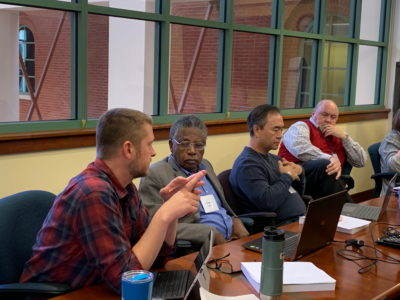
The per capita work team of the Special Committee on Per Capita Based Fundraising and National Church Financial Sustainability has not completed its work yet. It still has listening sessions scheduled later this week with two of the denomination’s 16 synods – and team members are adamant that that input is valuable and they will reach no final conclusions until they’ve heard from everybody.
Since last summer – and including the conversations this week – the work team will have spoken to representatives of all 16 synods and most of the 170 presbyteries. It’s been exhaustive, and sometimes exhausting, with travel and many conference calls — resulting in a massive pile of information and what team member Sarah Moore-Nokes called a “monster spreadsheet” compiling some of the findings.
At the committee’s meeting in Louisville Nov. 4-6, members of the per capita work team have been reluctant to share in any detail what they’ve learned so far with their colleagues on the special committee’s other work team, which is hard at work trying to produce a report on financial sustainability in the denomination – and is facing a Dec. 31 deadline.

Valerie Young, who is synod leader and stated clerk of the Synod of the Sun, serves as co-moderator of the special committee, along with Laura Cheifetz, a minister who is assistant dean for admissions, vocation, and stewardship at Vanderbilt Divinity School. “We are emphatic about respecting the fact that we want to hear that information” from the final two synods before reaching conclusions, Young told the committee.
Team members did discuss their process — they’re working to identify adaptive challenges that are emerging from the conversations, and possible experiments for alternatives to the current per capita funding structure.
And they spoke, in broad terms, about some of what they’ve heard – including a sense of disconnection between Presbyterians at the local levels and the national church, and the need for better communication. The per capita team also provided some feedback to the financial sustainability team – which had been considering recommending to the 2020 General Assembly, possibly in coordination with the Moving Forward Implementation Commission, some sort of process for restructuring the PC(USA).
That still might happen, but not quite yet.
The financial sustainability team has, in its conversations, suggested that the PC(USA) does have enough money, but needs a better structure of accountability and for ensuring that all of the agencies – particularly the Office of the General Assembly, which is on the verge of depleting its reserves and may ask the assembly for another hike in per capita – have sufficient money to do the work.
As a result of the conversations this week, the financial sustainability team is not likely to include actual recommendations to the assembly about denominational restructuring in the report it will deliver Dec. 31 (or sooner). Those recommendations could come later, perhaps in collaboration with the commission – as the special committee submits its full report to the assembly by Feb. 21.
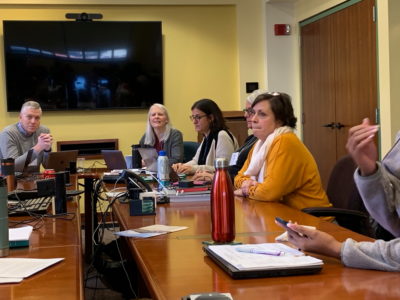
The reason for holding back now: The full special committee has not yet heard the findings from the per capita work group, as the synod conversations are still underway. While the financial sustainability team has determined that the PC(USA) has sufficient funding, but perhaps needs a different structure for making budget decisions, “the piece that’s missing is the house is on fire in the presbyteries,” Moore-Nokes said. “The findings are incomplete when it comes to the full church.”
There has been conversation at this meeting about what “financial sustainability” really means in the denomination. Also, what are the implications of being a connectional church when the financial realities are so mixed: when some congregations and mid councils really struggle, and some PC(USA) agencies, particularly the Presbyterian Foundation and Board of Pensions, have considerably deeper pockets?
In the structure as it stands now, and in how it might be reconfigured, who gets to make decisions about how the dollars get spent — and to determine what work is most important?
“There’s a lot of money at stake in this fight,” said Scott Lumsden, a committee member who serves on the financial sustainability team.
Members of the per capita team stressed that, while they aren’t ready to discuss their findings in detail, they are hearing from presbytery and synod leaders a clear sense that financial stress is a daily reality for many mid councils and congregations. For some presbyteries, “the gap is getting bigger,” as they dig into reserves trying to remit to the Office of the General Assembly the per capita dollars they have not been able to collect from congregations, said committee member Jeanne Radak.
In 2018, the uncollectable General Assembly per capita came to 11% of what had been sought, according to the Office of the General Assembly.
One presbytery leader said that a mid council is close to having to choose between paying uncollectable per capita or cutting a staff position, Radak said.
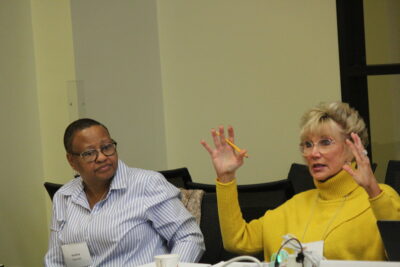
And in some places, the sole presbytery staff member works just 5 to 10 hours a week, said committee member Kevin Veldhuisen.
Committee member Audrey Toombs, stated clerk of the Presbytery of the Mid-South, said her presbytery has dropped from 79 to 41 churches, losing 10 of the largest churches to other denominations. The annual budget dropped from more than $600,000 to $200,000. With a smaller staff, her job responsibilities have expanded to include everything from janitorial duties to ordering supplies. Yet there’s a commitment that “we’ve got to keep our level of giving to General Assembly, we’ve got to sustain that,” Toombs said.
The responses to this financial stress from mid council leaders have varied. Some seem resigned. In some places creative work is being done in new collaborative configurations. And “we have listened to presbytery executives and stated clerks almost despondent in their work,” said committee member Paul Helphinstine.
And “then there were those who said blow it up,” Young said.
“Blow it up” – and create something other than the current per capita system that will work better for ministry in a changing church.