No, it’s not a committee, a task force or an overture. Not even a 40-page report.
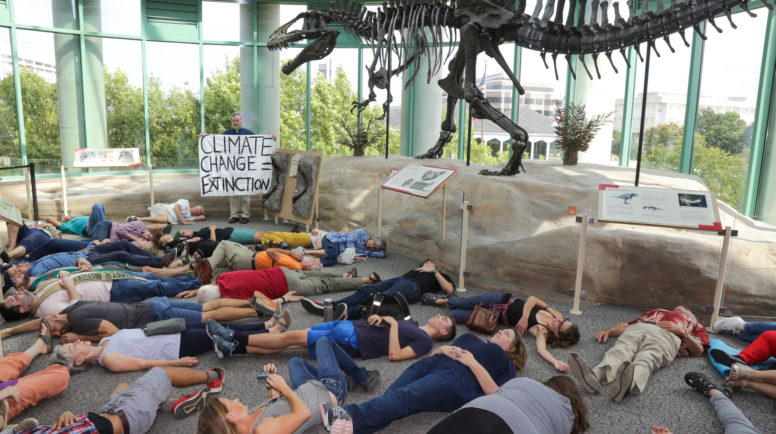
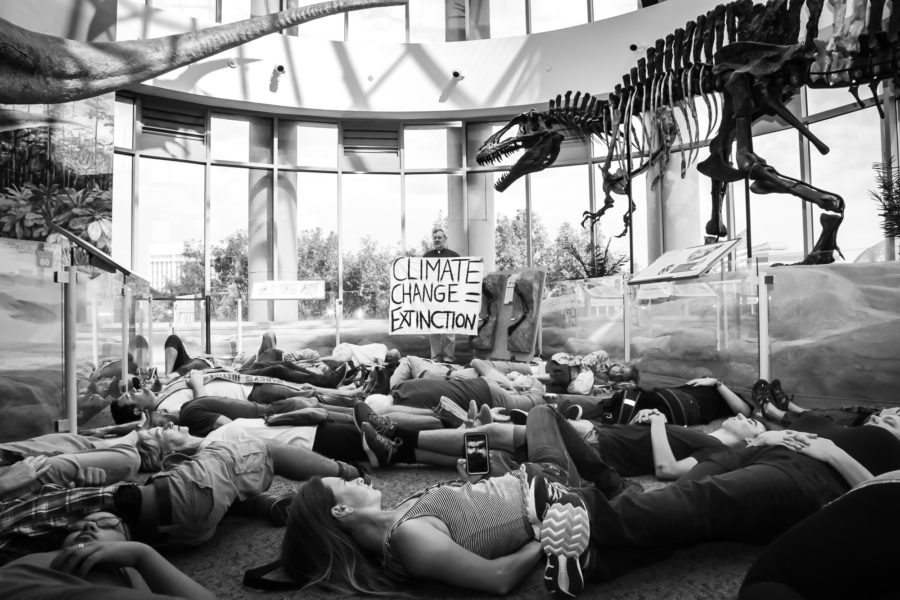
This was a bunch of Presbyterians staging a “die-in” at a science museum in North Carolina during Climate Strike week, trying to bring attention to the devastation of climate change.
This public action – so contrary to the deliberate, buttoned-up way Presbyterians usually talk about policy – grew out of the ongoing work of the Peace and Justice Task Force of Salem Presbytery, where the members have together been reading David Wallace-Wells’ book “The Uninhabitable Earth: Life After Warming.”
 That book “shook us up and woke us up,” said Stuart Taylor, pastor of Elkin Presbyterian Church. “Even though we were all generally aware of the climate crisis that we’re in the middle of, there was still an element of denial.”
Presbyterians from the task force started talking about what they might be able to do locally — including resistance to the proposed 600-mile Atlantic Coast Pipeline, which would run from West Virginia to North Carolina, crossing under the Appalachian Trail, and whose permit dispute the U.S. Supreme Court has agreed to consider.
Then Taylor saw an article in Sojourners magazine about a die-in at a natural history museum in Glasgow, Scotland — with protestors lying among the dinosaurs and carrying a banner that read “climate crisis equals the next great extinction.”
Climate Strike week was approaching — a time of public action all around the world. The North Carolina Museum of Science in Raleigh has dinosaurs. Together with allies in the Presbytery of New Hope, these Presbyterian environmentalists said “why not?” — and on Sept. 27, a group of about 35, including grandparents and children, staged a short die-in at the Raleigh museum among the dinosaurs, a way of warning what may happen if people don’t act quickly to slow global warming.
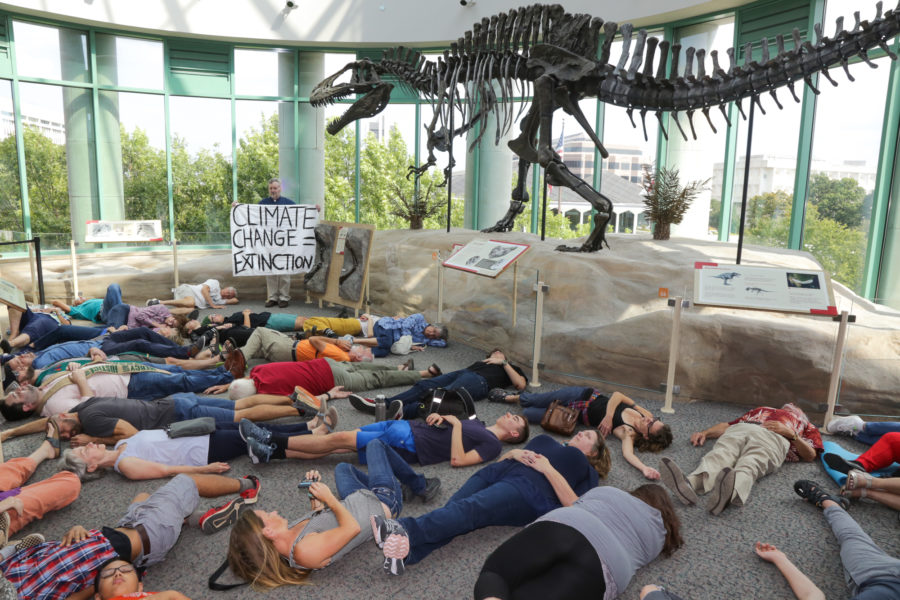
“To a person, it seemed to have an uplifting, empowering impact,” Taylor said. “One said, ‘I feel less despairing.’ Another said, ‘I have finally gotten past my anger to feel I can actually do something.’ … As we face the immensity of these challenges, our little action somehow fits into a larger global response.”
Close to home, Taylor and others are taking action – he’s helped to found a nonprofit organization called Watershed Now, focused on protecting the Big Elkin Creek watershed. The work is wide-ranging, including developing a school curriculum on watershed stewardship; landing a grant to do stream restoration following hurricane damage; and holding ecumenical concerts and worship services focused on the spirituality of water.
He encourages people in their own communities to “take action. Be visible. Raise your voices. Study and pray together. Resist the temptation to fall into denial.”
Taking action gives a sense that “we’re not alone,” he said. “We’re part of a global awakening, part of a global rebellion” of people “who are rising up and expressing their hope that we can save the planet.”
A driving motivation, Elkin said, is this: “We don’t have the luxury of a lot of time.”