
Much of my earliest faith formation came from singing in children’s choirs. Before learning the words and music of our anthems, we always went through a series of vocalizing exercises: singing “lu lu lu lu lu” on a descending scale, or “ma meh mi mo mu” on a single pitch, working to purify vowel sounds (a definite challenge for some of us Southerners).
 I think about such exercises occasionally now that I am part of the congregational choir that sits in the nave of the church rather than the choir loft. The nonsense syllables come to mind when I realize with some measure of chagrin that I have just sung through an entire hymn, resumed my seat and not registered a single word of what I have intoned. I might just as well have been vocalizing on “lu.” While I doubt I am the only person to have had this experience, I am all the more sheepish about admitting to it, because I should surely know better. After all, I am a professional hymn text writer with a decades-long commitment to studying the genre. So I am prompted to ask, both for myself and for others: Do I – or we – really mean what we sing?
Couched beneath the question are a few presuppositions. First, generally speaking, I assume it would be preferable to mean what we sing (at least, when the songs in question are the hymns of the faith), and hence, it is worth considering why we occasionally do not. Second, I expect there are various ways of “meaning” what we sing, and not all of these may be conscious or cognitive. Third, I believe practices are available to enhance the meaningfulness of our singing, enabling us to take better advantage of this tool for forming our faith.
Why do we not mean what we sing?
Often, when I am not meaning what I sing, the fault lies strictly in myself. I may be mouthing words to a tune, but my mind is miles away. The morning headlines have conveyed some new – or ongoing – horror. A warning light appeared on my dashboard during the drive to church. A child in the pew behind me has been chattering without interruption or correction since the start of the service. A deadline is looming at work, and my busy brain is similarly – if silently – chattering (also, alas, without interruption or correction). Under such circumstances, it is little wonder that I finish the song with no clue as to what I have voiced.
 Not just intellectual distraction, but emotional dissonance may also keep me from meaning what I sing. The words may be “joyful, joyful,” yet if I am feeling anxious, angry or just plain tired, my mood may interfere with entering into the spirit of the song. In an ideal world, the lyrics and music would lift me into a reality larger than my present preoccupation, but this ideal state of affairs does not always happen. When it does not, I end up giving mere lip service to the hymn’s proclamations.
Yet sometimes, the fault lies with some aspect of the song. The music may be the problem. If the tune is unfamiliar, I may apply all my energy to reading the notes, forgetting to attend to the text. Even with a familiar tune, if I am keen on adding the alto line, I may get distracted by searching for, or reveling in, the harmonies. This is one reason Calvin wanted unison singing in his churches. “We must carefully beware, lest our ears be more intent on the music than our minds on the spiritual meaning of the words,” he wrote in the “Institutes.” While it is appropriate to delight in music as a gift of God, lush harmonies, upbeat tempos or infectious rhythms can seduce us into thinking we are glorifying God when we are rather more glorying in our own artistry.
 In other instances, the words may cause difficulties. I may be blocked from meaning what I sing by ideas conveyed in an unfamiliar vocabulary. Hymnal committees revise older texts to minimize such blockage, replacing words like “vouchsafe” (“O Sacred Head Now Wounded”), which are no longer in common use, or words like “suffer” (“If Thou but Suffer God to Guide Thee”) or “molest” (“Jesus, Priceless Treasure”), whose meanings have shifted over time. Patriarchal language prevents some of us from fully meaning what we sing; for some people, language reinforcing a gender binary is increasingly proving troublesome. Yet, revisions of such language are also tricky: A new word that enhances understanding for some may distract others who are so habituated to an earlier text that any alteration proves jarring.
More serious than outdated language is an outdated worldview. Here as well, hymnal committees work to minimize difficulties. In Cecil Frances Alexander’s “All Things Bright and Beautiful,” an otherwise charming hymn intended to teach children about God’s good creation, hymnals published in the U.S. since 1900 have omitted the unquestioning social hierarchy of the original third stanza (“The rich man in his castle, / the poor man at his gate, / God made them high and lowly, / and ordered their estate”). Likewise, hymns about mission that refer to people of other cultures as “benighted” (in a state of pitiful or contemptible intellectual or moral ignorance) have largely ceased to appear.
What has been done for a few generations with regard to social worldviews has only just begun to be done for scientific ones. How, for example, do the language and imagery of our hymns now deal with billions of years of evolutionary history, with the vast suffering and death of non-human as well as human creatures as the price exacted for the emergence of new life? How exactly do we understand God to be at work in natural processes? In the aftermath of a hurricane that has taken a devastating toll of life and livelihood, disproportionately among earth’s poor (again, both human and non-human), do we really believe, in the words of Isaac Watts, that “clouds arise and tempests blow by order from [God’s] throne” (“I Sing the Mighty Power of God”)?
How do we mean what we sing?
 Some Christians would not hesitate to answer the previous question in the affirmative. Others, though, may be less confident that God directly orders natural disasters, and may rather attribute an important degree of causality to human activity that has disrupted climate systems, with increasingly catastrophic results. “But we can still sing Watts’ hymn,” this latter group might add, “because we know we do not mean the words literally.” This raises an important distinction, but also a larger question. To be sure, much hymn language – like much scriptural language – is poetic, reflecting human attempts to describe realities so far beyond our ken as to be literally indescribable. But at what point does our appeal to metaphorical meaning become a dodge to avoid grappling with serious theological questions? It is one thing to say that calling God “potter” is a metaphor; it would be quite different (and problematic) to say we only metaphorically believe God made the world.
However, we may also mean what we sing in ways beyond the conscious and cognitive. After all, being a Christian is not simply assenting to doctrines, but also living out a pattern of deep affections: gratitude for God’s gifts, love for God and neighbor, sorrow for our own sin and grief over the ills of the world, and earnest desire for redemption. If we profess to be Christian yet act in ways that are predominantly grudging, mean-spirited and despairing, something about our faith-claim rings false. Sacred songs help to train more appropriate religious emotions. They give voice not only to words expressing thankfulness, repentance and hope, but also to melodies, rhythms and memories that variously tug at or lift up our hearts. Even the chemicals released in our brains by the act of singing may play a role in such emotional training. And why not? We are embodied beings and worship is a bodily act.
Because of the emotionally evocative power of music, we may find on occasion that we actually sing our way into meaning. The distractedness or dissonance that initially clouded our convictions clear away as the Spirit moves through music to change our hearts. Perhaps, indeed, this is why the psalmist is so often able to make the turn from lamentation to trust before reaching the end of a psalm.
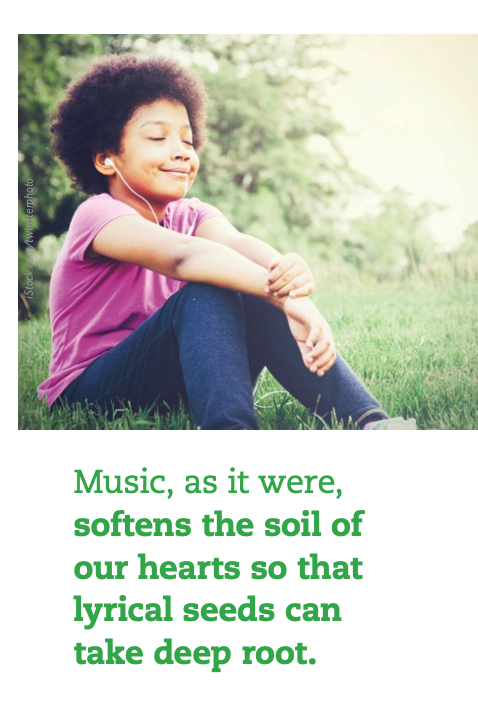
Three further ways of meaning what we sing emerge from the effective combination of texts set to music. One of these is a kind of “timed-release” meaning. Music, as it were, softens the soil of our hearts so that lyrical seeds can take deep root. Over time, those seeds can grow into sturdy and life-shaping convictions, even when we were not initially aware of their fullest significance. Related to this emergence over time is a type of corporate meaning. When I am grieving, for example, and my throat constricts both literally and metaphorically, preventing me from giving voice to a strong affirmation of God’s goodness, the larger body of which I am a member keeps the song going until such time as I can enter into it again. Finally, the texts we sing include a dimension of aspirational meaning: I may not at the moment fully believe the affirmations of a given song, but I want to do so, and I keep singing in the hope that the Spirit and the body of the faithful around me will help my unbelief.
How might we better mean what we sing?
Given the vital role that sung words can play in shaping and expressing our faith, here are four suggestions for enhancing their formative value —
suggestions, in roughly this order, for writers, musicians, worship leaders and all the rest of us.
 1. Continue composing, adopting and adapting new texts to address the issues and worldview of our own day, so as to minimize cognitive dissonance for current generations of singers.
2. Use the gifts of choirs, soloists and instrumentalists to teach unfamiliar melodies so that the mental focus of singing new tunes does not interfere with apprehending their words.
3. Incorporate songs more intentionally into worship. Explain with bulletin notes or prefatory comments why particular pieces have been selected. Draw attention to key images and themes, offering worshippers an opportunity to encounter the words independent of the music.
4. Practice, practice, practice: not just on “lu,” but in life! While we do sometimes mean what we sing more aspirationally than actually, if we only aspire and never enact, our sincerity grows suspect. To extol the beauties of God’s creation, for example, while continuing to abuse the planet suggests we are “sing-washing” ourselves, substituting lyrical words for deeds.
To paraphrase a prayer for musicians dating to the fourth century Council of Carthage: We must take heed so that whatever we sing with our mouths, we also believe in our hearts; and whatever we believe in our hearts, we show forth in our works. Amen.
 Mary Louise (Mel) Bringle is professor of philosophy and religious studies at Brevard College and a ruling elder at Trinity Presbyterian Church in Hendersonville, North Carolina. She is also a hymn text writer and translator who has served as president of The Hymn Society in the U.S. and Canada and chair of the Presbyterian Committee on Congregational Song, responsible for the new hymnal “Glory to God.”