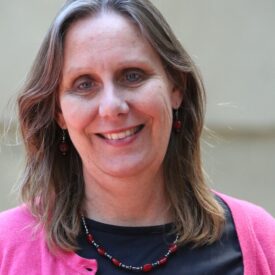
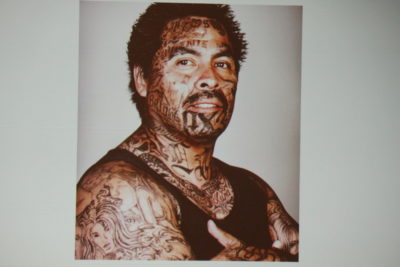
BALTIMORE – Implicit bias. As in: When you see a photo of this man what do you see? What do you think?
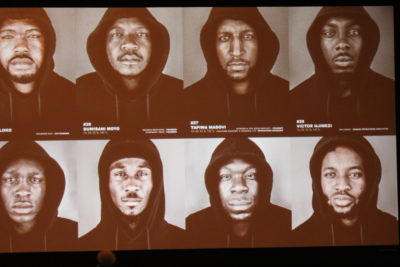
Or these men:
Or this person?

On Feb. 13, Shanea Leonard, associate for gender and racial justice in the Presbyterian Mission Agency, and Denise Anderson, coordinator of racial and intercultural justice, led cultural humility training for the Committee on the Office of the General Assembly and the Presbyterian Mission Agency Board, meeting jointly in Baltimore.
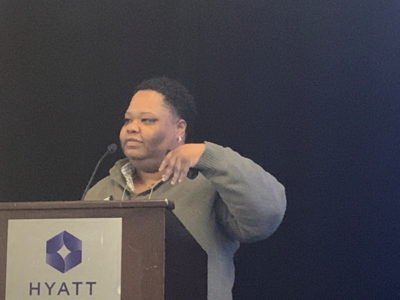
Part of it had to do with addressing implicit bias – “the stories we make up about people before we actually know who they are,” Leonard said. As in: The Irish are alcoholics. Those young blacks will steal from your store. “Do we see them as Christ wants us to see them, or through the lens of our own stereotypes?” they asked (Leonard uses they/them pronouns).
Leonard showed a series of photographs – asking people to write down their first reactions to the images.
For example, what one person sees as a potentially dangerous public housing project is someone else’s home. The image above of the men in hoodies actually was a group of professional athletes, trying to make a point after Freddie Gray died in police custody in Baltimore in April 2015, his spinal cord severed after he was transported in a police van.
When people see the image of someone who’s fat, often they think that person is lazy, won’t exercise, “doesn’t want to do anything to help themselves,” Leonard said. Sometimes, the underlying problem is medical.
“Perception is not always reality,” they said.
Then there’s systemic racism: the way that institutions with power, laws, policies and practices work to harm the disenfranchised and oppressed, Anderson said. Another reality: “Institutions are made of individuals,” she said. So systemic racism involves both institutions and the people who are part of them.
With the General Assembly meeting in Baltimore June 20-27, the city where protestors vented their anger in the streets after Gray was killed, “you need to hear from Baltimore,” Anderson said – to learn how the Presbytery of Baltimore responded, and about the required anti-racism training the presbytery put into place after those tense days.
It’s not just a question for Baltimore, Anderson said. An overture is coming to the 2020 General Assembly, sent by the Presbytery of Sheppards and Lapsley, to require that all councils of the church to implement an anti-racism policy, “with suggested training for all members of each council.”
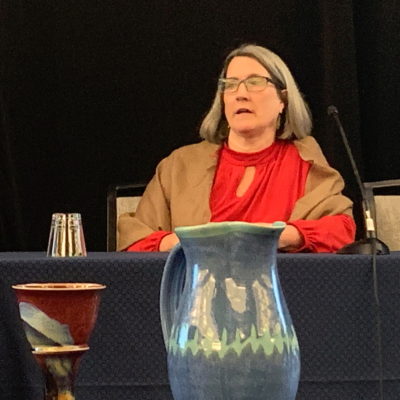
Susan Krehbiel, social justice consultant with Baltimore Presbytery, read a prayer that James Parks, chair of the presbytery’s steering cabinet, wrote in the days after Gray died – including this line: “Help us to become full-time, everyday outlets for your justice,” and an acknowledgment of the anger and desperation that led to violence in Baltimore in response to Gray’s killing.
“Baltimore Presbytery really didn’t know where it was going in the days after Freddie Gray’s death,” Anderson said – it became a time of a painful learning.
“Something spontaneous happened,” said Michael Moore, pastor of Knox Presbyterian Church and the presbytery’s vice moderator. People came to the church, and dialogues began with African Americans in the community – dialogues that continued for a year and a half, with a group forming called Apostles of Reconciliation. People stayed in the discussion, despite tension and discomfort.
Right after Gray died, when the protests began simmering, the presbytery sent out a call on a private Facebook group, and 30 pastors showed up within 24 hours to try to figure out how to respond, Krehbiel said.
There was a sense that “we want to respond as an institution, but have no idea how to do that,” said Mark Hanna, pastor of Roland Park Presbyterian Church. They felt the need to turn to African American pastors and elders and say, “we need you to lead us.” And the people of color said, “we have a lot of work to do here” already in the community.
Some Presbyterians wanted to join with blacks who were protesting, and “we made a mistake,” Moore said. “We got out in front. So we got our little feelings hurt, which demonstrates the white fragility we have. … We’re not willing to go into places and just sit and listen. In fact, theologically, that’s what Jesus did. He came down and he sat and he listened. And he sat with the uncomfortable people, the prostitutes and the sinners. So we learned something.”
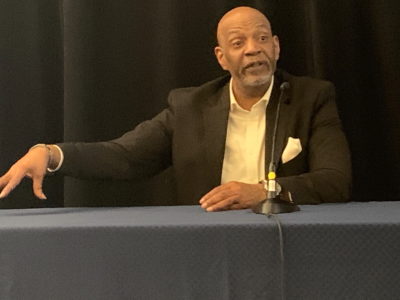
One of the learnings: when whites wanted people of color to come to the table, sometimes they got the answer, “we’ve got better things to do,” Moore said. What the blacks wanted was something concrete, some incentive that the white Presbyterians were willing to “take some kind of prophetic stand, to do something more than write papers.”
There’s a lesson there. “If you want to become an open church to the needs of a changing demographic, if you want to do discipleship and evangelism, then Matthew 25 is where you want to be” – doing real work towards confronting racism and ending poverty. “You don’t have to be a multicultural church. You can do ministry in the suburbs right where you are. But you have to be conscious. You have to be awake. … Do ministry where you are, but preach the gospel. We don’t need tokenism. … We need white allies. You go. You preach the gospel. Then you get people of color wanting to come to your table.”
Baltimore had 342 murders last year, “but it’s not hopeless,” Moore said. The city needs help, but “what it doesn’t need is a White House to accuse us of being rat-infested.”
Anderson asked: What are some of the learnings from Baltimore for the rest of the PC(USA)?
“We were not the church we wanted to be,” Krehbiel said. “We were not connected to the community the way we wanted to be. Freddie Gray’s death and the uprising brought that all home for us.”
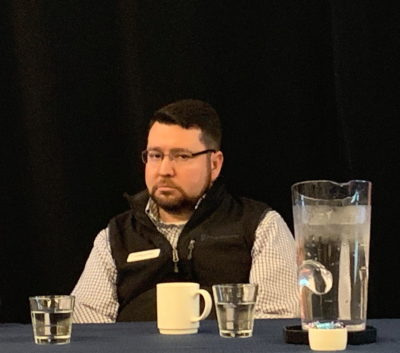
Hanna attended the required anti-racism training, which the presbytery contracted with Baltimore Racial Justice Action to provide, and found it “incredibly productive.” He left feeling “there’s so much work to do.” And it didn’t take long for what he’d learned to hit home.
Roland Park is the northern-most central neighborhood in the city, an affluent area about four miles from downtown. Five of the city’s most prominent private schools are either in or just adjacent to the neighborhood, he said. There are also two public schools: one elementary and one middle, with the middle school drawing from a broader area and with its student body more diverse. Roland Park also has “the distinct dishonor” of being the first community in the nation to establish restrictive covenants that homeowners would not sell their property to blacks or Jews – the start of the practice of redlining, Hanna said.
After the presbytery training, Hanna held adult education sessions for people from his congregation on some of what he’d learned. The day after the last session, in early January, he learned of an incident where a woman from the neighborhood had an encounter with three students of color from the middle school, calling them a racial slur. That led to a commentary in the Baltimore Sun with the headline “Racism in Roland Park.”
Hanna said he knew “we had to do something, even if it wasn’t perfect.”
He called the school principal. Put out a public statement that the newspaper published. Invited the community to write statements supporting the school’s students in chalk on the church’s sidewalks. Held a public witness outside the school as the students were arriving. Participated in stakeholder meetings the school has convened.
Without the presbytery’s anti-racism training, he wouldn’t have been ready to preach the gospel in that context, Hanna said.
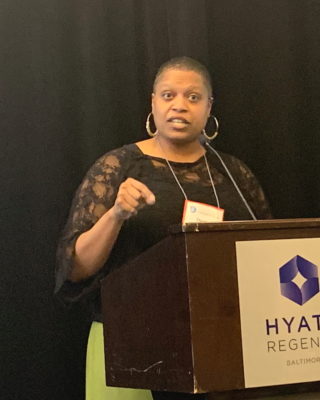
“Get ready and stay ready,” Anderson responded.
Hanna also found that “my congregation was far more ready to have the conversation than I had given them credit for.” He’s not aware of any pushback.
And then he added: “Maybe we haven’t done enough to get resistance yet.”
Baltimore Presbytery is offering one-day Dismantling Racism training sessions – the next one is March 12 (although registration is nearly full). The next one after that: October 14.