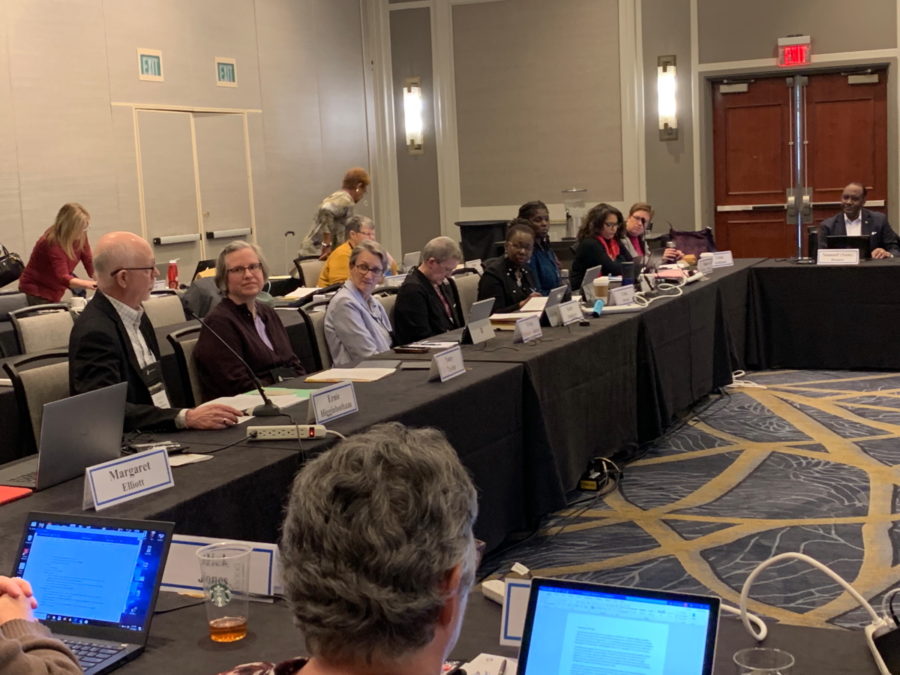
BALTIMORE – As two top policy-making bodies in the Presbyterian Church (U.S.A.) meet Feb. 12-14 in Baltimore, the specter of the 2020 General Assembly and “what comes next” is hanging heavy over these sessions, in discussions on budgets and priorities and new understandings on how to share what resources are available.
On Feb. 13, the Committee on the Office of the General Assembly and the Presbyterian Mission Agency Board will meet in joint session – a session that will include conversation with some of the key players involved in what’s transpiring, including the co-moderators of the Moving Forward Implementation Commission, Larryetta Ellis and Marco Grimaldo,
Also up: representatives from the Special Committee on Per Capita Based Funding and National Church Financial Sustainability, and the 2020 Vision Team.
Unified budget
The catch phrase for some of what’s changing is “unified budget.”
The subtext is: with nudging from the Moving Forward Implementation Commission, leaders at the top level of the PC(USA) are reaching new understandings about how agencies of the church can share resources so that General Assembly per capita doesn’t rise so quickly, as it otherwise might.
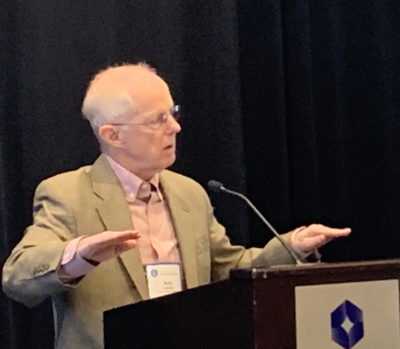
Having a unified budget means that three PC(USA) agencies – the Presbyterian Mission Agency (PMA), Office of the General Assembly (OGA), and the Administrative Services Group (ASG) – will present their budgets together to the 2020 General Assembly. The hope is to show the assembly that “financially we are in sync,” said Ken Godshall, a PMA board member who made a presentation on that subject on the first day of the board’s meeting.
It also signals some new understandings, at least in the near future, about how money will be spent and shared. In 2021 and 2022, PMA will waive collecting its share of per capita funds – currently about 15% of the General Assembly per capita collected, or about $1.4 million (roughly 2% of the PMA budget).
That money is used to help cover PMA’s administrative costs, including the costs of board meetings and of the office of the president and executive director. In 2021 and 2022, PMA will use bequests and reserves to cover those costs, although Godshall made it clear this is an arrangement for the next two years only.
That means in the next budget cycle an additional $1.4 million will be available to OGA, which is hurting for funds and under pressure from presbyteries not to increase per capita dramatically. Other implications of the arrangement:
- PMA and OGA will split the ASG costs on a ratio of 80% for PMA and 20% for OGA – an administrative cost-sharing arrangement that reflects the relative sizes of the two agencies’ budgets).
- Any large new gifts – unrestricted bequests over $500,000 – would be shared by PMA and OGA at the same 80/20% ratio, Godshall said. His presentation marks the first time that a dollar threshold – bequests over $500,000 – has been put on what would trigger that sharing arrangement.
Godshall also gave good news on PMA’s financial situation overall. “PMA is in equilibrium financially,” he said – with an increase in mission spending for the first time in several years, and no layoffs or early retirement incentives needed.
He also said: The PMA operating reserves are fully funded; unrestricted revenue has stabilized; and donors are being told that overhead costs come to 17% of the budget – so there’s clarity and potential donors know what to expect.
The boards won’t vote on the proposed 2021-2022 unified budget until their next meetings April 15-17. That’s also when the Committee on the Office of the General Assembly will recommend the proposed General Assembly per capita rate for 2021 and 2022.

Mission Work Plan
The board also heard a presentation on the Mission Work Plan for PMA for 2021 and 2022 (P.102 Mission Work Plan) – a plan the board will be asked to approve on Feb. 14, and which would become part of the budget document PMA will submit to the General Assembly for approval in June.
The intent: to keep the same three priorities that have been the focus of PMA’s work for the past two years. Those are:
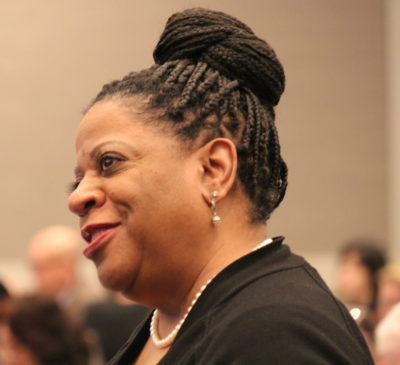
Diane Moffett, PMA’s president and executive director, said that by keeping the same priorities “this will give us an opportunity to dig a little deeper … and not change course midstream.”
She also reported that 404 PC(USA) congregations and 34 mid councils (representing more than 5,400 congregations) have so far joined PMA’s Matthew 25 initiative. “The response has been amazing and inspiring,” Moffett said.
ACWC
Board member Floretta Watkins, who serves as co-moderator of the Advocacy Committee for Women’s Concerns, outlined some recommendations ACWC will be bringing to the 2020 General Assembly. Among them: a resolution supporting transwomen of color, which calls for reading on the assembly floor the names for those who have been murdered. Other resolutions would call for reproductive justice; oppose violence against women; and draw attention to the disproportionate rates infant and maternal mortality for black women, and the statistics about indigenous women who’ve gone missing or been killed.
ACWC also plans to present a resolution celebrating the gifts of women and their contributions to the PC(USA), Watkins said.
It plans to ask that gender equity be added as a fourth focus of the Matthew 25 initiative.
And ACWC plans to present a resolution calling on the assembly to develop a process for preventing, reporting and responding to bullying, harassment and assault offenses at the General Assembly and at meetings of the PC(USA)’s committees and task forces, Watkins said.
Godshall asked if Watkins could give examples of some incidents of this type that have occurred at the assembly – situations that have led ACWC to call for this resolution.
Watkins spoke of her personal experience – responding that she volunteered for OGA at the assembly for a decade, and “indeed I was bullied. Usually when a woman is treated in some kind of disrespectful way, especially a woman of color, we just won’t say anything.”
But she remembers a man saying, “Wow, she makes that clergy collar look good,” as he passed. And Watkins said many women ministers report having been harassed by men in their congregations – either by colleagues or members of the church. Policies are needed at church meetings to “treat women with respect and make them feel safe,” Watkins said.
Leadership
The PMA board elected Shannan Vance-Ocampo, general presbyter of the Presbytery of Southern New England, as its as chair-elect for 2020-2022, pending confirmation from the 2020 General Assembly.
Warren Lesane, the board’s current vice chair and executive and stated clerk for the Synod of Mid-Atlantic, will become chair following this summer’s General Assembly.

Once confirmed, Vance-Ocampo would then become chair-elect – meaning she’d become the board’s chair for 2022-2024.
In her written responses to questions about key issues facing the Presbyterian Mission Agency and the church (B.001 PN Report One 2020 February), Vance-Ocampo wrote in part about prophetic ministry, continued implementation of the Matthew 25 initiative and consolidations in areas where there may be overlapping effort. She wrote of the value of “hearing and sharing stories of renewal” in the church, the importance of building trust and a sense of partnership, and the reality that immigrant fellowships are growing. “Our international partners are seeing the United States as a new mission field,” she wrote, and the opportunity for collaborative faith-filled partnerships with diaspora communities exists.”
Worship
PMA board member Lindsay Herren-Lewis, associate pastor of Fairmount Presbyterian Church in Cleveland Heights, Ohio, preached during the board’s opening worship, from Micah 6:8 – the call to do justice, love kindness, walk humbly with God. Reflecting on her six years of service on the board, Herren-Lewis said, “I finally understand in my being what it means to be part of a connectional church and what a gift that is” – having seen PC(USA) ministry in different contexts from around the world, in big congregations and tiny ones, in the halls of Congress.
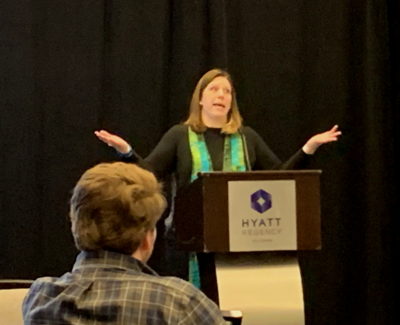
“Friends, it’s easy to believe the wisdom of the world and the wisdom of ourselves over the actual wisdom of God,” she said – using as one example her recent experiment, in an effort to leave a lighter carbon footprint, at making her own beeswax candles. Herren-Lewis’s stovetop adventure involved, among other things, beeswax, a recycled glass jar, an improvised double boiler, an enamel pitcher (bought used!) and a rash decision to put the concoction in the microwave (instead of calling her friend who used to work as a candlemaker).
“It’s power and prestige and the foolishness of one’s own power that goes unchecked that leads to exploding beeswax in one’s microwave,” she said. By the world’s standards of who’s important, “Jesus wouldn’t have been born in a stable. He would have been born in a palace, to parents who were married.”
But God cares about those on the margins, so walking with God means following a different path – guided by the wisdom of God incarnate, who was born in a stable and died on a cross, “and yet lives,” Herren-Lewis said.

“We need to set aside time to learn God’s wisdom, to see the Spirit in community, and to figure out how to do the kind of justice that God calls us to.”
The meetings continue with the joint session Feb. 13 – including conversation about policy decisions ahead, about racism, about the Rules of Discipline Task Force and plans for the 2020 General Assembly, June 20-27 in Baltimore.