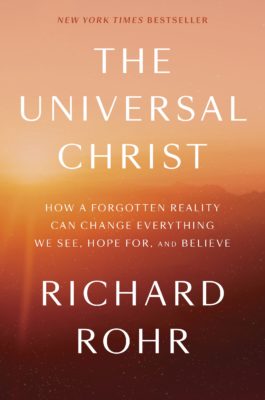
 Richard Rohr
Convergent Books, 260 pages
Reviewed by Leslie A. Klingensmith
“Homecoming” — that’s the best word I can think of to describe the feeling I have when I read Richard Rohr. It has never made sense to me – intuitively or spiritually – for the love of God to be tied to only one culture or faith tradition. We grow up hearing of a God of love, and yet are told that the same God will damn anyone to hell for eternity for being born into a Muslim or Buddhist family. Such an exclusive and narrow interpretation of the gospel has never added up for me with the doctrines of mercy and grace that we claim in the Christian church. Where did this rigidity concerning who is “in” and who is “out” come from? Why do we humans even concern ourselves with something that ultimately is up to God and not really any of our business? When I read “The Universal Christ” I could tell that Richard Rohr has given much prayerful consideration to developing a theology that creates space for everyone, giving God the room to be God. It’s not a theology that those who need to live in a carefully constructed system will easily embrace, but for many it is a life-giving way into the Christian tradition. Even more wonderfully, it is a way in that does not leave our non-Christian friends on the outside.
Rohr respectfully addresses the cognitive dissonance that plagues so many of us who want to follow and serve Christ but do not believe that people who follow a different path are any less God’s children than we are. He articulates the unlimited nature of God’s love throughout the book, but especially lifts it up in the chapter “Love Is the Meaning.” Rohr is not the first person to express such ideas; he draws heavily from French theologian Pierre Teilhard de Chardin. While I enjoy Chardin’s work, I believe that Rohr makes the concept of unlimited divine love, shown to us in Christ, much more accessible to readers without theological training.
“Remember again, God loves you by becoming you, taking your side in the inner dialogue of self-accusation and defense. God loves you by turning your mistakes into grace. … God stands with you, and not against you, when you are tempted to shame or self-hatred,” Rohr writes. This is just one of the places in the book where he tells us that what God wants is to be in relationship with us, that relationship is the essence of God and where we find God. Rohr’s open-hearted approach is such a refreshing contrast to the “us vs. them” mentality that is so common in our culture right now.
Let’s be clear, though, that Rohr’s ideas are not new. He freely admits that his goal is to take us back to the basic teachings of our faith, the essential foundation of who we are. Throughout his well-reasoned book he draws on Scripture, classic theologians and the poets to make his points. “The Universal Christ” is a hopeful read at a time when we desperately need a pathway to understand each other and recognize each other as God’s people.
Leslie A. Klingensmith is the pastor of St. Matthew’s Presbyterian Church in Silver Spring, Maryland.