CINCINNATI — Stones memorialize words, people, moments, movements.
Brian Blount, president of Union Presbyterian Seminary in Richmond, Virginia, looked to how Jesus regarded stones while he preached the closing worship sermon of the NEXT Church annual gathering that met in Cincinnati March 2-4. In addition to the conference text of Joshua 4:1-9, which tells the story of the Israelites setting stones in the Jordan River to remember what the Lord had done, Blount encouraged a side-by-side reading of Luke 19:29-40, as Jesus entered Jerusalem. The Pharisees asked Jesus to tell his disciples to stop praising God. But Jesus said, “I tell you, if these were silent, the stones would shout out.”
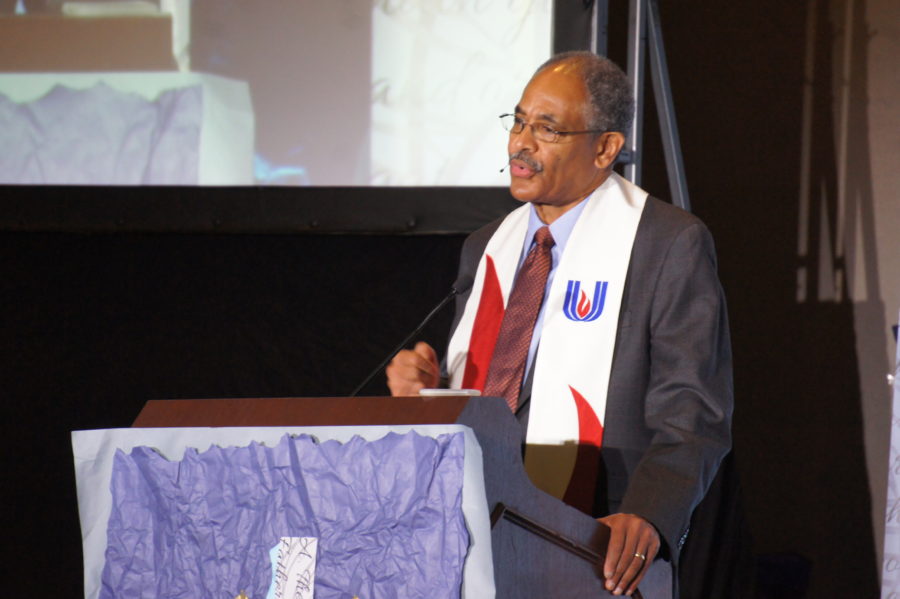
The stones in Joshua are “living reminders that the slaves were now free … the homeless were now home,” Blount said. But when Jesus walked into Jerusalem, he walked into trouble. Entering the land of power was nothing “short of a declaration of religious righteous revolution.”
In fact, Blount said, “Jesus didn’t just walk his way up to Jerusalem, he tore his way up to Jerusalem,” something often missed by the typical churchgoer. Blount contended that this passage gets read from a position of privilege, which means things get missed. It can be easy to see the pageantry of this Palm Sunday text: the roadway lined with festive colors and palm branches, the ensuring majestic parade.
But people of color read this, he preached, and “they see a passcode. … What’s a good adventure story without a good password?” For example, he recalled how slaves used password language in their singing as a covert way to warn others about dangers.
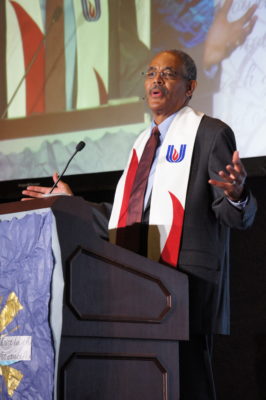 He asked: “What would it be like if the next version of church” was so into revolutionary behavior that Christians had to use passwords? So that those in power couldn’t stop the spread of the gospel until it was too late?
By the time leaders caught on to what was going to happen with Jesus, it was already happening. People were proclaiming Jesus as Messiah. Rome’s politics – and therefore Roman leadership – were on the way out.
So, the leaders tell Jesus to order the people to stop praising God, to stop declaring Jesus as Messiah. But, Blount said, Jesus knows “you can’t frighten a rock. A rock does what a rock does.” A rock is a monument to the moment. People can be paid or coerced to refute the truth, but not rocks — “the rocks will roar.”
“Stones remember, and stones speak.” Blount reminded worshippers about Joshua’s 12 stones, and said they were also “speaking stones” that witnessed to who the community was becoming as a people — and when the Israelites and their ancestors saw those stones, they would remember “that becoming.”
The healing, liberating message of stone will only work if humans speak as clearly and defiantly as a rock, he cautioned. “Can we Christians who claim to follow Jesus as the way to Jerusalem … speak as defiantly as a stone?”
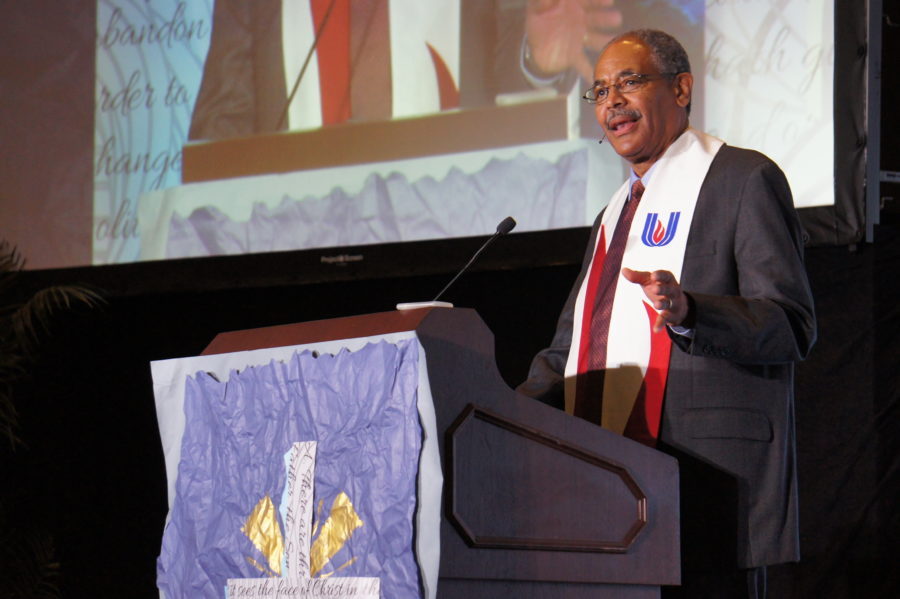
Blount said that Jesus’ threat was that if his followers don’t speak the radical message, the rocks will. “Can we be at least as faithful, at least as expressive, at least as active as a rock?”
Christians and pews are so closely identified it’s as though they are attached to them, he said, adding that he fears “that sometimes you cannot separate the Christians from the pews.”
If you put a glass holding an icy beverage on a napkin, the napkin sticks to it when you lift it up, Blount said, but if you put a salt on that napkin, it won’t still to the glass. “We need some rock salt on our pews,” so Christian get up and speak out.
“This is our stone-cold moment to be like Jesus, our rock and our redeemer.”