Once upon a time, a professor of theology heeded the lasting wisdom of H. Richard Niebuhr.
“Today,” he observed way back when, “we confront challenges different from the ones that Niebuhr faced: new wrinkles in hermeneutics, issues of gender and sexuality, struggles of the oppressed, the restructuring of American religion, new scientific theories and findings, environmental threats, religious pluralism, renewed reflections on myth and history, new configurations of international powers, global economic interdependencies and more. But at least one question remains as basic and elemental for us as it was for Niebuhr: Is the object of our theological inquiry the actuality of life in, with and before the living God, or have we pushed this primary reality aside?”
Doug Ottati, an ordained officer of the Presbyterian Church (U.S.A.), shared this insight 22 years ago, while serving on the theology faculty of my alma mater, Union Presbyterian Seminary. Surely, I’ve reflected recently, Ottati would invite us to engage Niebuhr’s theological method again and again — even in the year 2020, as we turn our attention (yet again) to a multitude of challenges that, if we permit them, illuminate the question before us: What does God have to do with us?
We, as radical monotheists (another nod to Niebuhr) who profess faith in Jesus Christ as Lord of all, confront the many challenges now before us (from climate change to racism to growing economic inequality to tyranny) with the assurance that God remains “with us always” as the omniscient Spirit of Christ — guiding, teaching, leading, chastising and creating as we follow in Jesus’ footsteps. This, we profess as a matter of faith, is also the Spirit of the eternal, sovereign Creator God who, to borrow again from Niebuhr, calls our many commitments into question. Our fleeting, short-lived commitments can, with the passing of time and investment of devotion, become idols — even, he would surely remind us, the ministries of the church, and even, we Presbyterians might confess, the success of a Protestant denomination.
So, one possible answer to the question of “What does God have to do with us?” goes something like this: The living God, as our Creator-yet-also-Lord-and-Redeemer, judges our propensity for idol making and idol worship. We can easily imagine John Calvin interrupting this line of inquiry with his still astonishing observation that the human heart is a “perpetual factory for the creation of idols.” Whether we offer a wholehearted “Amen!” to this pastoral reprimand or not, we know this much is true: We’re constantly tempted to give ourselves – mind, body and spirit – to one or more of any number of commitments that promise fulfillment of an ever-growing myriad of admittedly high-minded goals: progress, enlightenment, peace of mind, happiness, contentment, growth or cultural relevance.
And yet, to borrow from the Apostle Paul, the grace of God abounds. The divine condemnation of idols that would gladly stake as many claims as possible upon our time, energy, imagination, faith, hope and capacity for love, is accompanied by a God-given liturgy of consecration — liturgy that calls us back to the altar of confession and pardon, where the rivers of life-affirming baptism spill over the edges the font: “If we live, we live unto the Lord. If we die, we die unto the Lord. So, whether we live or die, we belong to the Lord.” Stated differently: We do not belong to ourselves and/or our frequently pretentious aspirations, for in life and in death, we are God’s.
The sovereign God to whom we belong calls us back, Sabbath after Sabbath, to the sacred, idol-crushing business of praise and exaltation: worship. There, at the center of the sanctuary, stands the cross of Christ — a symbol of God’s authority over life and death (“O death, where is thy sting? Thy victory?”); an Easter pronouncement of God’s triumphant grace; and an emblem of our communal faith that God the Creator is indeed the Father of our Savior Jesus Christ, “who died, yes, who was raised, who is at the right hand of God, who indeed intercedes for us.”
 There, in and amidst this communal, cross-centric act, are the echoes of words spoken by the prophets of old — words that apparently Jesus dedicated to memory and repeated. They are words that surely inspired Niebuhr’s stinging rebuke of the dull, lethargic theology of the modern-day church: “A God without wrath brought men without sin into a kingdom without judgment through the ministrations of a Christ without a cross.” God have mercy upon us; and God help us, as we fall prostrate and repent.
It turns out we modern-day followers of Christ are no better than the disciples and apostles of days of yore; sin, stubborn as ever, abounds. We stand before God’s altar as a judged and convicted people, guilty of “pushing aside the actuality of our life in, with and before the living God;” guilty of a benign neglect of God’s transcendent yet imminent presence; guilty of segregating our human ambitions, goals, priorities from the reality of God’s sovereign lordship of, and over, all things, people and institutions; guilty of anthropomorphizing a crucified God to accommodate our own hopes and dreams for the world; and guilty, as we neglect worship and muster confidence in the human capacity for improvement and of forgetting about God altogether.
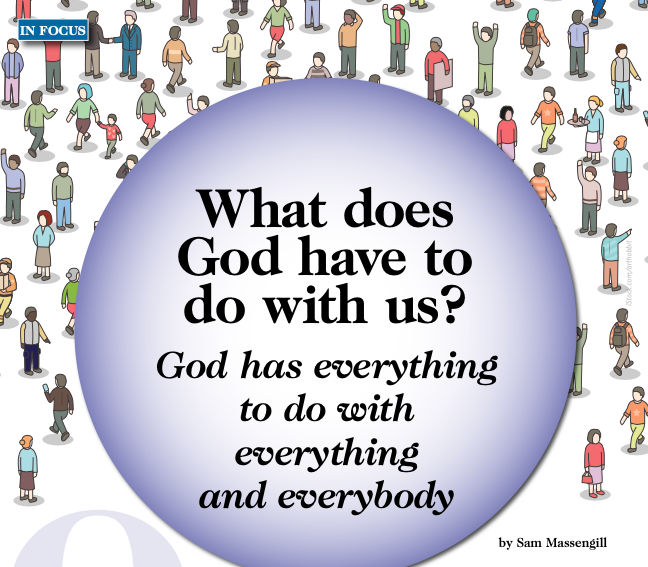
What does God have to do with us? Everything, it turns out, even as we declare our freedom, assert our independence and daily strive for what amounts to a beneficent deism. The living God has everything to do with everything and everybody under the sun; everything in the created universe and beyond; and everything that threatens to become idolatrous. But, as God is named and worshipped as the Creator and Redeemer of all, everything is graciously transformed into opportunities to witness to God’s sanctifying presence in and amidst the short (relative to eternity) history of the universe we call home.
What does God have to do with us? Everything ad infinitum! Always and forevermore. As the psalmist writes: “From where does my help come? My help comes from the Lord, who made heaven and earth!” Because God’s claim upon all of creation is total, constant and everlasting, there is no arena of life that’s beyond the relentless reach of divine providence. Thus, remember the oft-repeated Pauline affirmation of our communal life in, with and before the living God: “Nothing in all of creation will be able to separate us from the love of God that is in Jesus Christ our Lord.”
Nothing. Ever. As Niebuhr would join us in exclaiming: “Thanks be to God.”
 Sam Massengill serves as pastor/head of staff at Newtown Presbyterian Church in Bucks County, Pennsylvania. He is a native of Virginia, where he was born and raised alongside three siblings, lots of dogs and wonderful neighbors who taught him how to appreciate hospitality, good food and the art of storytelling.