We had come to the real question: What about communion? The Lenten season of repentance was quickly accelerating into a time of remoteness as COVID-19 expanded across Johnson County, Kansas, where we live. Five minds considered this, four in the room and one pastor via FaceTime, due to a viral illness after returning from Florida. Probably not COVID-19, but we were not taking chances.
That was March 12. Guidelines limiting groups to under 50 were fresh in our newsfeeds. We were altering offering collection and attendance pad processes, volunteer welcoming procedures and cleaning protocols. But what about communion?
An hour-long conversation came down to one word: probably. We could probably change communion styles and probably limit touching, but we probably would not be fully secure. Our decision was that in order to most responsibly love our neighbor, probably was insufficient. We settled on a troubling choice: worship without communion.
The next day, Friday the 13th, we sought input from health professionals in our congregation and arrived at a new decision: Loving our neighbor meant can celing worship outright. Sunday, March 15, a different five people gathered to record a 21-minute message to upload to a freshly purchased Vimeo Pro account. Worship now meant a Sunday morning message of hope amid isolation and concern. Due to increased internet usage that weekend, the message took 16 hours to upload. Technology was buckling under the rapid shift of churches moving to online platforms as COVID-19 spread.
In those four days, technology enabled us to make rapid-fire, difficult and large-scale decisions regarding our entire faith community and to do so with a level of transparency and haste that was needed for our evolving situation.
Church and technology: A long relationship
Technology and the church have always had a relationship, although it has not always looked like FaceTime, Vimeo or even online education. Take the portion of the New Testament we call the Epistles. Those letters were forms of technology, social media and social networking in the church’s earliest days. The early church letters helped create a backbone to support disparate communities learning what it meant to be a church of Christ and disciples of Jesus. The Reformer, Martin Luther, would use his day’s technology to alter the course of the written word of God. In seminary, the rule of thumb was that the church lags five to 10 years behind the culture. If true, that could mean that while our society has shifted to instantly accessible content, your church might be thinking about what to do with its first iPad (a technology first released in 2010).
Have you ever written or received an email stating: “Pastor, did you know this church has an app? Could we do that?” or “Church volunteer, check out this communications platform! My aunt’s church uses it and it looks so cool!”? There are dozens of different companies filling the inbox of church staff across the country with database management software, giving services and streaming options. Where does one start as a church community? What do we embrace, and what do we avoid? How does technology help us create a loving church community?
I propose a two-pronged approach, rooted in one basic assertion: We as a church are disciples of Jesus Christ, our Lord and Savior. Imperfect disciples though we be, we are called to the duty, responsibility and privilege of shaping one another in the community of faith. We all are disciples and all shape one another. No pastor, no technology, no company will save us or you. Jesus Christ is our Savior! We are students and followers of Jesus. In Matthew 28, Jesus commands his disciples to go and make more disciples, baptizing them in the name of the Triune God, “teaching them to obey everything that I have commanded you.” In the baptismal rite of my denomination (the ELCA), the congregation makes promises regarding the life of the baptized to do everything it takes to see to it that the baptized learns about the love of God in Christ Jesus. Disciples are compelled by God, Scripture and our faith to make more disciples who follow in the footsteps of Jesus by teaching the baptized what we know of the life, death, resurrection and ascension of Jesus.
Developing disciples
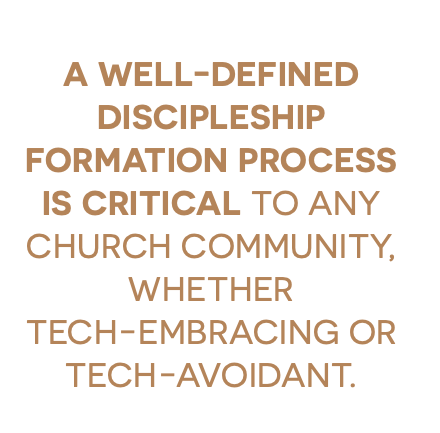
This gives us the first theological prong in our approach. What is a disciple? What is your community’s definition or profile of a disciple? Has your community thought and written out what it is you hope all who come in your doors, who participate and who teach and lead will become? These questions form the backbone of any loving faith community and its discipleship ministry. A well-defined discipleship formation process is critical to any church community, whether tech-embracing or tech-avoidant.
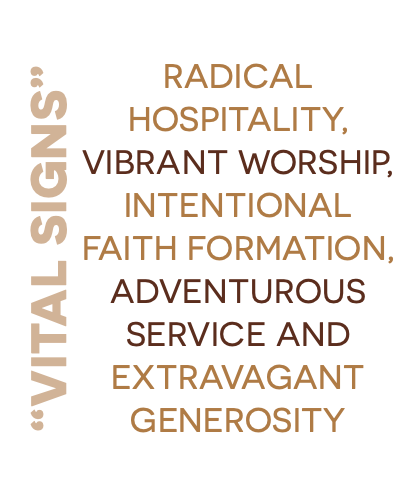
At the church I serve, we make use of five “vital signs” — measures of healthy and active disciples and community. They are: radical hospitality, vibrant worship, intentional faith formation, adventurous service and extravagant generosity. Each has roots in Scripture and tradition. Staff and leaders work to develop initiatives and ministries that exercise and strengthen these qualities. When the vital signs are balanced and strong, faith is renewed and challenged, disciples grow in service and stewardship and the church is able to love God and love neighbor well.
 What vital signs would you consider key to a healthy and mature disciple? When asked what those marks are, many refer to someone who is an active worship participant or someone who knows a lot about the Bible. That’s a start. But what does the word “active” mean for your community? Is that active as opposed to inactive or as opposed to passive? Inactivity may mean not attending often enough, whereas a passive worship participant may not sing, pray or respond and yet attends often. The two are not equivalent and necessitate different discipleship intercessions as part of a loving response.
How much Bible knowledge would you consider enough? I once witnessed a children’s ministry worker respond to a mother asking for additional Bible study material: “You can just Google something.” Yes, you could. But should you? Is any better than none? The congregation’s promises in baptism are about imparting our understanding of faith and biblical witness. A well-defined backbone of discipleship gives us insight into the theological response to such a question: We can do better than a search browser! You might refer them to a thoroughly reviewed company’s website, or the denomination’s publishing house, or a curriculum your own community has crafted. A denomination adds a distinctive and pertinent layer of its own history, theology and current context to your understanding of being a disciple. Yet no matter the denomination, we are all parts of the whole body of Christ: Each individual community expresses the marks uniquely. Praise God for the diversity! It makes your discipleship look different from that of the church down the street or another church in your denomination. It will even change over time as the Holy Spirit continues to work in and through your community to shape more disciples of Christ Jesus.
The church tech trinity
Creating this theological backbone of our model of discipleship and what a mature disciple of Jesus looks like lead us to engage the challenge of how to leverage technology as a developmental aid. This is the second prong: practical matters.
 We believe that disciples develop better together. For some, together means physically-shared space. For others, especially in this COVID-19 experience, together means being able to communicate in a relatively immediate way. The sense of connection and community are meaningful byproducts of time spent in a shared endeavor. I have never met Lynn and Philip; they live 17 hours away. But we have been friends for more than 15 years. In those years, we have shared milestones of careers, marriages and children all across technology. To this day I am grateful for their companionship (and the ketchup-flavored chips they sent one Christmas). Even after we stopped sharing our online gaming experience five years ago, our friendship has continued.
The shared endeavor of worship has embraced technology on a grander scale than we may realize or admit. A Bible, a bulletin, an audio system or screen — all technology. Many dismiss these as “tech” because they are familiar. Yes, it is a jump from bulletins to livestreaming services, but both involve what I term the church tech trinity: hardware, software and human wear and tear. Bulletins require computers and printers; streaming involves particular software and minimum upload speeds through your internet service provider. Bulletins and livestreaming cost money and contain definite human wear and tear costs. When considering any technology, which tools provide your community with the greatest potential for reaching out and growing disciples? Work to develop them! Which tools detract from reaching out and growing disciples? Work to let them go!
 It is helpful here to remember the commandment against coveting. You are commanded to let go of doing something just because the church down the street is doing it. Why do the disciples in your community need that particular technology? Many churches feel a call to be a neighbor to nursing homes and retirement communities. Churches with an active visitation ministry may choose to visit nursing homes and provide worship at the community itself. Other congregations may do well to invest in streaming or recording services for local retirement communities, shut-ins and those who physically cannot be in worship regularly. These are different ministries, and yet both seek to answer the call of Christ to love our neighbor.
Technology usage in your community helps strengthen the framework of mature disciple-making. If you determine that a type of technology will assist in discipleship development, it is part of your baptismal promise and responsibility to plan for the growth of that trinity of church tech. Hardware and software entail money and time to install and learn. The human piece requires vision and a growth mindset by those called to leadership in the church. Many churches rely on volunteers for long-term work in audio, visual and digital assets in a worship environment. Investing in the hardware and software for a good audio and visual system is necessary, but the people involved need to be developed as mature disciples who understand their work as ministry: mediating the worship experience for a community of faith in the presence of God.
If becoming a mature disciple means actively engaging in worship twice a month or more, then we may need to lean into technologies that create a worship experience that remains available to people even if they are not around. I have yet to read a story about a church that closed down because too many of its people were watching the services online. It is possible a streaming or recorded service would provide a way to create more resilient disciples who connect even when they cannot be physically present. How powerful it could be for someone who was strengthened by the worship or message to be able to watch it again! How could your worship’s digital footprint become an epistle for your own community of faith?
Your answers to these questions will be unique to your calling as a disciple. Starting with a clear understanding of how to develop more mature disciples will help your community make conscious choices that include technology. Called by Christ into a community of faith, we each bear a responsibility to all current and future disciples to lay out how the digital frontier can assist. It is a holy work, baptizing new disciples and teaching them everything that we have learned. How we teach must include all of the tools at our disposal. Which tools are at your community’s disposal? How are you called to use them for the spiritual maturity of your people?
And remember what Jesus told us at the end of Matthew 28: “I am with you always, to the end of the age.” We are embraced by our Savior in this holy work, so let us set about it with hope and joy!
 JON WOLF is pastor of digital engagement and faith formation at Holy Cross Lutheran Church in Overland Park, Kansas.