by Barbara G. Wheeler
On Easter Sunday 2020, in the National Cathedral – empty except for the requisite “fewer than 10” musicians and clergy – the Episcopal Bishop of Washington consecrated bread and wine, broke the host, and left it on the table, unconsumed and undistributed. Instead, she led the 18th-century prayer of St. Alphonsus:
My Jesus, I know that you are present in the Holy Sacrament.
I love You above all things, and I desire to receive You into my soul.
Since I cannot at this moment receive you sacramentally, come spiritually into my heart.
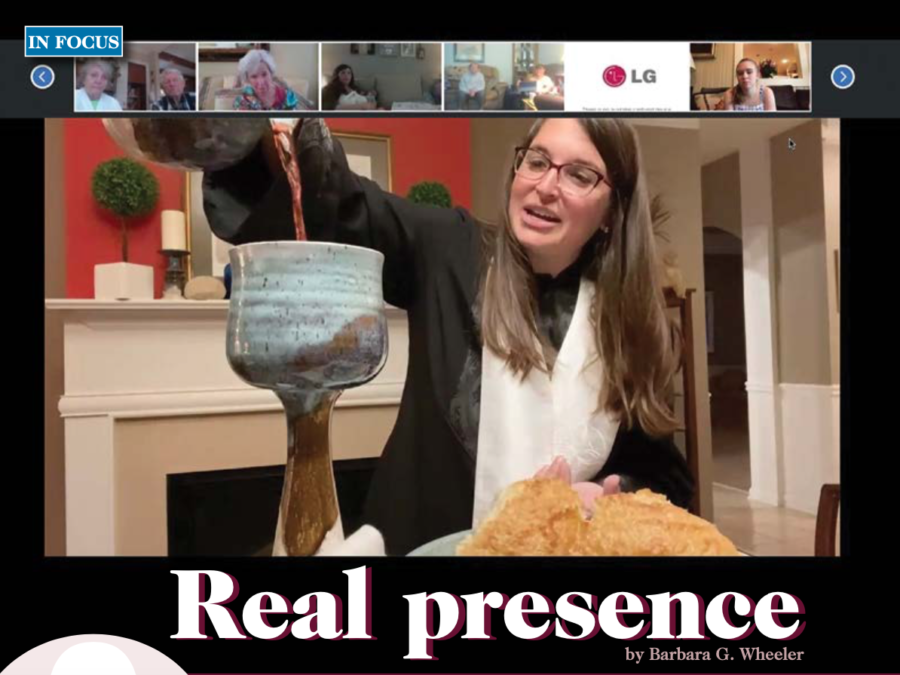
At the same time, on another YouTube channel, the pastor of the Church of the Covenant in Boston concluded the Easter service by lighting candles on a table containing an empty plate and cup and telling the Emmaus story. Then he invited members of the congregation to leave the livestream and rejoin each other on Zoom, where they “would have a chance to recognize the Tree of Life in a brand-new way, filling this cup and filling this plate as we see each other’s faces.”
 The Eucharist is central in Christian worship. On that most traditions agree. But as these simultaneous services illustrate, various communities and communions have very different convictions about “what we do when we ‘do this.’” For those who, like Washington Anglicans, stand in the Catholic tradition, the elements are the heart of the sacrament, substantially transformed into Christ’s body and blood by the special power given to his ordained delegates. If believers cannot commune physically, Christ is not sacramentally present to them.
For so-called free churches (Church of the Covenant has ties to the congregational United Church of Christ as well as the Presbyterian Church), the emphasis is on the gathered body of believers. Celebrating Communion reminds them that as Jesus in his death and resurrection has claimed them, they have claims on each other. The people, not the material consumed at Communion, are the body and blood of Christ. Eating and drinking together, present to each other, is what makes the moment transformative and (though they might not use the term) sacramental.
As Joe Small makes clear (see page 24), the Reformed view of Eucharist takes something from each of these disparate traditions. With free churches, we view Eucharist as “a communal event, not an act of private piety.” Most Presbyterian and Reformed Christians do not believe that the bread and wine are substantially transformed and would not accept the distinction between “sacramental” and “spiritual” communion. But with Episcopalians and many others, we strongly believe that nevertheless, in the taking, blessing, breaking and giving, Christ is really present. Those affirmations by themselves, however, do not tell us whether to celebrate the Lord’s Supper by the “virtual” means now available to us.
What makes the Eucharist communal?
For instance, it is not clear what makes a Eucharistic service communal. Small argues that embodied sacramental events require physical elements, such as wine, water and bread – “grains mixed together,” according to Calvin – as a sign of our unity in Christ. They also require “a full range of senses” and “the presence of other people.” Those criteria seem to add up to everyone and everything together, in one place at one time, as essential ingredients to the sacraments, without any artificial substitutes or separation.
 Consider, though, our practices before the pandemic. Many churches offered separate, gluten-free bread rather than one loaf with grains intertwined; some had wine and juice options rather than one cup. Almost all amplified the worship leaders and some made available hearing devices, which suggested that some people were not physically present enough to participate without mechanical help. At large services, communion was carried to people in the overflow room who viewed the proceedings on a screen and to nursery staff in the basement who did not view it at all. So how many walls of physical separation, how much artificial assistance in connecting, which variations in traditional sacramental materials disqualify a setting as communal? Perhaps we can at least agree that there are not two categories, together and apart. Instead there are degrees of separation in any celebration of the sacrament, but also closeness that transcends the limitations of the present to point to our communing, beyond time and space, with all the saints of God.
How is Christ present?
Even more important than these questions about our presence as celebrants and participants at the Lord’s Supper is the question of Christ’s presence in it. As Small and I have both said, Reformed Christians are not convinced that the material of the sacrament is mystically transformed into Christ’s physical body or that he is fully embodied in the human beings who gather to remember him. Yet we affirm his real presence. Reformed doctrine emphasizes the root meaning of the word Eucharist: giving thanks. We believe that Jesus Christ is known surely enough in the breaking of the bread that we are impelled, in Christopher Morse’s graceful phrase, to “thank God for loving all the world.”
Knowing and then preaching and teaching what is by the grace of God made known to us is pivotal in Reformed theology and church practice. Avery Dulles, in his careful catalog of various Christians’ models of the church, identifies the Reformed church as “herald,” because, he says, we “emphasize faith and proclamation over interpersonal relations and mystical communion.” In our parlance, the sacraments are “sealed to the Word.” This means, I think, not only that a Eucharistic service must include Scripture and sermon, but also that the sacrament must be celebrated in such a way that Jesus Christ, the living Word, is recognized. To that end, we invest heavily in the education and spiritual formation of ordained ministers, equipping them to proclaim Christ as powerfully as possible in word and in sacrament as well.
Responding in gratitude
Recognition of the real presence of the Lord at the table is necessary, but it is not enough. Unless we respond in gratitude, empowered to love the world for which Jesus gave his life, the sacrament of his sacrificial meal is not complete. Can virtual Communion be the occasion for that kind of transformation — hearts of stone becoming hearts of flesh, full of love of God and neighbor?
 Two weeks ago, a post circulated on the internet picturing an emergency room nurse at an urban hospital. Dressed in blue scrubs, she was taking a break in a supply closet to participate in a broadcast Communion service at her Lutheran church. The photos show her communing with a dinner roll and cranberry juice in a medicine cup. From her other posts on social media, one can learn that she has been married for five years and has a baby. She has a lot to live for, and yet she stepped out of that closet, after the sending that concludes the liturgy, to risk her life for others. Her most recent profile picture is overlaid with the words “I cannot stay home, I’m a nurse; We fight when others can’t anymore.”
I respect Joe Small’s penitential and hopeful Communion fast. It is deeply and fully Christian in a Reformed way, acknowledging not only that Christ has died but also that he is risen into the hiddenness of God. So, I think, is that nurse’s reverent reception of Communion – in a supply closet, watching a screen, drinking cranberry juice – Christian and Reformed. Grateful for Jesus really present in the sacrament, she finds the strength, in spite of the personal danger, to be really and selflessly present for her patients.
We rational Presbyterians like to settle matters, one way or the other. Perhaps, in the midst of this catastrophe, God is chastening our Reformed compulsion for certainty and order. Perhaps both Eucharistic practices, and others, are God’s will for the present, drawing us together in a kind of full communion that in more ordinary times we have not found the grace, or the gratitude, to achieve.
 Barbara G. Wheeler is the former president of Auburn Theological Seminary and founding director of its Center for the Study of Theological Education. She is an elder in the United Church of Granville, New York.
Read a different viewpoint from Joseph Small: What to we do when we “do this”?