While they were eating, he took a loaf of bread, and after blessing it he broke it, gave it to them, and said, “Take; this is my body.” Then he took a cup, and after giving thanks he gave it to them, and all of them drank from it. He said to them, “This is my blood of the covenant, which is poured out for many.” (Mark 14:22-24)
For I received from the Lord what I also handed on to you, that the Lord Jesus on the night when he was betrayed took a loaf of bread, and when he had given thanks, he broke it and said, “This is my body that is for you. Do this in remembrance of me.” In the same way he took the cup also, after supper, saying, “This cup is the new covenant in my blood. Do this, as often as you drink it, in remembrance of me.” For as often as you eat this bread and drink the cup, you proclaim the Lord’s death until he comes. (1 Corinthians 11:23-26)
The COVID-19 pandemic has led to the suspension of corporate worship in most of the United States and in many other parts of the world. In response, Christian congregations have provided livestreamed or recorded “virtual worship” from empty sanctuaries, encouraging persons to participate from home. Alone or with family we pray the prayers, sing the hymns, listen to Scripture and sermons, perhaps “chat” with others on the screen’s sidebar. For most this is a novel experience, while for some it is familiar. Yet for all of us, it seems to be a necessary and acceptable accommodation to the need for “sheltering in place” and maintaining “social distancing.” While few of us prefer online worship, it seems necessary and appropriate in these difficult times.
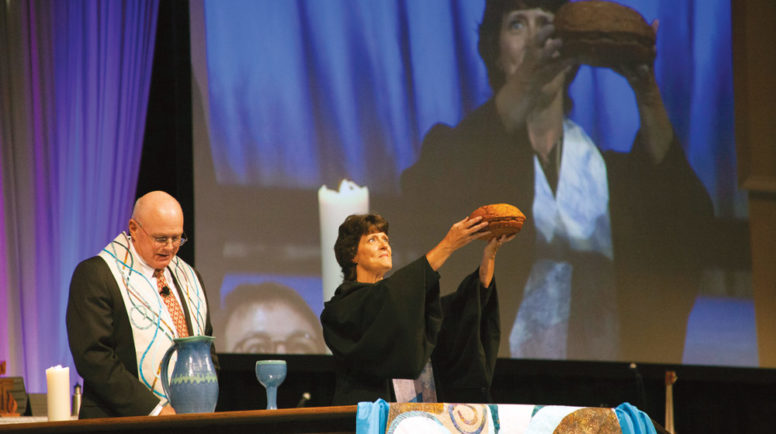
Except… what are we to do about the Eucharist? Will our congregation’s virtual worship (an odd way to put it) encourage virtual Eucharist (an even odder way of putting it)? Can we “do this” in separate places with our own bread? In the absence of wine or grape juice, can we substitute whatever beverage we find in our refrigerators? Are our improvised elements sacramentally consecrated/set apart from afar? We find it easy to hear online sermons, but can we commune online? Catholics and Orthodox say “no,” while Protestant responses are, predictably, all over the map.
 The question came into sharp focus on April 12, 2020 – Easter – the church’s preeminent feast day. In the early centuries of the church’s life, it was the annual responsibility of bishops to inform the church of the date of Easter to ensure that all congregations celebrated Christ’s resurrection on the same day. “Remember, dear friends,” wrote Bishop Athanasius, “that we are given this annual celebration of the Easter Feast by the God who established it in the first place. … For every year He brings us all together and unites us all in spirit, although we meet in many different places. We share everywhere the same prayers and the same grace in our common Feast.” But in 2020, congregations could not gather and could not share the feast with sister congregations. Is it possible for individuals and families, isolated “in many different places,” to share a “common feast”?
Athanasius’ Easter letters were not mere date-setting notices, but reflections on the meaning of Easter and the significance of the Great Feast. Our current eucharistic question on every Lord’s Day is not merely a matter of date or church law or individual preference. The prior question is, “What are we doing when we ‘do this,’ proclaiming the death of our risen Lord until he comes to us again?”
Paul’s transmission of the Lord’s Supper tradition in 1 Corinthians 11 is central because it is the earliest written expression of the church’s wide and deep eucharistic discernment. The pattern of the tradition Paul received and handed on is familiar: Jesus took bread, gave thanks and broke it. The Gospels’ supper tradition follows the same pattern: took, blessed or gave thanks, broke, gave to them (Matthew 26:26-29; Mark 14:22-25; Luke 22:14-23).
“Do this” lifts the church beyond a perpetual night of Jesus’ betrayal into the fullness of the life, death and resurrection of the Lord. The church’s eucharistic life coheres with the scriptural accounts of Jesus eating and drinking with sinners, for the risen Christ eats and drinks with sinners still. The eucharistic trajectory leads to hope in the heavenly banquet: “Blessed are those who are invited to the marriage supper of the Lamb” (Revelation 19:9).
From the beginning, the church has “done this,” but “this” is not merely calling to mind events from long ago and far away. Eucharistic re-membering [Greek anamnesis] is re-capitulating, living now in communion with Christ.
The cup of blessing that we bless, is it not communion [koinonia] in the blood of Christ? The bread that we break, is it not communion [koinonia] in the body of Christ? Because there is one bread, we who are many are one body, for we all partake of the one bread. (1 Corinthians 10:16-17)
Sixteenth-century Reformation disagreement about the nature of Christ’s presence in Holy Communion divided Protestant and Catholic, Lutheran and Reformed, Zwinglian and Calvinist, Anglican and Independent. Disputes centered on the relationship of Christ to eucharistic bread and wine: Transubstantiation? Consubstantiation? Spiritual presence? Symbolic presence? The disputes continue to this day, but apart from those who take bread and wine as mere symbols, most Christian churches affirm in one way or another Christ’s real presence in the Eucharist (and in baptism). We do not share bread and wine alone; we share in the life and sacrifice of the risen Christ here and now. John Calvin sets out a central aspect of Christ’s real presence in the sacrament:
“It has a special application to charity [love], which is above all recommended to us in this sacrament; for which reason it is called the bond of charity. For as the bread, which is there sanctified for the common use of all, is made of many grains so mixed together that one cannot be discerned from the other, so ought we to be united among ourselves in one indissoluble friendship. What is more: we all receive there the same body of Christ, in order that we be made members of it.”
 So, what do we do when we “do this”? We eat bread and drink wine in the real presence of Christ, in communion with him, and in love for one another. All references to the Eucharist in the Bible as well as in the central Reformed tradition assume that it is a communal event, not an act of private piety. The Presbyterian Church (U.S.A.) Directory for Worship stresses that even when the Lord’s Supper is celebrated with the sick and those isolated from public worship, it is to be an act of the whole church represented not only by the pastor but also by “one or more members” of the congregation (W-3.0410).
None of this settles the question of “virtual Eucharist,” when the congregation cannot gather together, however. In the PC(USA), virtual Eucharist is permissible, and so the decision becomes a matter of pastoral judgment exercised by the session. Easter day is behind us, but the season of Easter continues until Pentecost. Will sessions authorize weekly virtual Eucharist as long as in-person worship is suspended? On the first Sunday of every month? What of weekly Eucharist congregations?
The sacraments are embodied events that employ physical elements (bread, wine, water) and a full range of senses (sight, smell, hearing, touch, taste) and the presence of other people. Diminishing any of these elements constricts participation and tends to replace community with a collection of separated individuals. Could we imagine a virtual baptism in which a recorded pastor recites the liturgy and pours water into the font while parents at home then pour their own water over an infant’s head? Probably not, but if not, what would make a similar dynamic acceptable for the Eucharist?
Many congregations celebrated virtual Eucharist on Easter. Many sessions will continue to struggle with the issue. For myself, I will continue a Lenten fast. As a weekly communicant, I will hunger and thirst for bread and wine, body and blood, as I also hunger and thirst for the presence of my sisters and brothers together in worship.
The questions around virtual Eucharist bring to mind words from an old Joni Mitchell song: “You don’t know what you’ve got ’til it’s gone.” So, I yearn for grand earthly reunion with my congregation, together again, sharing Christ’s real presence in shared bread and wine. Until then, I will hunger and thirst.
 Joseph D. Small is adjunct faculty at the University of Dubuque Theological Seminary and Pittsburgh Theological Seminary, and church relations consultant to the Presbyterian Foundation. Prior to this, he served as director of the PC(USA) Office of Theology and Worship. He lives in Louisville, Kentucky.
Read a different viewpoint from Barbara Wheeler in “Real presence.”