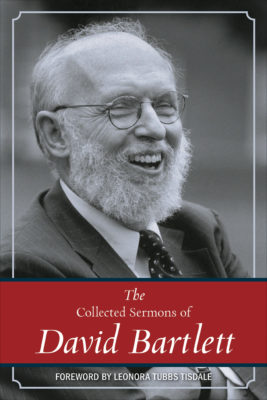
 David Bartlett (foreword by Leonora Tubbs Tisdale)
Westminster John Knox, 256 pages
At a commencement ceremony in Richmond, Virginia, I introduced myself to Jonah, David Bartlett’s son, adding, “I’ll bet I’m the only one here who heard your grandfather [Gene Bartlett] give the Beecher Lectures at Yale Divinity School.” Of course, David Bartlett also delivered the Beecher Lectures some four decades after his father, but he and I never met. However, I had used some of his writing in my own teaching, and knew that his voice was one to be trusted.
The most recent of these published sermons were preached either at Trinity Presbyterian Church in Atlanta, where David served as theologian in residence for several years while teaching at Columbia Seminary, or at The Congregational Church of New Canaan, Connecticut. Together these account for more than half of the 52 sermons. The last is one he preached at Yale Divinity School a few months before his death in 2017.
Since Bartlett’s Ph.D. was in New Testament, it is no surprise that he was committed to preaching from biblical texts. His sermons theologize. Bartlett approaches the text as one listening for a word from the Triune God, listening with his whole being, including his reading of the cultural moment. He brings with him the questions, anxieties and concerns born of our historical epoch as well as of events and issues commanding attention in the daily news, from Vietnam to Sandy Hook — the same sorts of things that congregations are likely to bring to their own listening. The result is that one may hear a word that is consistent with what listeners in other times and places have heard, while at the same time prophetically addressing today’s struggles and challenges. He manages to be relevant without attitude. Bartlett demonstrates the utter delight of being so fortunate as to be among those sharing that amazing and daunting calling in which one finds oneself positioned between the living, lively text and the cries of the moment.
The sermons cover the era between the 1970s and 2017, and, as would be the case if one were to examine the sermons of most preachers, he repeats some stories. One features Milton Mackaig, a member of the congregation in which David grew up. In the pre-civil rights era, an African American man had applied for membership in this American Baptist congregation. They voted not to accept him, with Mackaig in the forefront of the movement to reject. Some years later, after Bartlett’s father had been preaching there for several years, Mackaig had come to regret what he had done, and policy had changed. One Sunday, an African American member of the choir was mugged in the choir room. The next Sunday, as the choir processed, Mackaig appeared in a choir robe beside the man who had been roughed up. Milton couldn’t carry a tune, but he carried a changed heart. Mackaig’s story serves more than one text.
Bartlett’s sermons are not grouped by liturgical seasons or the lectionary. A Scripture index is useful for finding specific texts. Maybe best to read one or two sermons at a time, and, for those who preach, to be read with colleagues who might reflect together on form, theology, contextualization and homiletic strategy.
 Ronald P. Byars is professor emeritus of preaching and worship at Union Presbyterian Seminary in Richmond, Virginia.