
“By the rivers of Babylon, there we sat down and there we wept when we remembered Zion.” Oddly, perhaps, in the church of my youth I heard those words from Psalm 137 more often than any other Scripture. More than John 3:16, more than the Beatitudes, more than the Great Commission.
We were Associate Reformed Presbyterians, a southern splinter of the Presbyterian family, stubbornly Scottish in heritage and resolutely psalm-singers in worship. Our craggy Calvinist forebears had insisted that God wanted us to sing only from the Psalter, the Bible’s own songbook, so, while other Presbyterians embraced hymns and spiritual songs, we ARPs clung to exclusive psalmody until the middle of the 20th century. We sang all 150 psalms, but our cherished favorite was a melancholy choral arrangement of Psalm 137, a psalm of the Babylonian captivity. As the choir intoned dolefully, “How shall we sing the Lord’s song in a strange land?” our best soprano would raise her voice in a beautiful and at once mournful and defiant solo, “If I forget thee, O Jerusalem, let my right hand forget her cunning!”
I have been thinking often of that sorrowful old psalm in these days of sheltering-in-place. Like many others, I have participated vicariously in countless streaming worship services in which vested preachers accompanied by the organist and a corporal’s guard from the choir preach and sing into the gloom of empty sanctuaries, or casually dressed pastors lean across their kitchen tables to pray and to proclaim conversational homilies. It is touching, these faithful leaders keeping the candles lit and the liturgies going, making the most of a troubled time. But for all its bravery, worship in this time of pandemic still seems like hanging our harps on the willows in Babylon.
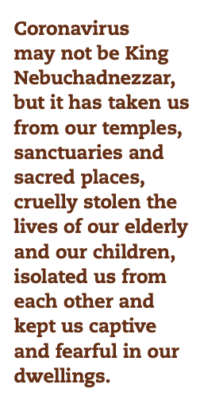
 An astute theological colleague objected the other day when I used the language of exile to refer to the church during this time of pandemic. As bad as COVID-19 is, he said, to compare our current experience with the decades of suffering and captivity in the exile trivializes that bitter history. I get his point, but I see parallels nonetheless. Coronavirus may not be King Nebuchadnezzar, but it has taken us from our temples, sanctuaries and sacred places, cruelly stolen the lives of our elderly and our children, isolated us from each other and kept us captive and fearful in our dwellings. “Let’s see if you can keep singing those songs of Zion, now,” it seems to sneer.
Curiously, some in the church have seen a silver lining in our predicament. For many congregations, worship attendance has actually increased online, in some cases exponentially. People are worshipping virtually who otherwise would stay at home on Sunday, sipping coffee and watching “Face the Nation.” Worship technicians have figured out innovative ways to use Zoom and the other technologies to make services more vibrant, spontaneous and interactive. Many have discovered the ability to parachute into services in California and Maine, Virginia and Iowa, all in a single morning, and to be thrilled and nurtured by the diversity of witness encountered there. In this crisis, they say, God has called us out of the old patterns of worship and into the new and creative. The toothpaste cannot be returned to the tube. We will never go back to what we were.
 Maybe, but like those captives singing their laments on the banks of Babylon’s rivers, even in exile as I lift my voice in praise and thanksgiving, I mourn for a lost Zion and yearn to be restored to the house of God. On Easter this year, the lectionary gave us a reading from the prophet Jeremiah (31:1-6). It was mostly overlooked (who preaches from the Old Testament on Easter?), but the prophet’s words were amazingly apt for our predicament. Jeremiah recalls the wanderings of Israel in the wilderness. Out there in the severe conditions of the wasteland, God did not abandon Israel. “I have loved you with an everlasting love; therefore I have continued my faithfulness to you.” Jeremiah assures us that God’s people “found grace in the wilderness,” but then he announces a glad promise. There is surely coming a time when “again you will take your tambourines and go forth in the dance of the merrymakers.” The watchman will cry out, the trumpet will sound and the time will have come when God’s people will say with joy, “Come let us go up to Zion, to the Lord our God.”
My tambourine is ready. I yearn to return to God’s house for worship, and I believe that one grace of our season of separation will be a heightened hunger for congregational worship, an underscoring of how gathering together for prayer and being present to and with one another, which we have often taken for granted, is a deep expression of the incarnate reality of the Christian life. Having practiced social distancing, we will have our eyes opened anew at just how tactile, physical and fully present Christian worship is.
Christian worship is far more than can be realized by watching other people speak and sing on a computer screen. It involves a coming together to perform once again the great drama of God’s grace, of how it is that we wayward sinners were gathered by the kindness of God into the redemption of all of creation. We were, after all, wandering in the wilderness, minding our own business, when suddenly the bush in front of us burst into flames (the call to worship). We fell to our knees in awestruck wonder (hymn of praise), only to realize that we needed to remove our shoes for we were standing on holy ground (confession). Having forgiven us, the Mystery gave us its name (“I am”) then spoke to our hearts (Scripture and sermon). We responded in grateful affirmation (creed) and gave all that we are (offering). The Mystery who is Christ took our little loaves and fishes, magnified them into a feast and invited us to table (the Lord’s Supper). Then Christ’s hand was placed on our heads and we were blessed and sent to be God’s people in the world (blessing and charge).
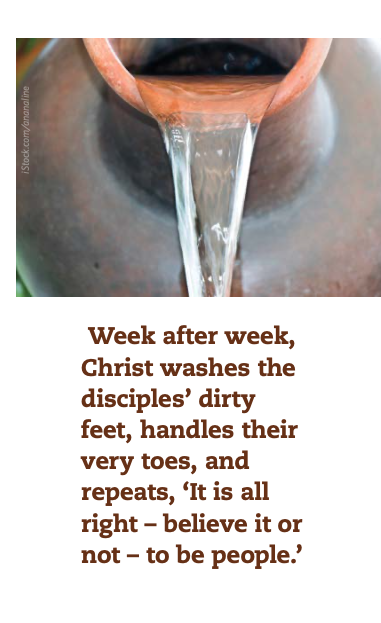 This is the drama we reenact week after week. It is an ancient play and, like “The Sound of Music,” it has both adults’ and children’s parts. All of God’s people, young and old, are needed, present and on stage. Sometimes we forget our lines, and none of us is very accomplished at performing it. But we gather nonetheless, greet each other with a gesture of peace, and the curtain goes up once again. As Annie Dillard wrote: “A high school stage play is more polished than this service we have been rehearsing since the year one. In two thousand years, we have not worked out the kinks. … Week after week, we witness the same miracle: that God, for reasons unfathomable, refrains from blowing our dancing bear act to smithereens. Week after week, Christ washes the disciples’ dirty feet, handles their very toes, and repeats, ‘It is all right – believe it or not – to be people.’ Who can believe it?”
In her profoundly Christian novel “Gilead,” Marilynne Robinson describes the physicality, the sacramentality, of Christian worship when she describes John Ames, an elderly minister, writing to his young son about the sermon he just preached. “Today was the Lord’s Supper,” he writes, “and I preached on Mark 14:22.” He goes on: “Normally I would not preach on the Words of Institution themselves when the sacrament is the most beautiful illustration of them there could be. … You may remember this, when almost everyone had left and the elements were still on the table and the candles were still burning, your mother brought you up the aisle and said, “You ought to give him some of that.” You’re too young, of course, but she was completely right. Body of Christ, broken for you. Blood of Christ, shed for you. Your solemn and beautiful child face lifted up to receive these mysteries at my hands.”
In his book “Reformed Sacramentality,” the late theologian Graham Hughes’ defines two kinds of sacramentality: disseminated and condensed. Disseminated sacramentality emphasizes the ways in which Jesus has torn down the veil between the sacred and the profane. At its best, this kind of sacramentality discloses how God’s glory shines in all creation and in the everyday. An oak tree changing colors in autumn mediates the holy as much as the Great Prayer, a sunset can be as holy as Philippians, a U2 song as sacred as “Old Hundredth,” washing dishes as spiritual as praying in a chapel. Condensed sacramentality, by contrast, locates holiness in specific places and things — this book, this bread, this water. Both forms of sacramentality are valid, Hughes argues. In fact, they need each other. Condensed sacramentality, left unfettered, can lead to magical thinking about altars, statues and prayer shawls, and disseminated sacramentality, left unchecked, can unwittingly participate in a secularized disenchantment of the world. If everything is holy, nothing is really holy.
 We Presbyterians, by and large, have huddled on the disseminated side of the ledger. Banned from our sanctuaries by the virus? No problem, we say. God is everywhere, and our TV rooms can be our temples, our backyard patios our cathedrals. We quite rightly affirm that all of life is holy — our work, our play, our relationships, art, music and literature. But sometimes our disseminated sacramentality leaves us theologically stunted, and I think that when the virus has run its course, we will gain a new appreciation for what a condensed sacramentality affirms.
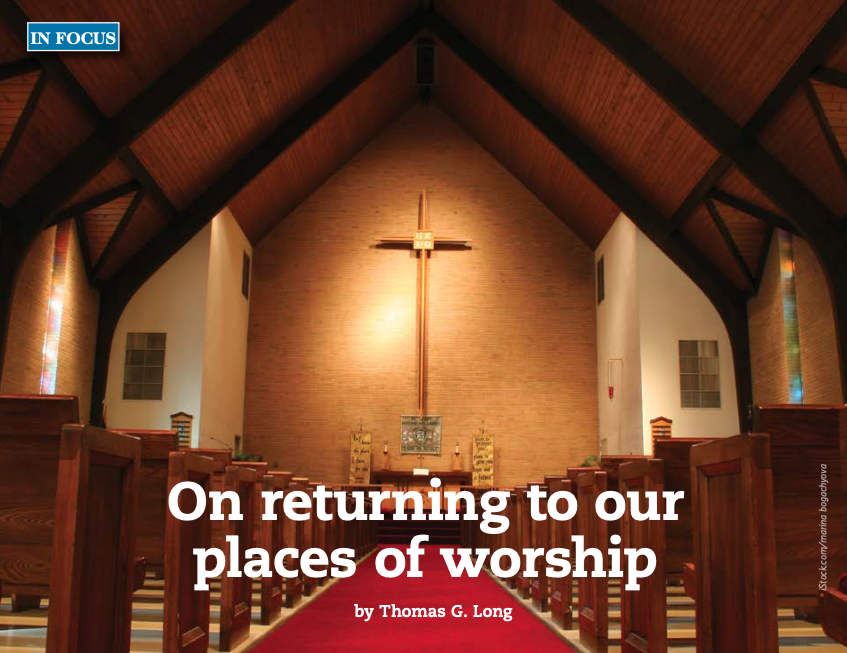
Take, for example, our official views of church buildings. We are eager to affirm, in the name of disseminated sacramentality, that the “church isn’t the building; it’s the people.” We are contemptuous of congregations that, for reasons of nostalgia or mistaken ecclesiology, “worship” their buildings. In reality, though, I have rarely met a Presbyterian who actually held wholeheartedly to this official view. Down deep, we know better. We cherish the places where we worship, not out of some misplaced wistfulness but because our sanctuaries are sacramental places. They are more than merely “nice spaces,” to use the jargon of house-hunting couples on HGTV. Spaces are empty, blank canvasses upon which I may impose my autonomous will. Our churches, by contrast, are places. People have prayed there. Vows have been made, the gospel has been heard, hymns have been sung, marriage promises have been spoken, funerals have been held, sins have been confessed and forgiven there. This place is the theater of God where God’s people have gathered to perform every week the great story of God’s redemption of all creation. Now if the building burns down or needs to be replaced, the church will continue and God will still be Emmanuel, but we will – and should – grieve the place we have lost.
This pandemic is a terrible evil, and it gives us no gifts. But we do have a God who walks with us and guides us, even in the valley of the shadow. Perhaps yet another worship gift God is giving us in this dark time is greater humility. In this virus we have glimpsed the true nature of evil. It is highly contagious and cares not whom it infects. Our sophisticated medical science does not know how to cure it. Our vast financial resources cannot abate its pain. It has shaken world economies, the ability of leaders to keep us safe, and our confidence in our own strength and abilities. It has even shone a harsh light on the broken and unjust places in our society.
Sometimes the worship of Presbyterian and other so-called “mainline” churches has been degraded by hubris. “We are wise and righteous people,” our prayers subtly imply. “Here is a list of some more righteous deeds to perform,” our pulpits sometime proclaim, as if the only thing standing between us and God’s kingdom is applying wisdom we already possess and performing righteous deeds we already intend to do. In his recent book “The Meaning of Protestant Theology,” Phillip Cary reminds us that the classic liturgies of the ancient church breathe a different air. They “give us Christ,” he writes, “not advice about how to live the Christian life. … They focus not on telling us what to do but on telling us what Christ does, thus directing attention away from our own works to Christ himself.”
Of course, when we have been given Christ, we rise and go out into the world to serve him. But in the face of an evil pandemic that has thwarted all efforts to domesticate and control, perhaps we will return to our sanctuaries on our knees, aware that we are beggars in need of Christ’s mercy and alert to and hungry for what former archbishop Rowan Williams names as the mark of good worship: something happened in this place today that no human being in the room has done.
 Thomas G. Long is the Bandy Professor Emeritus of Preaching at Candler School of Theology. He lives in Cambridge, Maryland.