One of the challenges for seminaries: how to prepare people for ministry that deals with contextual change.
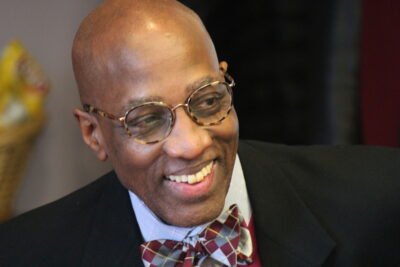
That was part of the message that J. Herbert Nelson, the stated clerk of the Presbyterian Church (U.S.A.), and Diane Moffett, president and executive director of the Presbyterian Mission Agency, brought Sept. 22 to the Committee on Theological Education, meeting virtually via Zoom.
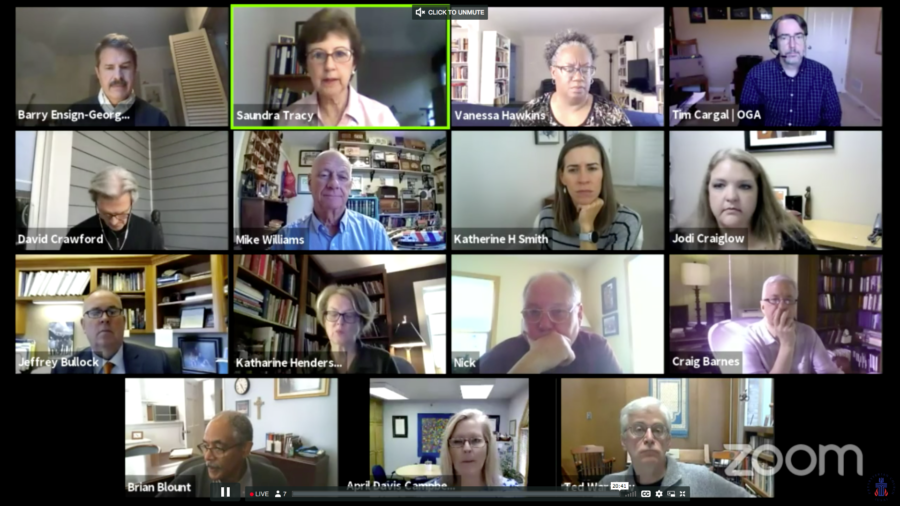
These denominational leaders told the committee, whose membership includes presidents of Presbyterian seminaries, that one of the biggest challenges is finding ways to prepare church leadership for a world in which change is a constant and in which many PC(USA) congregations – most of which are small, white and aging – don’t reflect the demographics around them.
“We are too insular,” Nelson said of the church. And “the biggest struggle we have in the denomination right now is with classism” – with congregations that are not looking for “who God sends to us and calls us to” – the full diversity of humanity, including immigrants and poor people, but to potential church members who have the resources to pay the bills.
“How do we teach adaptive change to congregations?” Nelson asked.
“How do we climb off of this high mountain and be with the people?”
As a young pastor in Greensboro, North Carolina, it was leaders of the labor movement who pushed him into working on issues of poverty, threatening a boycott of a business over its treatment of workers, Nelson said.
“How to we catch up to a generational culture that’s running fast,” and learn from it “what they understand church to be?” he asked. Recently he watched as a news reporter interviewed a young woman in Washington, D.C., who showed the marks on her skin from being hit by two rubber bullets in a protest this summer — and who continued to march.
“How do we teach today and not mention Black Lives Matter?” — or immigration or the politics of the presidential election, Nelson asked.
With the impact of COVID-19 and declining revenues, the PC(USA) at the national level is having to cut back, to rethink what it means to do ministry and what the denomination needs to give up, Nelson said. “Institutionally, we have been this big unwieldy thing that takes up a lot of room. We do good things, don’t get me wrong,” but there needs to be a revision of the idea that “bigger is better, and the more we do, the better we are. … We are having to really reconstruct our institutions around the changing of the United States of America and the world.”
Some complain that the PC(USA) is too political. But Moffett said that through the Presbyterian Mission Agency’s Matthew 25 vision, “we are certainly going to embrace the politics of Jesus. … The center of ministry is at the edges and on the margins,” at the borders.
With that, teaching practical theology becomes especially significant, Moffett said — with seminaries preparing church leaders to be entrepreneurs, public theologians and community organizers. Some say “you’re so political,” but a church that follows Jesus needs to be concerned about poverty, marginalization and oppression, she said.
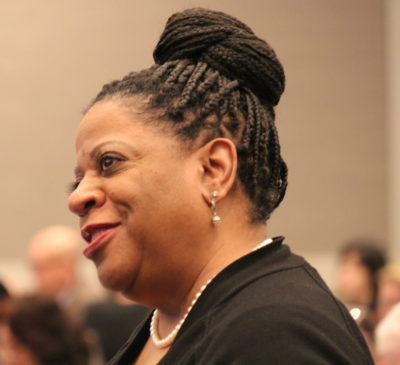
The PC(USA) is still 90% white, Moffett said. “What does that say about us as a church?”
Katharine Rhodes Henderson, the president of Auburn Seminary, spoke of the idea of a church that “lives at the edge of movements, justice movements.” And Nelson said he sees a “movement culture” in every aspect of American politics today. Jesus was an organizer, not a pastor, Nelson said. “He was always in the places that nobody else wanted to go.”
Brian Blount, the president of Union Presbyterian Seminary, said that while both Nelson and Moffett – top leaders in the PC(USA) – are Black, Presbyterian congregations are mostly white. He spoke of disparities: that seminary students and graduates see the need to lead the church in new ways, but “feel that push against reformation and reforming” out in the congregations. “There’s something happening at one level” – the General Assembly and national church leadership – “that’s not happening across the church itself,” Blount said. “How do we address that kind of conundrum?”
With the dual pandemics of COVID-19 and racism, it’s critical for the church to speak to these issues, Moffett said – and Nelson added the polarization in politics as well. She said the Presbyterian Mission Agency, in partnership with Stony Point Center and Johnson C. Smith Theological Seminary, is offering online courses on addressing matters of race and poverty, and how to do community organizing. In many congregations, “they want to be able to do it. They don’t know how to do it,” she said.
Seminaries provide church leaders the biblical and theological foundation for why churches should deal with issues of justice — even when some see that as divisive. “We’ve got to frame this out of our faith,” Moffett said.
As a Black woman with a double consciousness, Moffett said she’s always known that the Black church was prophetic “because we had no choice.” Today’s church leaders need to push the church to get into “good trouble,” as the late congressman John Lewis put it, instead of seeing the church primarily as “a place of comfort.”
That’s what the church is called to do, Moffett said. “But it’s not easy.”
In many congregations, “people are really super-hungry for some framework through which they can process what’s happening today,” said Paul Roberts, president of Johnson C. Smith Seminary. Presbyterians are waking up to the fact that “we have been living in a bubble, and it will no longer suffice to live in a bubble.” By thinking creatively, seminaries can provide training that connects theology and community organizing — including for people who may not want to become ministers, but can provide significant church leadership.
Some of those who attend PC(USA) seminaries don’t intend to become parish pastors. Many aren’t Presbyterian. “We have to shift the mentality of what theological education means in an inclusive setting,” Nelson said.
“We’re all in the space of unknowing,” Henderson said, “which can be a very scary and fruitful place.”