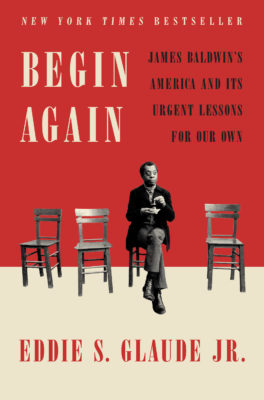
 Eddie S. Glaude Jr.
Crown, 272 pages
When Abraham Lincoln signed the Emancipation Proclamation, it must have seemed to many abolitionists that their work was done. When the post-Civil War constitutional amendments became law, those with hopes for political and social rights for former slaves may have thought that theirs was done. But soon came lynchings, the KKK, Jim Crow, voter suppression and the virtual replacement of slavery with something remarkably like it. Retrospectively, it can seem as though every movement toward racial justice is followed by a complacency that leaves the status quo undisturbed. Eddie Glaude, who teaches at Princeton University, reflects on the ways that new beginnings have typically fizzled out, borrowing Walt Whitman’s use of the label “after times.”
When discussions of race come up in churches, there’s often a participant confident that race is a non-issue in the 21st century. After all, we have civil rights acts from the 1960s — and people of all races can vote, eat wherever they want, lodge wherever it suits them and marry outside their race. And, in 2008 we elected a Black president, didn’t we? And, we have a Martin Luther King Blvd. and a King holiday, don’t we? So, why a “Black Lives Matter” movement?
Glaude tells a story using quotations from the writer James Baldwin at various stages of Baldwin’s life. Baldwin had tried living abroad — in Paris for a time, then Istanbul. He insisted that it was when he was outside the U.S. “that he came to understand the country more fully.” And yet, he always returned home. Heartened by the civil rights movement, he was disheartened by the deaths of Medgar Evers, Malcolm X and, of course, Martin Luther King Jr. As though these deaths were not sufficient to mark the end of an awakening, the election of Ronald Reagan in 1980 signaled to him the onset of another of the “after times.” Reagan, seeking to appeal to the formerly solidly Democratic South, began his campaign at the Neshoba County Fair in Mississippi, near where civil rights workers had been murdered. The message was clear. The whistle was being blown on the 20th century freedom struggle. “After times.”
Fast forward: Barack Obama was elected in 2008 and 2012. Then, Donald J. Trump. “After times”? What proves consistent over time is inconsistency. For a bright moment or two, it seems that people “get it.” Then, we forget it. A law passed. A landmark reached. Everything’s all right now, isn’t it? White lives have always mattered, no question. But when events require the insistent reminder that Black lives really do matter too, people in high places see “terrorists” rioting in the streets. Send in the troops! “After times.”
James Baldwin died in 1987. He knew neither Obama nor Trump, but he knew how the rhythm of history goes. And yet, Glaude writes, “Baldwin never gave up on the possibility that all of us could be better.” He “never relinquished the idea of the New or Heavenly Jerusalem found in the book of Ezekiel and the book of Revelation.”
Glaude reminds us that “in the end we cannot hide from each other. … We have to run toward the trouble that makes us afraid of life. We have to choose life, Baldwin repeatedly said.”
True. But choosing doesn’t end when the news cycle does.
 Ronald P. Byars is professor emeritus of preaching and worship at Union Presbyterian Seminary in Richmond, Virginia.