 During a series of Presbyterian Church (U.S.A.) meetings that have taken place in recent weeks, some questions have surfaced over and over.
With General Assembly held virtually this year because of the COVID-19 pandemic, what will – and should – happen in 2022?
With the pandemic reducing the funds available for both the national levels of the denomination and for local congregations, what can be done to cushion the blow and encourage Presbyterians to give?
And whose voices are not at the church decision-making tables that need to be heard?
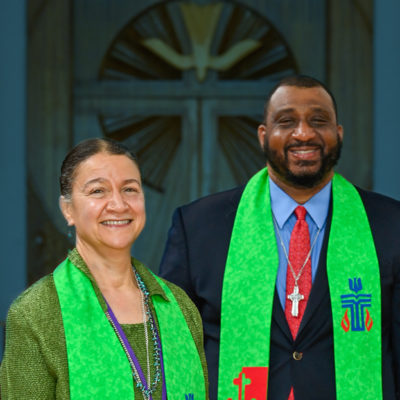
On Oct. 15, the board of the PC(USA), A Corporation, the corporate expression of the denomination, began its two-day virtual fall meeting. That included a 45-minute conversation with the co-moderators of the 2020 General Assembly, Elona Street-Stewart and Gregory Bentley.
The co-moderators said they had just announced a new book study – asking Presbyterians to study together Edgar Villanueva’s book “Decolonizing Wealth: Indigenous Wisdom to Heal Divides and Restore Balance.”
They’re also holding a new Facebook Live program called “Good Medicine” – with the first session held Oct. 14 and the next one scheduled for Nov. 11 at 2 p.m. Eastern.
A Corporation board member Cynthia Campbell asked about the shape of the 2022 General Assembly, saying that “I get it about saving money” — there have been some indications in discussions of the Committee on the Office of the General Assembly (COGA) that the traditional model of holding a week-long, in-person assembly may be too costly going forward and that it may be time to consider new models, including possibly some sort of hybrid approach. COGA has work teams considering that and other issues and is expected to make recommendations about the shape of the next assembly by the end of this year.
“I’m very concerned that we not too quickly move away from the value of in-person engagement as a denomination in gathering together,” Campbell said — saying that an in-person assembly provides valuable opportunities to build relationships in a connectional church.
Bentley said the PC(USA) needs to ask: “What is the business of the assembly, and how can we be effective? … Is there something more we can get out of it,” beyond voting on overtures and other business?
And this is the time, Street-Stewart said, to look carefully at inclusion. “We’re in a time of reckoning about what’s really been just and equitable” about decision-making structures in the church, she said. While building relationships is “a part of seeing the General Assembly as a homecoming … in the midst of that there have been people who have been overlooked, and histories that have been overlooked.”
While BIPOC (Black, Indigenous and people of color) are part of the assembly, they “may not be there as creators and innovators,” or providing evaluations and executive leadership, she said. Is the money spent on General Assembly being used in a way “to be a witness to the world that we are committed to justice and equitable access?”
And questions of diversity need to be considered broadly, Street-Stewart said. “We need to make sure we’re looking cross-generationally as well,” and at the role of advisory delegates.
A Corporation board member Joyce Rarumangkay said she has long been a member of an Indonesian fellowship in Maryland — and said immigrants sometimes are excluded from certain types of service in the PC(USA) if their fellowships are not formally chartered congregations. The Racial Equity Advocacy Committee submitted a proposal to the 2020 General Assembly seeking to develop new rules for chartering immigrant fellowships, worshipping communities and new church developments, and a proposed amendment to the PC(USA) constitution to allow pastors of immigrant fellowships to become members of presbyteries.
Because the 2020 General Assembly was held online and curtailed its business, it referred both those matters to the 2022 General Assembly.
Street-Stewart said “we have been addressing these issues for decades” – the role of immigrant fellowships in the PC(USA) – and that the contributions immigrants make in serving the church in those settings need to be respected, rather than limiting their ability to serve the broader church.
“You’ve been part of a long-term fellowship,” she told Rarumangkay. “Does that not demonstrate a faithfulness?” Could the rules be changed so that Presbyterians serving immigrant fellowships or new worshipping communities have voice and vote to serve the broader church? “Perhaps this is the time we need to bring some reconciliation into the process,” Street-Stewart said.
The question is “are they adding value to the PC(USA)?” Bentley said. Look at “what’s right in front of us.”
Those questions of inclusion also are important – especially in a time of tight budgets – as the PC(USA) considers the resources given for translation and simultaneous interpretation services, Street-Stewart said.
When she served on an urban school board in Minnesota, materials were routinely provided in a range of languages, including Somali, Karen, Spanish, Hmong, Ojibwe and Dakota, she said, and information was provided verbally for parents who were not literate. “Our public municipal entities often have already stepped way ahead of the church,” she said. “There are learnings we’re all going to have to get better acquainted with.”
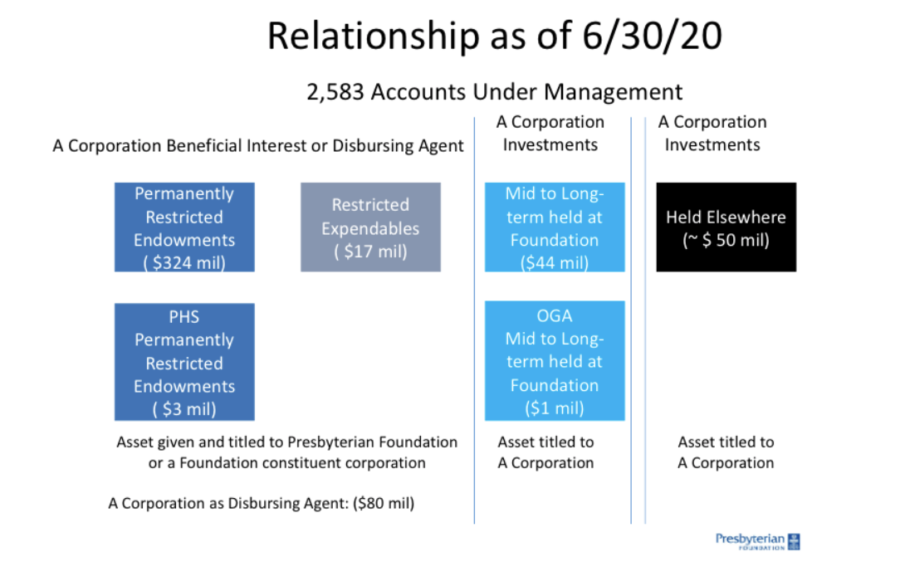
The board also discussed financial realities — hearing an in-depth report from representatives of the Presbyterian Foundation (A.205 Presbyterian Foundation) on the performance of assets held by the Foundation, through August 31. “The markets have continued to recover from the March lows,” said Anita Clemons, the Foundation’s vice president for investment.
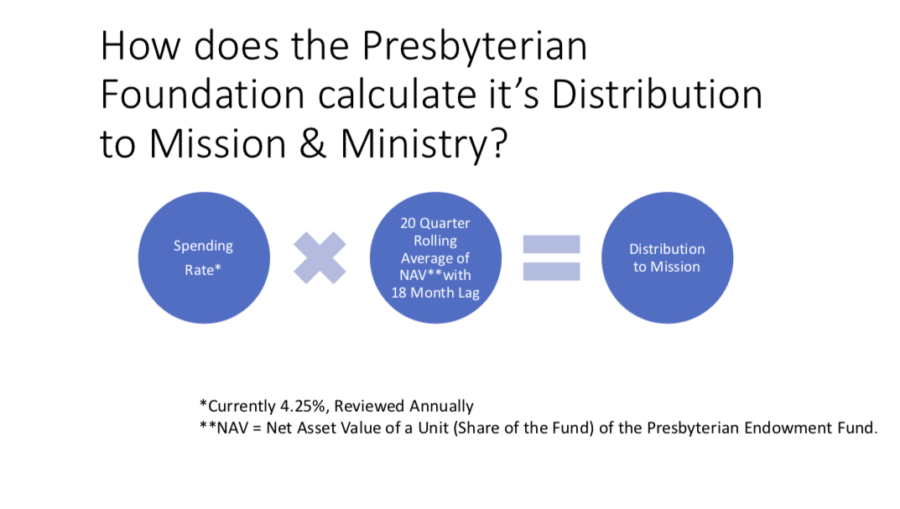
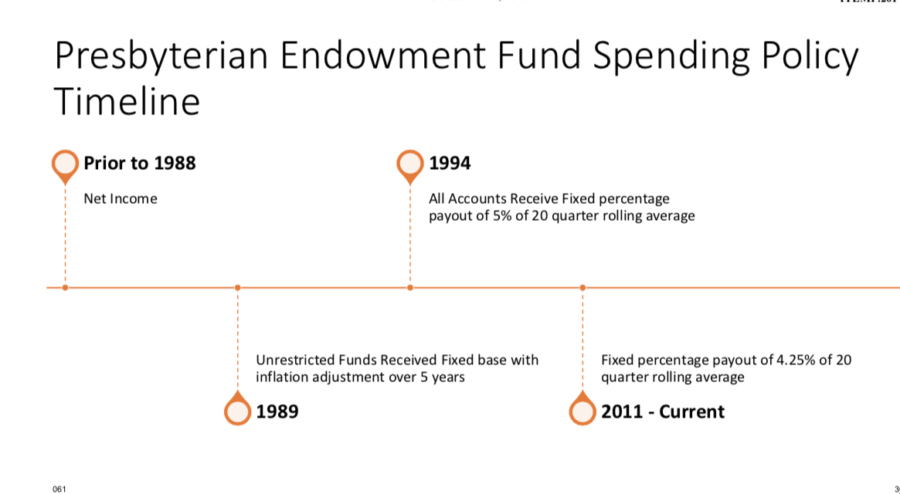
The Foundation sets a spending formula to determine how much money to draw from the investments to support the Presbyterian Mission Agency and the A Corporation — currently, a fixed percentage payout of 4.25% of a 20-quarter rolling average. Using a 20-quarter rolling average provides some “smoothing,” Clemons said — allowing more consistency in budgeting and cushioning the impact of short-term market highs and lows.
Because of that lag, the Presbyterian Mission Agency knows the distributions it will receive from the Foundation in 2021 and 2022, Clemons said. The distribution for 2023 won’t be set until June 2021, she said.
Board co-chair Bill Teng asked about how PC(USA) leaders are communicating to people in the pews the financial needs of the national church.
Street-Stewart said she’s keeping in mind the realities that many families are trying to absorb the economic impact of the COVID-19 pandemic, and communities are facing spikes in coronavirus infections. It’s important, she said, to make it clear how donations would be spent and to involve people from local congregations and mid councils in sharing stories of the good work the PC(USA) is doing — where Presbyterians “have become good medicine in the world.”
Street-Stewart said both she and Bentley came from marginalized families – “we’ve got grandmothers who made a way out of no way,” but still were committed to supporting the church. “Let’s really talk about our faithfulness” — how Presbyterians have stepped up financially even in hard times.
This is a time for leadership, Bentley said; to dwell not on what the PC(USA) has lost but where it is going; to “trust God and get through it.”
Following a closed session, the A Corporation board announced that it had:
- Approved unspecified reductions in the budget of the Administrative Services Group, which provides administrative services to the Presbyterian Mission Agency and the Office of the General Assembly, of $1.5 million in 2021 and $1.1 million in 2022.
- Determined that the staff of the Administrative Services Group would not receive raises in 2021. The Presbyterian Mission Agency Board announced last week that there would be no salary increases for the Presbyterian Mission Agency staff next year either.
Those financial decisions are being made in light of the economic impact the pandemic is having on PC(USA) finances. Revenue for the national church is expected to drop by 25%, or $9.1 million, by the end of this year.