 Frederick Christian Bauerschmidt
Eerdmans, 152 pages
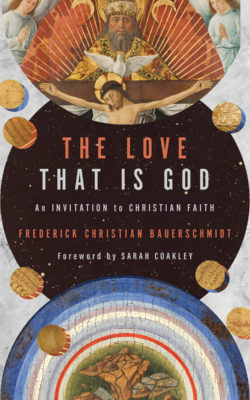
It is not uncommon for someone to ask a pastor for a book that will describe the Christian faith in a compelling manner. The answer for such a request varies, and many pastors stumble for the right one. “The Love That Is God” grew out of such a request. The author offered a sermon that laid out the Christian faith in five beautifully written movements focused on John’s assertion that God is love. In response, a parishioner asked to share that sermon with one considering Christianity. (The sermon is included as the epilogue.)
Frederick Christian Bauerschmidt acknowledges that being a Christian is difficult – always – because the heart of the faith proclaims what is astonishing: God is Love and this Love is crucified so that all humanity may experience the fullness of life. It’s a shocking proclamation, yet no one in recent times has written a more compelling case for its truth than Bauerschmidt. “This book,” he says, “attempts to make the case that the difficulties are worth it. … Because the fundamental affirmations of Christianity can be a source of love and joy and meaning, even amid the difficulty.”
Bauerschmidt has an eloquence that will remind some of “Mere Christianity” by C.S. Lewis or Rowan Williams’ book “Being Christian.” One might be skeptical of any book about love given how the word has been tarnished nearly beyond recognition. Yet, strangely, love has an enduring appeal that defies all attempts to remove it from human longing — and that may be the beauty of this book that unflinchingly claims that the source of all love is God. Moreover, this love is crucified. Bauerschmidt has a way of weaving seamlessly Paul, Julian of Norwich, Saint Augustine, Chaucer, Aristotle, Martin Luther King Jr., Dorothy Day and more into his vision. With magnetic power, he draws you into his description. He asserts that the Love that is God is indeed the source of all creation, as shares its compelling eternal purpose: the presence of love in all of humanity. But what kind of love? “Jesus is the God who is love running out to meet us wayward wasters who have squandered the divine gift of our existence. The question is, why does this love that is God take the form of the cross when it shows itself to us?” He then moves to render the answer in the very way that Jesus lives.
Along the way, Bauerschmidt, an academic theologian and a deacon who draws heavily upon Julian of Norwich, displays his pastoral warmth with a particular interest in those who are religious “nones.” I’ve not read a more compelling answer to those who argue for spirituality while rejecting religion. He is a good listener, refraining from judgment on those who question the audacious claims of Christianity. He admits the failures and flaws of its practitioners and of the church. Nevertheless, what shines forth brightly is his vision of the Love that is God.
At the conclusion of the book, I was so encouraged that I wanted it to continue. I realized that the sum of the Christian faith from creation to mission to eschatology, including the communion of the Saints, had been beautifully laid before me. Stanley Hauerwas said this book is bound to be a classic. I agree. When someone asks me for an introduction to the Christian faith, without hesitation I will give them this book.
 Roy W. Howard lives in North Potomac, Maryland. He is a coach and consultant with Kairos Coaching, dean of the Academy of Artful Leadership and the book editor of the Presbyterian Outlook.