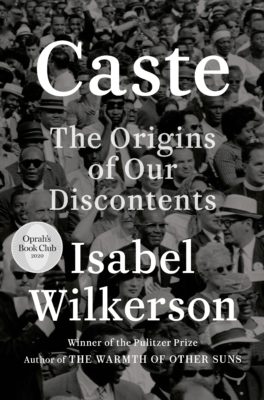
 Isabel Wilkerson
Random House, 496 pages
Isabel Wilkerson explains “systemic.” “Systemic” racism isn’t a blanket accusation against non-Black people. Rather, it encompasses presumptions, attitudes and practices developed to serve the interests of slaveholders before we were born and, subtly updated, continue to distort the way we interpret the world. Unless drawn to our attention, we neither see it nor recognize the role it plays in our lives.
Few of us think of ourselves as racist. We would never treat another person rudely, whatever their race; we try not to use or even think offensive language; and insist that all people are equal. But racism exists, nevertheless, and affects us all, even those who mean well.
One way to awaken to systemwide blind spots is to identify similarities in a different culture. Wilkerson has found a parallel of sorts in the caste system. In Hinduism, one is born into a particular caste that absolutely determines one’s status and role forever. Caste originated as an unfolding of the law of karma. Whatever score the universe gave you after the last life determines how you end up in the next. It has nothing to do with intellect, ambition or efforts. The status is unchangeable, a working out of divine justice that must not be tampered with for fear of making it worse in the next incarnation. In India, the Dalit caste (formerly “untouchables”) is the lowest, and they are destined to do the dirtiest work. Wilkerson sees Black people as the Americanized version of Dalits, condemned not by the logic of karma, but, ostensibly, by the curse of Ham (Genesis 9:20-27).
The colonial powers in India legally abolished the caste system in 1843. Nevertheless, law or not, elements of it persist. Wilkerson writes about attending a presentation by an Indian scholar, a Dalit. While Wilkerson was in conversation with him after his talk, they were approached by an Indian woman of higher caste who, without introduction, simply interrupted the conversation and began making suggestions to the presenter about how he could have improved his lecture.
The sense of caste status doesn’t just disappear after laws have been changed. It persists and affects behavior even of those with enlightened intentions — thus “systemic.” Perceptions of African Americans were formed under conditions of slavery and modified to conform to post-emancipation circumstances. We have civil rights laws, but tradition-sanctioned expectations still exert their effect, even though few would approve them under scrutiny. Black, in our society, has meant inferior, subordinate, dangerous — an “otherness” that shapes relationships and destinies.
Wilkerson offers Nazi Germany as a dramatic example of systemic racism. Hitler consigned Jewish people to an underclass. In fact, the role and treatment of African Americans served as a model and encouragement for Nazi racial theories. In South Africa, similarly, a more subtly graded system distinguished gradations between Black, “colored” and white. Designating some people as lower status can serve to reassure those who are insecure about their own standing.
One who is white is not likely to be conscious of any racial privilege, taking commonplace advantages for granted: not afraid of the police, not worried about meeting face to face for a job interview, not expecting to be followed while shopping and generally presuming that you will be treated fairly most of the time and be personally offended when you’re not. For people of color, life is experienced differently — not necessarily because of individual malice, but because people of goodwill are not aware of how our sensibilities have been shaped by presumptions of which we are not even aware: “systemic.”
“Look, the tears of the oppressed — with no one to comfort them” (Ecclesiastes 4:1b).
 Ronald P. Byars is professor emeritus of preaching and worship at Union Presbyterian Seminary in Richmond, Virginia.