
How do we listen to one another in a fractured world? Our society is polarized by increasing partisanship. According to the Pew Research Center, the gulf between the aisles is widening and opinions of the “other side” are souring. We see it in conflicts on the streets, read it in the news, hear it online and feel it in congregations.
Some days, social media seems to only amplify the noise. Discourse can give way to grandstanding and scattershot broadcasting, but there is an alternative use for social media that allows us to connect more deeply, serve authentically and do so with less stress and doubt: social listening.
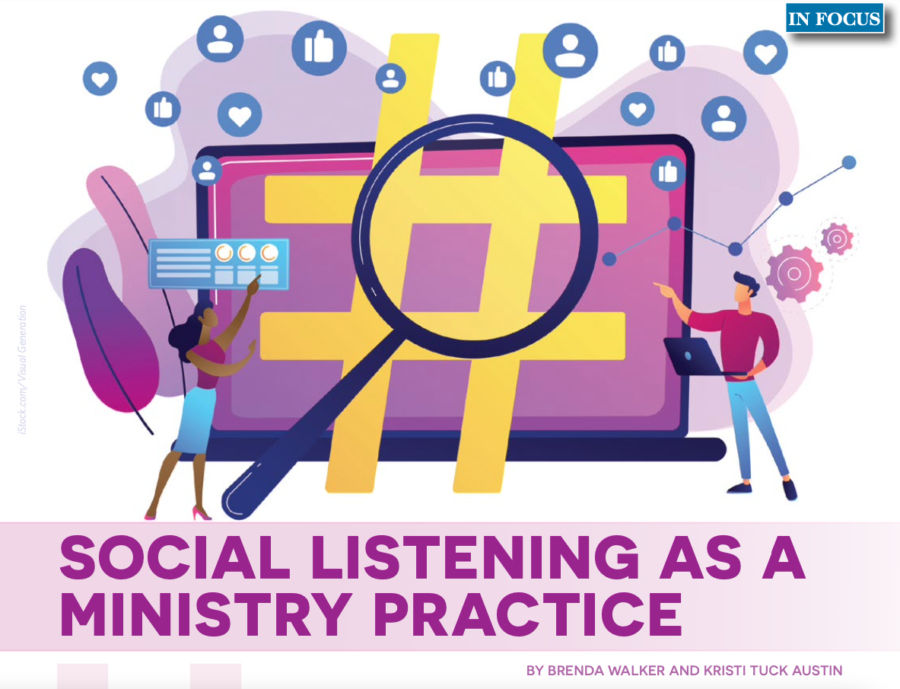
Social listening is a practice that requires us to quietly, humbly observe conversations happening on social media that are relevant to our ministries, learn from them, then chart actions that serve the needs we’ve heard expressed. We know that healthy relationships require listening; yet we can forget the same is true for online communications. On social media, as in life, it’s important to listen more than we speak.
What is social listening?
Social listening is a concept familiar to marketers and brand managers. In ministry it takes on a different tone and becomes an essential way to meet the needs of people with compassion and insight. It is an analysis of the population we are called to serve, including what they care about and what they need, by identifying which social media platforms they use and listening to their concerns. Social listening leads to action as it gives us the opportunity to respond in a manner that is caring and relevant.
Why is it essential for ministry today?
Kelley Connelly began a new call in July 2020, in the midst of the pandemic, as campus minister for UKirk at Virginia Commonwealth University in Richmond, Virginia. Because of COVID-19, she was prohibited from in-person visits to campus. The virtual world then became the context for her ministry. She responded by pinpointing the primary social media platform used by her students and creating a strategy for the campus ministry presence there.
How do we engage in social listening?
This article covers how to develop your social listening plan, implement it effectively and manage it efficiently using free tools that will save time for church staff and volunteers.
Here are six steps toward creating your ministry’s social media strategy.
1. Begin by asking the right questions.
Three simple questions will guide you to a plan that meets the needs of your congregation and locale. Take the time to commit your lists to paper and review them annually.
Who are the people you serve?
Take a moment to contemplate your ministry, your mission and the individuals you encounter in your church and community. Consider the individuals who make up your congregation by thinking in terms of faces and names, not broad strokes and generalizations. Pull out your church directory and move beyond the first congregants who come to mind.
Next, write down the areas and wider communities you serve, such as the geographic area around your church and neighborhoods in your city. Are you in a rural area where many people are involved in agriculture? Or, are you an urban congregation of young office workers? Do those you serve enjoy the blessings and challenges of retirement? What is the demographic and economic makeup of your community as well as your congregation?
Then, list the groups your church supports. Do you host AA meetings, Scout troops or grief support groups? Does your church have a weekday school or other forms of childcare? What programming do you provide for children, teens, singles and older adults? Do you aspire to become more welcoming for LGBTQ+ people and their families? What other ministries are active in the church?
In addition, take a few minutes to scroll through your followers on each social media channel used by you or the church. Also note who has interacted with your posts by commenting, liking or sharing.
Who serves the same people you do?
Thankfully, we are not in ministry alone. Write down other churches in your area, partner congregations, schools, community groups, publications, support organizations and nonprofits, local chapters and national groups — anyone who supports the people you listed in the first exercise. For example, Trinity Presbyterian Church in Herndon, Virginia, where Stephen Smith-Cobbs is a co-pastor, partners in ministry with the local food bank, a nearby elementary school, Virginians Organized for Interfaith Community Engagement (VOICE) and organizations that assist the Latino community; therefore, the pastors, along with social media-savvy members of the congregation’s service and mission team, pay attention to posts from these partner organizations.
From the list you create, note which voices, messages and resources you want to amplify. If creating posts feels intimidating or time consuming, try curating information tailored to your audience. Sharing within your ministry circle allows you to increase the benefits for those you serve, support the good work of others and accomplish more in the limited time you have.
 Where do the people you serve congregate online and post publicly?
Each social channel was created for a specific purpose and appeals to different groups based on the users’ goals. Perhaps it goes without saying, but youth and retirees will be less likely to be on LinkedIn, while statistically, a majority of young people in America use YouTube. You’ll want to spend your time where the people in your first two lists congregate. At VCU, Connelly found that college students preferred Instagram, so she focused her ministry there.
If you don’t know where to begin, review the Pew Research Center’s statistics on social media usage in America, a free report published on their website annually. Then review many channels to see who is using them, when and how. Check organizations’ websites to see what social media profiles they list.
In addition to social media timelines, people gather in niche collectives called groups — spaces within social platforms, such as Facebook and LinkedIn, where people can discuss a shared interest, form connections, build relationships, organize, ask questions and share knowledge. You can create a group or join an existing one in your areas of interest. As Smith-Cobbs pointed out, Facebook community groups allow their ministry to hear if they are meeting the needs in their area.
2. Learn effective social listening.
When you know whom you serve and where they share their voices, it’s time to be still and listen. Listen for the topics they discuss, the concerns that weigh on their minds, the problems they face. Notice what they omit from their conversations, the subjects they never broach. What appears to be taboo? What perspectives are missing? Who is in their circle of connections and voices they heed, and who is excluded?
Look for conversations around the focuses of your ministry. Seek out what people are saying about the church and the community with an ear for where you can improve.
 After you listen, pause. Don’t respond immediately. You can circle back at a later date or offline, if necessary. You can also message people privately. During the pandemic, Smith-Cobbs started using direct messaging on Twitter with colleagues in community ministry and multifaith efforts as well as public officials responding to the needs of people.
Look for patterns. Soon you’ll discover repetitions of inclusions and exclusions, “safe” topics and unsettling ones. What questions are frequently asked and when are they raised?
Note the language they use so you can repeat it back (when appropriate) to show people that they are heard and valued. (Of course, you should never perpetuate offensive language or misinformation.)
 Take time to analyze your observations. Get to the root of what people are saying without letting assumptions cloud your judgment. Note the sentiment implied by their words. As we try to extrapolate, humbly acknowledge that we don’t really know what others think and feel. We can notice what they do express and ask them in a safe setting and mode of communication to expand, not defend, with a “tell me more” kind of response.
3. Exercise caution.
As concern grows about bots, trolls and conspiracy theories that lurk online and sow disinformation and discord, learn to distinguish authentic, trustworthy sources. Begin with reputable news outlets, trusted organizations and vetted individuals. While you listen, respected experts in every niche will naturally emerge. Before you believe a source (even one shared by a friend), ask yourself: Who is behind the statement? What are their objectives, their credentials and their sources? Learn how to spot misinformation, and verify everything you read. Initial skepticism and healthy curiosity should be cultivated.
 Be aware that algorithms can lead you into an echo chamber or deliver biased information, subverting the purpose of social listening. Our social media experiences are driven by algorithms that read and interpret hundreds of signals and predict what is most likely to personally interest us and keep us on the platform, which can result in reinforcing biases.
Smith-Cobbs worries that people will only hear one perspective about something like Black Lives Matter because of how algorithms respond to their self-selected media input, which can limit their understanding and definition of a subject and perpetuate assumptions that may not be accurate. Seek out diverse viewpoints rather than relying solely on the algorithm that dictates your timeline.
Don’t patrol or regulate conversations. We don’t want individuals to feel they are being monitored by their pastors. Make others’ privacy a priority, particularly for minors, and be mindful of whether your replies are public or private.
Activist Loretta Ross, the author of “Calling in the Calling Out Culture: Detoxing Our Movement,” teaches the difference between toxic criticism and speaking truth to power. She provides an important distinction as we consider our use of language on social media. “Call-outs are justified to challenge provocateurs who deliberately hurt others, or for powerful people beyond our reach,” Ross wrote in a 2019 New York Times opinion piece, “I’m a Black Feminist. I Think Call-Out Culture Is Toxic.” According to Ross: “Effectively criticizing such people is an important tactic for achieving justice. But most public shaming is horizontal and done by those who believe they have greater integrity or more sophisticated analyses.”
This “horizontal shaming” is also to be avoided in ministry, as we are not practicing social listening in order to violate trust, instigate backlash, or expose someone while they’re still learning and growing. As church leaders, we can offer patient, humble guidance.
4. Utilize social media management tools and time management strategies.
If social listening seems overwhelming, there are tools and tricks to make the process faster and easier. Hashtags, keywords and lists allow you to identify conversations and organize them by topic. A social media management tool will allow you to do all your listening, engaging and posting using one dashboard rather than spending time in each individual channel.
Hashtags are words or phrases preceded by the pound sign that label a post’s topic and create an index of social media conversations. There’s likely a hashtag for every topic, region and ministry you listed in part one. For example, conversations about our hometown of Richmond, Virginia, use the hashtag #RVA.
Lists are curated groups of Twitter accounts. They’re a game changer if you use Twitter for conversations, announcements or news feeds because they allow you to cut through the noise and focus on the content you need. A list timeline will only show tweets from the accounts you’ve added to that list. You can create your own public and private lists or subscribe to lists curated by other users. Try creating lists for the organizations and ministries you named in part one. One example Brenda Walker shares of her own practice: I’ve created one list for LGBTQ+ affirming congregations, another to learn about developments in the Black Lives Matter movement and a third to stay connected to the presbyteries where I’ve served.
Keywords are commonly used words and phrases that define what your content is about, whether that’s a webpage or social media discussion. You can search for keywords in social channels or use a social media management tool to create timelines only around that topic.
Hashtags, lists and keywords when combined with a social media management tool will save hours in your social media strategy. Social media management tools are third party web-based software services that allow you to view and manage all your social media accounts in one place. Most of these services offer free and paid options, allowing flexibility for your needs and budget. Setting up a social media management tool with your lists, hashtag searches and keyword searches requires upfront work but will save you time in the long run.
When your social media management tool is ready to go, allocate small blocks of time to listen and engage around a particular topic. Using a few five-minute breaks during your day is sufficient, and it’s simple to build them into your routine for consistency. Set a timer for your goal because social media sites were built for us to become engrossed, losing minutes to constant scrolling.
For more information, including tools, tactics and a resource list for identifying misinformation, visit pastorbrendawalker.com/listening.
5. Take action and learn.
Use what you’ve learned to share resources that meet the needs of your congregation and wider community. Let the concerns you hear guide both the content and format of your message, such as curated resources, written posts or live video.
Listening doesn’t end when we begin to broadcast. Monitor feedback and adjust. Smith-Cobbs shared that Trinity Presbyterian Church learned the optimal length for devotionals that engaged the most people. They discovered which hashtags helped reach the community for upcoming events. They have found that posts that invite participation, asking for questions or reflections, get more engagement than posts that simply offer information. Connelly learned that her students preferred only one group Zoom meeting per week. She posts most other days of the week on Instagram and invites participation by posing questions.
6. Apply these principles beyond social media.
Social listening is never meant to replace face-to-face pastoral care or relationship building, but it can be an effective tool to hear voices and spread news, perhaps more so as we practice social distancing.
When Trinity Presbyterian Church worked with COVID-19 testing in the Latino community, church leaders heard resistance to testing because there had been instances of authorities waiting outside soup kitchens and homeless shelters. In response, Trinity helped spread the word that participants’ information would not be requested and they would be safe. Smith-Cobbs and the church helped get local organizations involved in spreading the message.
Brenda Walker describes how she used social listening to strengthen her presence in the pulpit, noting: When a young woman died in a car accident, my preparation for her funeral included looking at her Facebook page and “listening” to what her friends had posted before and after her death. I gained an even deeper understanding of her and the magnitude of her loss upon her loved ones. What I heard helped me tailor my comments at the service to meet the needs of those who grieved her.
Just as listening brings compassion and empathy to relationships, social listening can bring vitality and a fresh perspective to our ministry as we seek to heal the fractures in our communities.
 Brenda Walker is a retired pastor after serving PC(USA) congregations for 37 years. Since retiring, her ministerial focus is on helping faith communities become informed advocates and safe spaces for transgender people and their loved ones. Her forthcoming memoir tells of her transformation into a trans ally as she discovered that her oldest sibling, Martine, who died in 1982 under mysterious circumstances, was transgender. Visit her at pastorbrendawalker.com.
 Kristi Tuck Austin attended Baptist Theological Seminary and is founder of Tuck Austin Associates, a company that’s helped authors, nonprofits and small businesses understand their audiences in order to meet the audiences’ needs and communicate with them in meaningful ways. Both authors live in Richmond, Virginia.