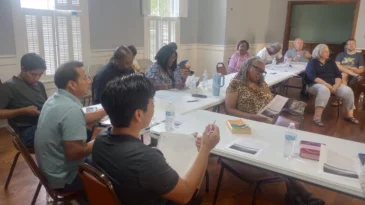
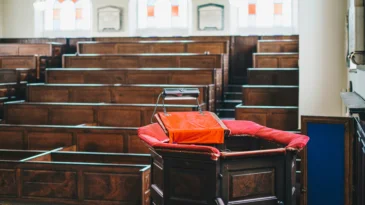
Pretty much every Wednesday, James T. Burns calls his friends at Second Presbyterian Church in Portsmouth, Ohio, from jail.
They’re the ones who drove him from Ohio to Kentucky to turn himself in when a warrant was issued for his arrest. They’re the ones who bought him a sleeping bag and let him sleep on the porch of the church on a cold night when he didn’t have anywhere else to go.
They’re the ones willing to take a chance on someone who cites the Bible, but probably never will show up in church in a crisp white shirt and a suit — a mentally ill, homeless, sometimes-addict and convicted felon.
Through an unusual twist of fate, James Burns also is a key player in a courtroom drama involving a judge from Eastern Kentucky who was recently elected to the Kentucky Supreme Court, and who the Kentucky Court of Appeals reprimanded in a Nov. 6 ruling for losing his temper at Burns’ court hearing — the second time the judge has been chastised for his courtroom behavior. During a hearing in December 2019, that judge, Robert Conley, berated Burns (the appeals court said he acted “peremptorily, profanely and dyspeptically,” cutting off Burns’ explanation and slamming his hand on the bench) before sentencing him to 10 years in prison — a ruling the Kentucky Court of Appeals has now reversed and remanded for reconsideration.
“You know what your problem is? Your hands are too dirty, your hands are too dirty,” Conley told Burns during that hearing. “You’ve got too many things going on in too many different states.”
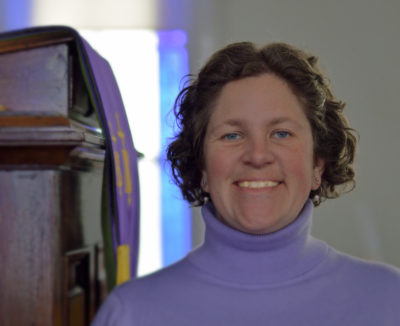
Although she never would describe him as “dirty,” Allison Bauer, pastor of Second Presbyterian in Portsmouth, would be the first to admit that Burns has a lot going on — and that he has nudged both her and members of her congregation into sometimes uncomfortable territory as they have tried to respond with compassion to his complex needs, forcing them to think more deeply about what it really means to be a Matthew 25 church.
Pretty much every congregation – and most people these days – have encounters like these. People show up at the church or approach someone on the street or in a grocery store parking lot and ask for money, food, help, sometimes with a long story about what’s gone wrong.
“This has been a little bit of an awakening experience for us,” Bauer said. “As a middle-class church, this is bringing us closer to people who are just barely hanging on. His story has poverty and mental health and prison — all of those are elements that I don’t know a lot of us in the church are terribly familiar with. People outside the church might say the stars just aligned that day,” when Burns showed up asking for help.
“I would say God’s providence just worked it out. God just dropped James literally on our doorstep. The right people opened the door.”
Church member Kim Bentley was the point person who negotiated with the officials in Greenup County, Kentucky, for Burns to turn himself in.

Bentley is a retired paramedic who’s familiar with the social service network, and was trying to get Burns a placement in a recovery house when she became aware that Kentucky officials had issued a warrant for his arrest. He was supposed to have gone promptly to Kentucky to deal with court matters there after being released from jail in Ohio, but he didn’t because he wasn’t sure the Ohio authorities were done with him yet. Instead, he took up residence on the front porch of Second Presbyterian.
“He was saying to me, ‘I have mental health issues and I have a drug addiction problem and I need help, and I don’t know what to do — I feel like I’m being thrown to the wolves,’ ” Bentley recalled. He told her he was off drugs and wanted to stay clean. She began searching for a sober house where he could live, assisted in trying to sort through his legal difficulties by church member Valerie Webb, who’s a lawyer.
While some might be tempted to walk away from the homeless convicted felon fresh out of jail, Bentley didn’t. What church has taught her: “Those are the directions we need to walk toward.”
Location, location, location
In part, Second Presbyterian’s ministry commitments have emerged from its location. The building is big, with four entrances, two of which provide some shelter from the weather. For decades, the church has operated a food pantry, where people in need know they can get help. The church is right across the street from the high school, and before the COVID-19 pandemic was involved in providing food for the weekends for food-insecure students who otherwise might go hungry.
And when the opioid epidemic hit, Portsmouth became known as “the place where hard-core drugs really hit the heartland of America,” as chronicled in journalist Sam Quinones’ book, “Dreamland,” Bauer said. “It wasn’t any longer just big cities on the coasts. Portsmouth has the blessing and curse of being right smack in the middle” — not far from the crossroads of major transportation routes that drug traders often used.
James Burns first came to the church about three years ago. He needed money, “but didn’t want a handout,” Bauer said. “He was willing to work for it.” Burns told her had had family in the area and had recently returned from Florida, where he’d been in jail — stealing to support his drug habit. She paid him for some small jobs around the property and provided clothes he could wear to job interviews.
“He came to church several times on Sunday mornings,” Bauer said. “He’s very religious,” guessing he was possibly from a Pentecostal or nondenominational background. “He uses the vocabulary of faith.”
Church member Mark Near met Burns around that time, as a volunteer at the food pantry. “My early experiences with him were not real good,” Near said. “There was the evidence of continued drug use. … I’m a little suspicious, so I’m never sure whether to believe people’s stories.” Near said of Burns: “He’s been a cascade of trouble in other people’s lives.”
Then Burns disappeared for a year or more — apparently living some distance from the church, and getting into trouble with the criminal justice system again. In August 2019, he pleaded guilty in state court in Greenup County, Kentucky, to theft over $500 and being a persistent felony offender; the judge gave him a 10 year sentence probated for five years, on the condition that he enter a residential treatment program.
Things got complicated when his probation officer learned that Burns had an outstanding warrant in Scioto County, just across the state line in Ohio. The court ordered him to turn himself in to authorities there, serve that sentence first, then report back to Kentucky, where the authorities would try to find him a treatment program. According to the Court of Appeals ruling, Burns walked from Kentucky to Ohio and turned himself in.
When he reappeared at Second Presbyterian, he’d just been released from the Scioto County jail and was unsure if he still had another court appearance to make in Ohio. He needed a place to sleep and was trying to stay away from addicts.
Bauer said he could spend a few nights on the porch. Bentley – who Bauer said “just kind of has a heart for this” – was trying to find him a bed in a sober house, when they learned that there was a warrant for his arrest in Greenup County, Kentucky, for not showing up immediately after his release from the Scioto County jail.
“He’s asking for treatment, and he’s still thinking he’s done the right thing,” Bentley said. They talked him into going back to Kentucky and turning himself in.
That last night, before church members drove Burns back to Kentucky, the temperature was expected to turn frigid, so some church members chipped in and Bentley went to Walmart to buy Burns a sleeping bag, gloves and warm socks for his last night on the porch. On the way back, she picked up dinner from a Mexican restaurant. Bentley brought the food to a table in the church’s parlor, where the coffee fellowship hour typically was held before the pandemic, and where she, Bauer and Burns sat down together to share a meal.
Before eating, “I asked who would like to pray for this meal, and James said he would,” Bauer remembers. “And he proceeded to give the most beautiful prayer — the vocabulary and language he used, the biblical imagery and Scripture he cited, just knocked my socks off. It was one of those holy moments I will never forget.”
Lessons from James
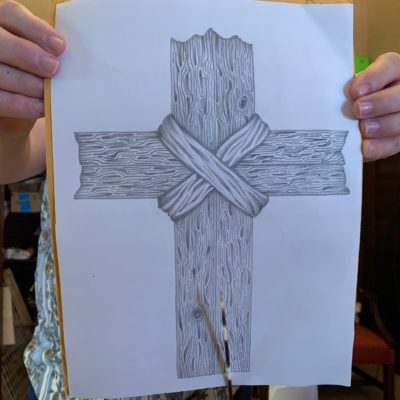
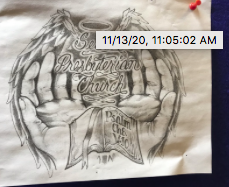
What the church has learned of Burns’ history is roughly this. He’s about 40, and Near says “he’s kind of a tough guy.” His neck and arms are covered with tattoos. He loves to draw and in jail leads a Bible study — Bauer said he’s begun to think of himself as an evangelist and prison ministry as his calling. He is conservative theologically. He’s possibly bipolar — sometimes “he is just frantic and really manic,” other times down in the dumps, Bauer said. Sometimes he talks too much — Near said Burns almost certainly did so that pivotal day in court.
He has told Bentley his mother died when he was young. He has some relatives in the Portsmouth area, but they have their own problems. “He’s had a pretty rough life,” Bentley said. “He has told me on multiple occasions that this is the first time in his life that he has had anyone love him like he is being loved by our church.”
What’s next for Burns isn’t clear. The Kentucky Court of Appeals has ordered that the court in Greenup County reconsider the order revoking his probation and sentencing him to 10 years in prison. Bauer said she got word that Burns’ 10-year sentence has been vacated, and that his lawyers are working to get him released if possible to an addiction treatment or sober living facility.
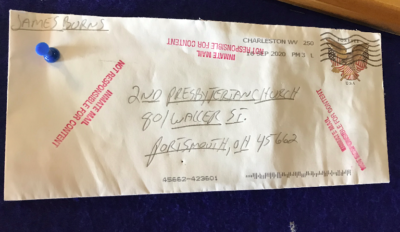
Before the COVID-19 pandemic, Near visited Burns every week in jail. Now Burns sends him letters. “I consider him like a son, but a wayward one,” Near said. “I’m committed to James for life, wherever we go, whatever happens. … I really love him.”
In helping James Burns, people from Second Presbyterian have learned about walking alongside someone who is hurting, about “breaking down those barriers between church and community,” even when it feels scary, Bentley said.
Their eyes are open. There have been others who have slept on the porch for a time, and it hasn’t always worked out. But “why have a church if you’re not going to meet people and demonstrate Christ to them and be Christ?” Near asked. “Why even bother?”
For Bentley, being part of a team helping Burns has shown her how each person – no matter their limitations – can play a small part.
“Everybody uses their own resources, their own blessings. Some folks may have the money, some may have the time, some may have the knowledge. If we all put those resources together, it all works together. It’s like the loaves and fishes. We all get fed that way.”
Her reasons for wanting to help are also a bit more personal. A few years ago, she’d been sick, didn’t have a place to live with her three dogs and was trying to get on disability. A woman involved with a homeless shelter suggested they approach Second Presbyterian and ask for help.
“Second Presbyterian church took a chance on me,” Bentley said. “They helped me with rent,” so she moved into a house and got some time and space to heal and rebuild. She became a part of the church, volunteering at the food pantry. “Because they took a chance on me, then I’ve been able to be there to help them take a chance on others. It’s God moving and allowing people to grow. If they hadn’t taken that chance, I wouldn’t be here for James. …. God was working on James’ situation to put me in the right place at the right time.”