One of the characteristics of the overarching narrative of the Bible, both the Hebrew Scriptures and the Christian New Testament, is a series of covenants. These covenants express the will and purpose of God in creation. To examine the covenants is to come to some understanding of the ways of God, and the place of human beings within those ways.
What is a covenant?
A covenant is a formal agreement between parties. It can have a purely secular meaning, as an agreement between individuals or groups to do or accomplish something. In this sense, a covenant is something like a contract or a treaty. In a biblical context, a covenant is an agreement between God and a created entity.
Covenants in the Hebrew Bible
Covenants in the Old Testament have two forms. One is conditional; it has the form of “if.” One such example is found in Exodus 19:5, which forms a kind of prelude to the giving of the law: “Now therefore, if you obey my voice and keep my covenant, you shall be my treasured possession out of all the peoples.” Violation of the terms of the covenant results in punishment.
 The other form of covenant is unconditional. Such covenants simply express what God intends to do. The covenant with Noah is an example: “I establish my covenant with you, that never again shall all flesh be cut off by the waters of a flood, and never again shall there be a flood to destroy the earth” (Genesis 9:11). There is no “if” attached to this covenant. It is God’s promise to all living creatures.
There are two covenants that are of particular importance to Jews and Christians alike (although they are interpreted in different ways). The first is the covenant with Abraham: “I will make of you a great nation, and I will bless you, and make your name great, so that you will be a blessing. I will bless those who bless you, and the one who curses you I will curse; and in you all the families of the earth shall be blessed” (Genesis 12:2-3). This covenant, which is repeated with some variations in subsequent chapters, is notable in several respects. First, it is made to a single individual: Abraham. However, the promise extends to Abraham’s offspring. Second, those offspring are to be numerous. Third, they are to be a blessing to all the people of the earth. The covenant begins with the particular and extends to the universal. It also defines the vocation of the people of God: to be a universal blessing. This is not just a promise. It is a task. The call to Abraham concludes with a calling.
The covenant with David is similar to the Abrahamic covenant in that it begins with an individual, but includes his progeny: “Your house and your kingdom shall be made sure forever before me; your throne shall be established forever” (2 Samuel 7:16). This promise was the basis of the expectation of the Messiah: a descendent of David who would restore the kingship and reestablish the greatness of the nation. At this point, Christians and Jews part company. Christians see Jesus as the fulfillment of the promise contained in this covenant. Jews do not. The identification of Jesus as the Messiah accounts for the heavy stress on Jesus’ Davidic ancestry in the infancy narrative in Matthew’s Gospel. For Jews, the promise of the Davidic covenant remains unfulfilled, while Christians understand the fulfillment – the king and the kingdom – in a spiritual way.
The new covenant
 Of particular importance to Christianity is the promise of a new covenant contained in Jeremiah 31:31-34:
“The days are surely coming, says the Lord, when I will make a new covenant with the house of Israel and the house of Judah. It will not be like the covenant that I made with their ancestors when I took them by the hand to bring them out of the land of Egypt — a covenant that they broke, though I was their husband, says the Lord. But this is the covenant that I will make with the house of Israel after those days, says the Lord: I will put my law within them, and I will write it on their hearts; and I will be their God, and they shall be my people. No longer shall they teach one another, or say to each other, ‘Know the Lord,’ for they shall all know me, from the least of them to the greatest, says the Lord; for I will forgive their iniquity, and remember their sin no more.”
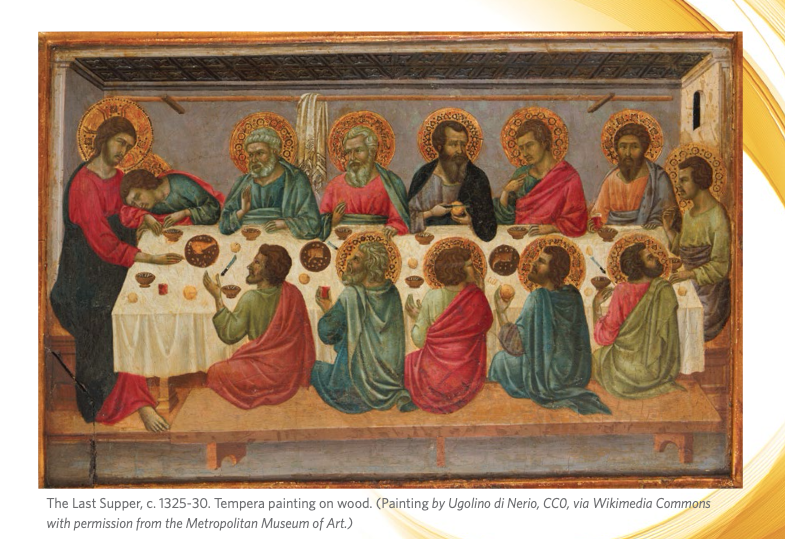
This passage does not establish the new covenant so much as predicts it. The new covenant belongs to the future. It is to be expected. In this sense, it is eschatological. It says nothing about an individual messiah, but it perhaps characterizes a messianic age. The establishment must wait until Jesus the Christ. More specifically, the establishment must wait until the Last Supper, when Jesus says, “This cup that is poured out for you is the new covenant in my blood” (Luke 22:20). The blood of Christ is the sign that brings about the New Covenant, with its promise of forgiveness of sins.
Divine covenant in Reformed theology
The idea of covenant has received extensive attention in Reformed theology. Both John Calvin and Heinrich Bullinger (Ulrich Zwingli’s successor at Zurich) spoke of a single covenant of grace, which was operative throughout human history, that expressed God’s determination to save humanity (or at least the elect) without regard to works or merit. This covenant had the character of promise until Christ’s coming, when it was fulfilled.
Later Reformed theologians, notably Zacharius Ursinus and Caspar Olevianus, introduced the idea of a second covenant, a covenant of works, which was a covenant that God made with Adam. This covenant promised eternal life on the condition of perfect obedience. This covenant was abrogated with the fall.
A third covenant, the covenant of redemption, was posited by other Reformed theologians, notably Johannes Cocceius. This was a primordial intratrinitarian covenant between Father and Son, in which the Son agreed to offer himself as a sacrifice for the sins of humanity, and the Father responded by redeeming the people who were elected.
This threefold scheme has been very influential, but it has also engendered controversy. The idea of an intratrinitarian covenant has drawn controversy, and the place of works in the covenant of grace has been an issue. Karl Barth, perhaps the most influential Reformed theologian of the 20th century, made covenant a central theme in his theology, but rejected the threefold scheme in favor of a single covenant of grace.
Living the covenant
What does the covenant mean for the Christian life? First, it shapes our understanding of the nature of God. However one conceives of the covenant of works, the covenant of redemption or the various biblical covenants, the covenant of grace is foundational for the entire created order. The covenant of grace reflects God’s will, and God’s will is the expression of God’s being. God’s being is love and God’s will is to save. This is the self-binding of God. We can live in the confidence that God’s purposes will succeed and God’s love will prevail. Faith’s foundation is found in the covenant.
 Second, the covenant shapes our understanding of each other. We have seen that both the Abrahamic and the Davidic covenants move from the individual to the universal. The new covenant is inclusive from the beginning: “They shall all know me, from the least of them to the greatest.” The new covenant is with the whole people – the houses of Israel and Judah – but, as Paul reminds us, that people is constituted by faith rather than physical descent
(cf. Romans 4:9-12). Paul maintains that the separation between Jew and Gentile is a temporary thing (Romans 11:28-32). The division will be overcome. As it says in Ephesians: “But now in Christ Jesus you who once were far off have been brought near by the blood of Christ. For he is our peace; in his flesh he has made both groups into one and has broken down the dividing wall, that is, the hostility between us” (Ephesians 2:13-14). The covenant of grace does not build walls; it tears walls down. We are forbidden to set boundaries on God’s grace.
Third, the covenant shapes our calling. As we have seen, the Abrahamic covenant concludes with that which is both promise and vocation: “In you all the families of the earth shall be blessed.” The followers of Christ are sent to all the families of the earth (Matthew 28:19; Acts 1:8). They, as children of Abraham and disciples of Jesus, are to be a blessing. They are called both to preach the Good News and to embody it. The shape of that blessing will vary according to circumstance, but it certainly does not mean that they are allowed to enslave, conquer or destroy.
There are many instances in the history of the church when it has enslaved, conquered and destroyed. Many times, the church has failed to live according to the covenant. The church was not a blessing when it went on the Crusades. The church was not a blessing when it sought biblical justification for slavery. The church was not a blessing when various factions of Christianity went to war with each other, as in the horribly brutal Thirty Years War (1618-1648). There are many instances in the history of the church when it has failed to be what it could or should have been. In short, the church has often failed to honor or live according to the covenant. For those failures we can only repent and resolve to do better.
But the covenant does not depend on the history of the church, and the failures of the church do not invalidate it. The validity of the covenant depends only on the grace and fidelity of God. That grace is never exhausted and that fidelity never fails.
From beginning to end, the covenant is shaped by promise. Abraham was called with a promise, that in him all the families of the church would be blessed. The earthly ministry of Jesus Christ concludes with a promise: “I am with you always” (Matthew 28:20). The witness of the entire New Testament is summarized with a promise: “For God has imprisoned all in disobedience so that God may be merciful to all” (Romans 11:32). If the covenant calls us to repentance, that repentance is based upon hope. Our failures as a church do not bind us. Only the covenant binds us: to God, to each other and to the world. In the self-binding of God, we are granted freedom, forgiveness, grace and love.
 DAVID W. JOHNSON is associate professor of church history and Christian spirituality at Austin Presbyterian Theological Seminary. He is an ordained teaching elder and author of “Trust in God: The Christian Life and the Book of Confessions.”