 Guest commentary by George C. Anderson
Last month, my attention was drawn to the current crisis in our nation’s capital. Still, I have lived and served the church long enough to know that you cannot get stuck in the moment. Good leaders react to crises but also plan beyond them.
In that spirit, congregational leaders need to plan beyond the pandemic. Right now, most congregations are in a holding pattern, a “temporary normal,” while waiting for local infection rates to drop and full congregational life to resume. Planning, though, should not be on hold if the goal is to emerge as a congregation equipped and ready to serve in a post-pandemic world.
I have come up with a way to frame strategic planning for my congregation that you might find helpful. I have asked an overall question of staff and church leadership: “How do we R.A.T.E.?” The leaders of my congregation are being asked to work through the stages represented by this acronym so that lessons can be learned about what we have been through before it becomes ancient history, and plans can be made for what the church can become post-pandemic before it is too late.
In describing the four stages, I know I will not speak to every congregation’s context, but I hope I evoke something of shared experiences and challenges.
Reacting
When the pandemic first hit, congregational leaders were confused about what was going on and what needed to be done to keep people safe. We were urged at first not to wear masks because they were needed by healthcare workers and to be especially vigilant about handwashing and disinfecting. Then it became clear that the COVID-19 virus spreads more through airborne droplets than from touching surfaces. We learned that choir practices could be “super-spreader events.”
Responsible church leaders became amateur epidemiologists, aerosol experts and videographers. In-person gatherings were canceled and in-person visits halted. Ways were found to offer worship taped or online and meetings were held using platforms like Zoom. Weddings, funerals and baptisms were postponed.
The hope was that these safety precautions would last only for weeks or maybe a few months.
Adapting
Then it became clear that restrictions were not going to end soon. Congregational leaders who listened to health professionals learned that the ease of transmission combined with the bumbled response of many countries, including the foolish politization of safety measures, meant that restrictions would last for at least a year and a half and possibly longer.
 Sadly, and in some cases necessarily, some congregations closed and others carried on with worship and little else. Other congregations, though, found ways to adapt. Staff and members learned multimedia skills. Churches established YouTube channels to make online worship and education readily available. Churches began to conduct weddings and funerals online or in socially distanced and downsized ways. Congregational care was offered in ways that did not involve in-person visits. Many congregations increased benevolent outreach in response to pandemic related crisis needs.
Transitioning
Remarkably, at the end of 2020, effective vaccines were approved and began to be distributed. It will take at least a few months before vaccinations make a measurable difference in local infection rates, but there is now cause for confidence that within the year 2021 it will be safe for some, then more, and then maybe all but the homebound to attend on-site in-person events. Church thinking will increasingly move from “why we can’t” to “how we can.” Safety protocols will change and then change again. Churches that moved mostly to an online presence will progressively shift their priority from those attending online to those attending onsite.
This transition stage will be for some congregations the most difficult to plan and manage. There will be tension between the pull of those who are ready to move on and the pull back of those who remain cautious. Leaders who were trusted to make decisions about restrictions might begin to meet resistance from those who become convinced that masks and distancing are no longer needed.
Emerging
Congregations eventually will get past the pandemic and either return to the way things were or will have become new versions of themselves. Given that the world will have changed, the former is probably not wise. If this transition stage is not managed well, congregations might emerge showing more signs of what was lost than what has been learned.
The congregations that do best will be those that proactively plan. They will have learned from the experience of the pandemic. They will have addressed any financial impact that the pandemic had and made the cuts, adjustments and reappropriations needed for the congregation to move forward. They will have seriously considered if and how to maintain an online presence. They will have done the continuing education or reorganization needed to make sure the staff is the size and has the skills needed so as to help move the church forward rather than holding it back. Accepting that the connective tissue of church fellowship might have frayed, they will have made intentional plans to reconnect not only with those who return but also with those who would not have re-engaged without having been given personal attention. They will have ended some programs that were exposed as unnecessary. Worship, education, fellowship and outreach will be offered in renovated ways.
What now?
I hope I have effectively illustrated how this “holding stage” of having adapted to the pandemic should not be a “wait-and-see stage.” The time is now to do strategic planning by whatever process is appropriate to a congregation’s context. Within that process, I suggest asking questions of all four stages I described.
 In terms of the reacting and adapting stages, what has the experience of the pandemic revealed about the congregation? What was the financial impact? What was begun during the pandemic that might be worth continuing? What old programs and practices now seem less essential?
By asking these questions of the past, leaders will already be thinking about the future. Then, in turning attention to the stages to come, leaders can begin serious deliberation about what the congregation can become to be best suited to serve in a post-pandemic world. The focus should first be on emergence, because that will guide plans for the transition.
In envisioning the future, more questions need to be answered:
- What will be different about the church from its pre-pandemic life?
- What programs and practices will be in place so the church can be fiscally sound, effective and relevant?
- How will worship, education, fellowship and outreach be different?
- What role will technology and media continue to play?
- How will the staff be trained, reorganized or reshaped to help the congregation move forward and not hold it back?
- How can grief over what was lost be managed and excitement be created about what is ahead?
- How can the congregation know it is not losing its identity but is evolving?
I suggest that leaders who engage in this planning might receive some unexpected pastoral care. The year 2020 has been a tough year for several reasons, beginning with the pandemic and an ugly and now dangerous election cycle. It has been easy to grow weary, worried and discouraged. Strategic planning can bring hope because a future is envisioned, confidence because one sees a path ahead and excitement because to see what can be is to begin becoming it.
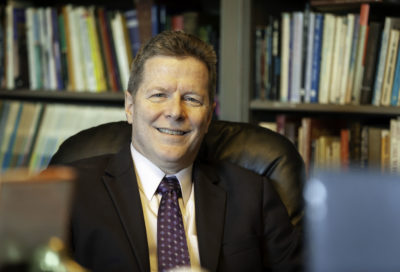 GEORGE C. ANDERSON is pastor of Second Presbyterian Church in Roanoke, Virginia.