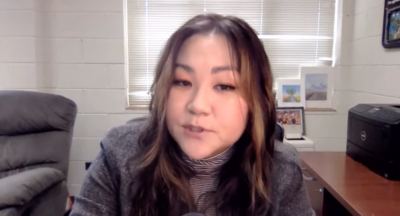
The past few years have been marked by multiple griefs, Christine Hong acknowledged in her keynote address to the Next Church 2021 National Gathering, being held online March 5-7.
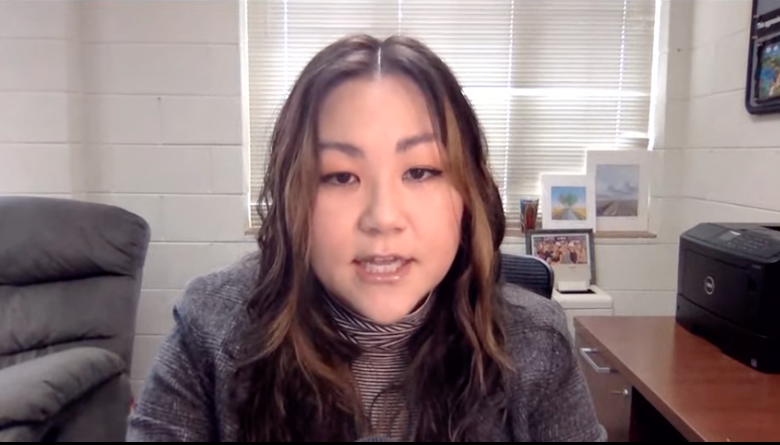
White supremacy and COVID-19 are twin pandemics that have made us “soul-sick,” she said. So she started by offering participants a moment to consider what accretions of grief they are currently holding space for — griefs such as people gone too soon, the pain they see others expressing or a loss of hope. “Hold them and acknowledge them. They are part of you, too,” Hong said in her March 6 presentation.
Hong is assistant professor of educational ministry at Columbia Theological Seminary in Decatur, Georgia. She has a special interest in anti-colonial and decolonial approaches to religious education and is the author of the recently released book “Decolonial Futures: Intercultural and Interreligious Intelligence for Theological Education.”
Recent years have been defined by witnessing violence and redefined by recognizing complicities that contribute to oppression. On top of that, the COVID-19 pandemic has prevented people from sitting by hospital bedsides, from keeping watch with those will are ill and from attending funerals. “We are carrying so much in this moment,” she said.
Black, Native and people of color have “learned to push through and push ahead,” even while feeling weary and depleted. There is an urgency to “keep going, no matter what” — to mourn or grieve later. “All of that is part of the white supremacist lie,” she said — that people of color must continue to work and produce without regard for their human condition.
However, that is not God’s call for people, she said. Instead, Hong called participants to consider what she termed “genealogies of the intangible” – not literal family trees, but lessons taught in community.People are meant to flourish together — to build and rebuild, to bless and be blessed. “We build and bless by remembering that we are not alone.” She said, “Remember those who struggled and thrived before we took our first breath. … Our great cloud of witnesses — they co-conspire with us. … This great cloud continues to witness to us about liberation and freedom.”
 These genealogies are intangible to empire, she explained — they are not those that have to do with “bloodlines or ancestry.com. They cannot be harnessed for the furthering of empire.”
Hong used two concepts drawn from her Korean heritage to explain the role of genealogies of the intangible in the rebuilding process. The first is translated as “the flavor as of one’s hand” (and is represented as 손맛 / sohn-mat, as one participant typed in the chat). This relational idea conveys that flavors produced in cooking can’t be communicated through a recipe alone; rather, the whole body knows and understands how a particular food should look, feel and taste.
“The flavor of one’s hand” connects people; it can be a cultural memory that re-grounds someone’s identity and personhood. Though the Korean War has separated Hong from her ancestor’s villages – she is not able to visit the places where her grandparents lived – sohn-mat allows her to know who she is and where she came from through the flavors and losses of the past.
That great cloud of witnesses – the ancestors – teach that part of liberation is remembering to grieve losses as part of the rebuilding process, Hong said. She introduced a second concept: that of “us-ness as the framework for all our lives” (우리 / uli, as provided by a participant in the chat). This idea of “us-ness” ties people to one another — to land, to grief, to community.
Through the shared ancestral journey, Hong said that she has seen that God is good because “we are the inheritors” of the connectional language of liberation. That is part of how people are called to bless and build. “You have inherited what cannot be stolen by empire,” because all can taste and feel God’s justice, mercy and love.
“It can only be erased if you choose not to pass it on. … We are meant to inherit and co-create a just world for all,” Hong said. “You cannot inherit something if you do not know and do not believe that you are the heir. … Strive to believe and know. And trust that God will help us with our unbelief. God is familiar with our mistrust … yet God works through us and with us.”
Don’t sweep pain and trauma under the rug, she cautioned — hold them. “We build by building one another up.”