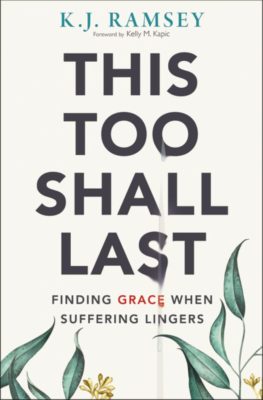
 K.J. Ramsey
Zondervan, 224 pages
Reviewed by Christina Tutterow
This was half the book I needed.
K.J. Ramsey writes beautifully about her life experiences, her theological convictions and her vocationally acquired understanding of psychology and neurobiology. She states that the book is about the “messy middle” of her life, which includes both the diagnosis of a chronic, pain-filled illness that is unlikely to be healed and an abrupt ending to a church call that left her feeling doubly wounded. The latter event is only briefly mentioned in the preface. I could have written this book. I should have loved it — which is an odd thing to say about a book so unapologetically focused on suffering. But misery does love company.
The book doesn’t follow a linear or a chronological trajectory. Each chapter could stand on its own as a faith-tinged essay. The tome is more scholarly than personal, though there is the feeling that the author means it all to be personal for us, the readers. Ramsey shares personal reflections in each chapter before quickly moving on, but what one can detect in the pattern of what she shares is the pain and the disappointment the author has experienced (largely unintentionally) in the company of both fellow church members and friends. Perhaps as an antidote to these imperfect relationships, Ramsey offers the refrain that what we all truly need is connection and communion with others who stand in solidarity beside us and to whom we can “securely attach.” For Ramsey, the fully human Jesus, our “suffering Lord,” is the ultimate other we need and our connection to him can help us remain faithful and find joy in the midst of suffering.
Peppered throughout the pages of “This Too Shall Last” are quotes and reflections from scholars, theologians, philosophers, neurobiologists and mystics. The viewpoints of those included run the gamut from traditional to progressive, with a bit of phenomenology and radical orthodoxy thrown in the mix. Despite the breadth of voices lifted up, Ramsey leans heavily in the direction of more traditional stances on the ancient theological issues of original sin, the fall, the curse and the enemy. It was these theological underpinnings that had me breathing out a sighed “no” almost immediately after each awe-filled “yes.”
Still, there are things in here that we as believers need to hear. We as the church need to become more comfortable with the liturgical act of lamenting. We need to recognize that individuals going through lingering difficulties ache to hear their ongoing struggles acknowledged and lifted to God within the scope of our prayers and our gatherings. In addition, those who feel they have not (yet) gone through an extended period of despair or grief will find within this work the opportunity to understand a bit more fully those who have. Armed with new knowledge, your relationships with those in the throes of suffering are likely to be enriched and you may just become for them a source of grace.
This was half the book I needed. Through the bits of the story she shared, I felt a connection and a solidarity with Ramsey, which is half of what she was trying to accomplish in writing. Perhaps you will experience the other half.
On break from full-time ministry, Christina Tutterow is living, writing and moving slowly in the beautiful mountains of western North Carolina.