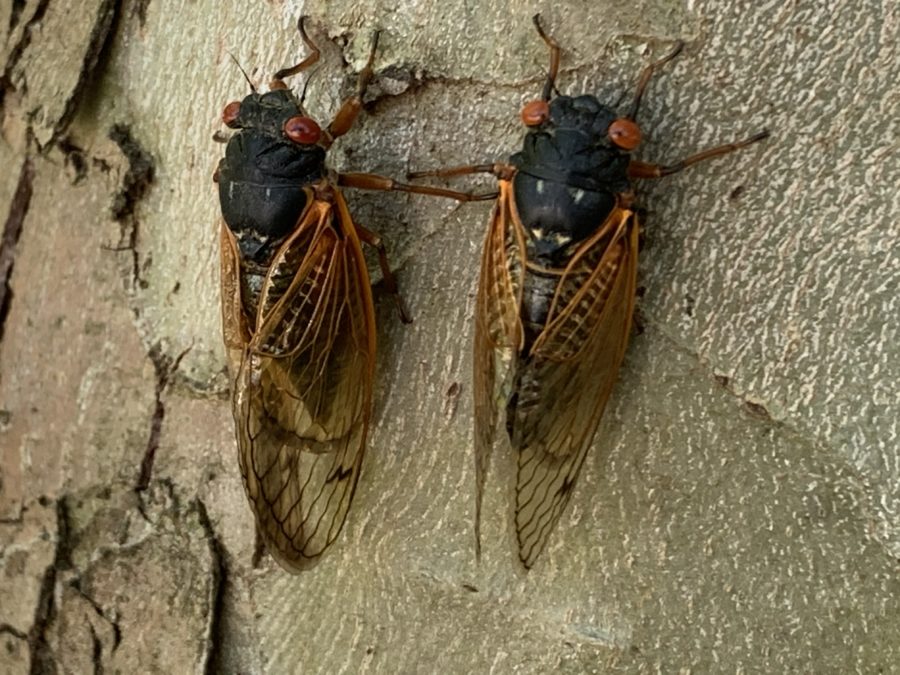
 While I know I should be awash in appreciation for the sheer scientific wonder of these winged creatures – living underground for 17 years, only to then come roaring to life? – I admit I trip right over the miserable first impression.
Let’s just say that, before we knew better, our dance with Brood X involved a 14-year-old dog for whom this was his first cicada rodeo; a fenced-in back yard with two enormous maple trees; one miserable night; and a rented carpet cleaner. We rented the machine for 24 hours, and my husband was prepared to haul it back after we’d cleaned up the worst of the mess. I told him we might want to wait until the next morning, to see what nocturnal surprises might still lie ahead.
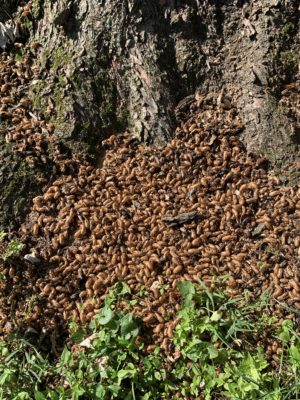 We live in an old house in a neighborhood full of trees. The bases of our backyard trees are covered with cicada shells — piles inches deep nestled in some of the roots. We have cicadas hanging from our grill, the back door, the deck chairs, the parsley and oregano growing in the herb garden, the screens on the front porch. The sidewalks are coated in them. Their red eyes see everything.
One night, I woke up in the wee hours and, from our second-floor bedroom, heard an enormous clicking coming from downstairs. I staggered down the stairs and stared at the fireplace. My head knew a single cicada had wangled its way in. My heart wondered if an entire army was coming straight through the fireplace, demanding a ransom in bitcoin.
“I’ve just surrendered,” said a friend, whose dogs like to jump in the air and catch them on the fly.
And yet, a piece of me – the part that can nudge its way past that first impression – is a tiny bit mesmerized.
There is a sort of wonder to them, if you can get past the mountains of discarded shells that crunch under your feet as you walk. For the past 17 years, as we’ve planted hostas in the garden and pulled up weeds and mowed the lawn, the cicadas were there. They emerge in this frenzy of survival, desperate for love, and for a few weeks take over the universe. They morph before our eyes — you can stand and watch the transformation as they shed their shells, one creature essentially becoming another.
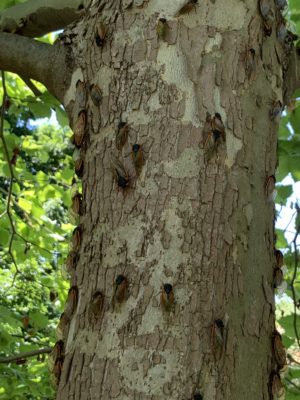 You can tell which trees they favor – the bases are coated in cicadas, the thrumming from above head-splitting. Other trees – the smooth-trunked Japanese dogwood in our front yard – are essentially untouched. Some friends say they have no cicadas in their front yard, which they dug up a while back to reconfigure the front walk. Their backyard, like ours, is Cicada City.
We live near a big city park, in which we walk the old dog several times a day, because he’s in lock-down and banned from backyard cicada-snacking. In the park, which is full of trees, the hum is much quieter, the cicadas fewer — you can actually hear the birds.
I’m starting to wonder about cicada preferences. Why this tree, and not that one? When I see a newly-risen one staggering down the sidewalk, way later than all his friends, I wonder why that particular one was so slow. Sleeping in? Didn’t get the message? Less competition? Purple-haired teenage rebel?
I wonder what I could learn about cicadas and our ecosystem if I really studied up. If I took a deep dive into what I don’t know, I consider how astonished I’d likely be — embarrassed and unnerved by what was right before me and I didn’t understand.
I wonder how often I slide through on first impressions, and about all the beauty and complexity I overlook. What’s the cost of not knowing the names and idiosyncrasies of individual flowers and trees and birds, of not really noticing people not marked by power or beauty or achievement? I recently learned that a friend of a friend – a man who only registered to me as an old guy at church – had a long career in academia and the Foreign Service and speaks multiple languages. He may have been a spy, before he was the old guy.
I wonder about the 17-year-olds who aren’t the valedictorians and aren’t sure what they want to do next. I wonder about the people who made a mistake and went underground for a while, and are now shedding the old skin and being transformed. I wonder about the people we don’t notice, but are capable if given a chance of making magic and shouting from the trees. The ones with hidden complexities and powers. Last weekend, I went to the Breonna Taylor exhibit – “Promise, Witness, Remembrance” – at the Speed Art Museum in Louisville, and found myself wondering what I would have thought of her, if I could have glimpsed her promise and her spirit, if we’d had a chance to meet.
I thought about the art in that exhibit made by Noel W Anderson, in which the faces of Black women, taken from old issues of Ebony magazine, are partially erased. I thought of the faces of marchers in the Breonna Taylor protests — protests still continuing in Louisville and chronicled in photographs at the Speed.
I looked at the face of Travis Nagdy – 21, an exuberant natural leader, shown in some of those photographs with his crown of hair and megaphone raised high – who was shot and killed by a carjacker last November. For a few moments last year, I did notice him — when he swerved his car into a parking lot off Bardstown Road and dashed out, megaphone in hand, to join a group of kids with their parents holding protest signs, patient and sweet when they were shy with the call-and-response. (“Breonna Taylor.” “Say her na-ame.”) “Keep it up,” he yelled as he drove away, honking.
I wonder what my first impression of Travis – big, young, Black, running toward us down the street — would have been in another setting.
Outside my windows now, the cicadas are winding down for the night. In a few weeks, they’ll be gone — but not necessarily the rest of the thrumming. Regularly last summer and fall, and a few times already this year, the thwacking overhead came from the police helicopters circling, tracking the protestors, preparing to make arrests.
Time then for a deep dive — to pay attention, to put aside certainties and first impressions. To to start figuring out all that I don’t know.