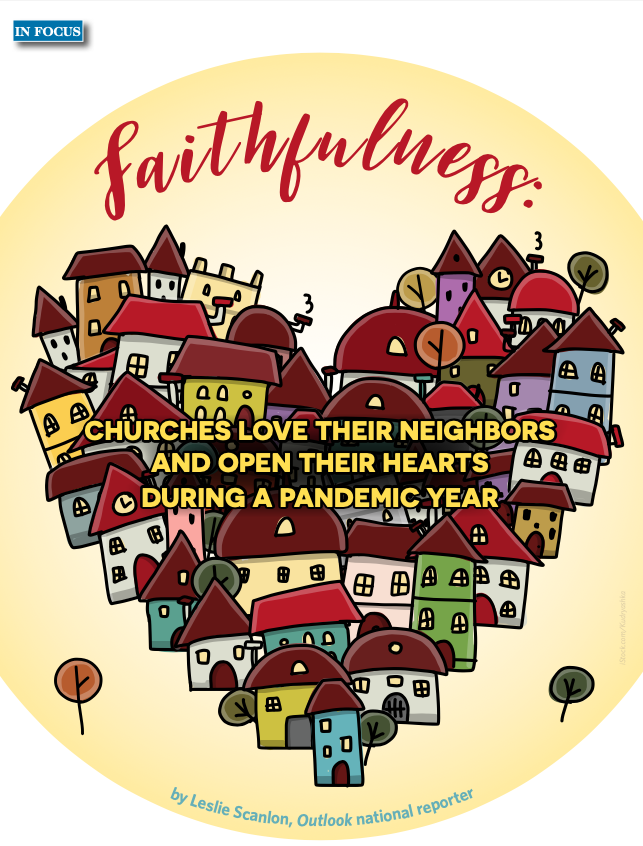
 The stories of churches serving in a pandemic year are full of faithfulness. Faithfulness not defined as unfettered success, but as ministry done at full sprint and in new ways — sometimes in desperation or wild hope. The hallmarks: exhaustion, creativity, technological experimentation, phone calls and letters to the lonely and grieving, communion wine in coffee cups, arguments over masks, vaccinations, singing and what is safe.
Sometimes, grace appears on the new unmarked road.
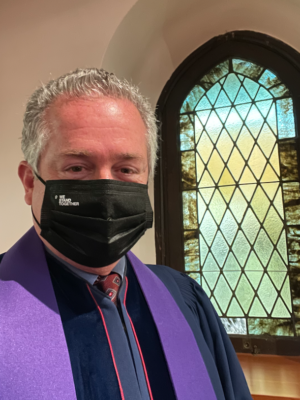
It’s what pastor John D’Elia heard from a mom with two young children — an inquisitive 11-year-old boy and a 4-year-old daughter he describes as a “Bohemian in the making.” The family almost never showed up in the sanctuary on Sunday mornings. But now, the mom says they love Zoom church, which they watch as a family on Sunday afternoons in comfy clothes. Sometimes the boy will ask his mom to pause the recording in the middle of the sermon, saying: “OK, stop it, what did John mean right there? What was that word?” And “the 4-year-old dances through all the music,” fully in motion, with no one complaining.
Faithfulness is forged in the pressure for constant innovation; by inventing strategies for connecting at a distance, in the heartbreak of a pastor unable to pray at the bedside of someone who is sick or dying, or to stand with families in times of grief.
When someone is ill, “you can’t go visit them. You can’t go in there — you can’t even get close,” said Irvin Porter, pastor of Church of the Indian Fellowship on the land of the Puyallup tribe in Tacoma, Washington.
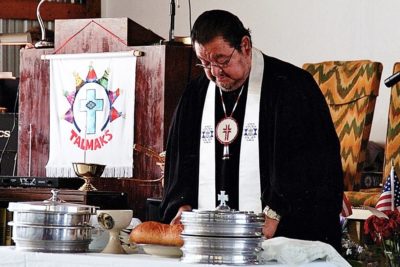
When Porter’s cousin, Cecil Corbett, was hospitalized with COVID-19 last September, his family could only communicate with him via an iPad. “That is so un-Native American,” Porter said. “We would all be in the same room. We would surround that person literally until their dying breath. Not being able to be there in the room with a dying relative or friend — it takes a toll. You feel like you’re not doing your job as a pastor.”
Faithfulness is forged in confronting the pressure from parishioners who are vaccinated and who want the church to be open even before the pastor and staff were able to get vaccinated — or from people who refuse the COVID-19 vaccine and won’t wear masks, but want to sit in the front pew.
Looking ahead, it’s calculating what comes next. How will and how should the church be different going forward?
What does it mean to be faithful to innovation — knowing the church might not have been willing to make those changes without the hammer of a pandemic? What are the lessons of COVID-19?
Mission
At East Liberty Presbyterian Church in Pittsburgh, people were determined to find ways to continue mission work despite the pandemic. “Despite the separation, despite the loneliness, despite the fear, despite all the illness … we could still remain faithful in the way we walked and carried ourselves in the world,” said Patrice Fowler-Searcy, associate pastor for mission ministries. “And we recognized there was even greater need” than before COVID-19.
 Early on, volunteers from the congregation started sewing masks, giving them away in the neighborhood — more than 3,000 masks, all hand-sewn.
The church has a long partnership with East End Cooperative Ministry, which provides groceries and lunches to food-insecure neighbors. With the pandemic, East Liberty switched to drive-by collections — with people giving more than 1,000 pounds of nonperishable food for the pantry in April 2020.
In later collections, parishioners gave books for inmates at the Allegheny County Jail; over 2,000 pairs of socks to distribute to the homeless; and more than 11,000 diapers, 13,000 wipes and $1,700 for the Pittsburgh Diaper Bank.
When church members got stimulus checks, some needed that money to pay rent or buy food. But those who could afford to were encouraged to donate to Casa San Jose or Hello Neighbor, local groups that provide support and services for immigrants and refugees, “to make sure we were caring for the neighbors who often are the ones who are in the shadows and overlooked,” Fowler-Searcy said.
The innovations are continuing. In Baltimore, a few churches have become vaccination hubs — pop-up sites where people from the neighborhood come to get COVID-19 vaccinations.
Technology
In the beginning of the pandemic, Porter used his cellphone to livestream worship. And when the nearby casino and tribal buildings shut down, “we couldn’t piggyback off of their signal,” Porter said. “It was a nightmare the first couple of months.”
 But they figured it out — using a laptop and hotspot in Porter’s home to livestream worship.
A few years ago, the congregation had ended a Wednesday night Bible study because attendance was so low. “We brought it back,” he said, and online attendance has been strong, with people watching from all over the country — from Arizona, Kentucky, Idaho, even France, where Porter’s wife is from.
In part, that’s because some of the 95 Native Presbyterian congregations across the country stopped having services during the pandemic, said Porter, who also serves as associate for Native American Congregational Support for the Presbyterian Church (U.S.A.). Many Native churches don’t have stable internet or much equipment.
“I know that many of our Native American congregations have had to basically close their doors,” he said. “They don’t live in an area like we do where we can easily access the internet. … We’ve got churches that are so remote, they’d need a satellite to hook up, they are that far out,” away from broadband service.
Leaders in some Native congregations are checking in with parishioners by cellphone. Many are family churches, so they already are in touch — but that communal culture also has contributed to the spread of the coronavirus in many Native communities, Porter said. “Many of these churches live check-to-check,” with no financial reserves, although the Presbytery of the Grand Canyon and Synod of the Southwest are accepting donations for the Native American COVID-19 Relief Project.
“The biggest loss for Native people has been the loss of being able to physically be among each other,” Porter said. “We can talk by phone, we can talk on the internet. But it’s not like being there.”
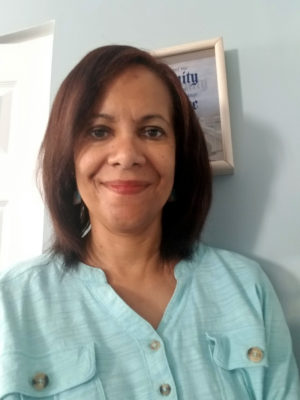
When the pandemic began, the Presbytery of Baltimore set up a COVID-19 relief fund and also a technology fund for congregations. “The difference between then and now is amazing — from stone tools to major technology,” said general presbyter Jacqueline Taylor. “I’ve just been really proud of the churches,” many of whom are committed to continue some form of virtual or hybrid worship presence even when the pandemic doesn’t require it. “That’s been very exciting to watch — not only churches using new technology, but to actually adopt a new way of being church, a new way of experiencing community.”
For many years, The Center in Baltimore has hosted youth and other church groups trying to learn about ministry in a diverse, urban setting, but in 2020 the pandemic made that impossible. So they went online — for example, hosting coaching sessions with middle school students and congregations from across the country to teach them how to do community development work in their own contexts and discuss issues of equity and justice.
The presbytery set up a private Facebook page for pastors and has helped pastors connect with mental health resources. Congregations are divided into geographically structured ministry groups, and one of them – known as the Susquehanna Parish – set up a minister support group and began sharing sermons, to give pastors an occasional break from preaching.
Collaboration and support
The Presbytery of Northern Kansas has used Zoom as a way of supporting church leaders and building collaboration.
Every week since March 2020, pretty close to the start of the pandemic, the Presbytery of Northern Kansas has held a Zoom chat for pastors. At first, the ministers were mostly sharing ideas and practical suggestions — how to livestream worship, how to hold a virtual session meeting. Over time, it’s become more personal — a space where pastors can open up about their stresses, their frustrations, their joys.
 “Pastors that have sessions that have felt they’re being too cautious or pressure them to open back up before it was a good time to do that,” said general presbyter Melanie Hancock, and “they are getting support from other pastors in that group.”
Early on, a small group of pastors who have children at home and who are struggling with all that entails during a pandemic – home schooling, online learning, pastoring a church “and doing all of that with kids climbing on them” – formed their own Pastors as Parents Zoom chat.
And Christian educators started talking on Zoom about “how are we going to continue faith development among our churches that are not open face-to-face?” Many congregations don’t have Christian educators on staff, so the group includes pastors, Sunday school teachers and people who serve on children’s ministry committees.
The presbytery got permission from the PC(USA) to purchase the “Growing in God’s Love” curriculum for use by all the congregations in the presbytery. The Christian education group has met online every week since April 2020, producing a lesson every Sunday during the pandemic for four different age groups. Last December, they organized a virtual Christmas pageant.
“Great things have come out of it — they’ve really taken it and run with it,” Hancock said. “Now they’re talking about ‘What does Christian education look like post-COVID?’ … How can we be very careful to not lose this opportunity for Christian education to be different for our families?”
Hancock has seen the stress of the pandemic piling up on pastors. At first, “they had this big push: We can do this, we can make this work.” Now, many pastors are caught up in tensions around when to resume in-person activities and how to do so safely.
“We had a lot of folks, probably until early fall, that still believed that it was all a hoax, that COVID wasn’t real, and we didn’t need to be taking all of these precautions,” she said. “We had pastors who were really struggling. But now I’m even more worried than earlier. … I think our pastors are exhausted. Spiritually, mentally, physically, but also creatively. They have had to work so hard to be creative. And churches are pushing to get things back to normal. … There are people in the congregation who are angry we aren’t singing yet or they have to wear their masks at church. The pastor takes the brunt of that. They’re exhausted.”
Zoom community
Before the pandemic, Westminster Presbyterian Church in Ann Arbor, Michigan, used to have Wednesday night suppers — an intergenerational time for learning and friendship. With COVID-19, pastor Melissa DeRosia was looking for ways to make Zoom less intimidating, knowing that it was “for many people foreign technology.”
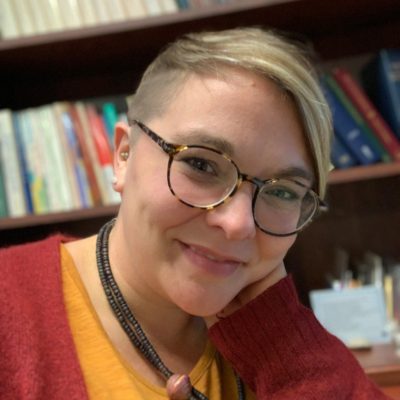
So she began Wednesday night all-church gatherings — only one hour, via Zoom, with a chance for everyone to share. They begin by passing the peace. “We unmute everyone,” and all together people say to one another: “The peace of Christ be with you. And also with you,” often greeting friends by name. “It’s chaos. It’s beautiful,” DeRosia said. “You can feel the love in those moments.”
Then she mutes everyone, and goes square by square around the Zoom room, asking each person to share a joy and a concern.
Then DeRosia asks a question that serves as the theme of
the night.
What do you hope for? What biblical character do you most relate to? If you could describe yourself as a shoe, how would you describe yourself? (“It was hilarious.”)
One recent week, she asked: “What would you like to leave behind from your pre-pandemic life? … They did not like that question at all,” although some of the answers were beautiful.
 She has asked: “What have you lost? What are you grieving?”
“People have talked a lot about missing family, the isolation, the loneliness,” DeRosia said. “We’ve learned about how for so many people church is their primary community — it’s where they connect, it’s where they serve. We really noticed how heavy and hard this was for folks at Christmas, the not being able to be together, not being able to gather.”
But Zoom has formed new connections too. “So many people with physical disabilities who can’t make it to church on Wednesday nights, who can’t make it out at all — this has been a way for them to reconnect in deep and meaningful ways,” she said.
One man with mental illness and addiction issues attends online Alcoholics Anonymous meetings many nights; on Wednesdays, he Zooms with his church. “He has been probably one of the most faithful church members in the pandemic,” DeRosia said. “He shows up at everything, where he could rarely get a ride to worship before.” Online, “people have been able to create a space of inclusion.”
Creativity
In California, D’Elia began a call as the interim pastor of First Presbyterian Church San Luis Obispo early on in the pandemic — and still has not met many of the people from the congregation in person. He’s seen, however, how people in an older, not particularly tech-savvy church have been willing to learn.
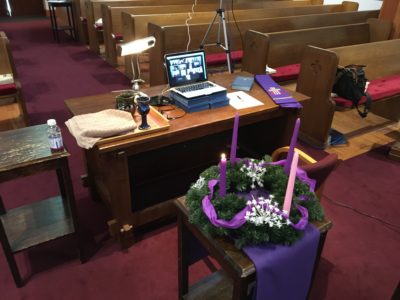
At first, D’Elia recorded the worship service and posted it online. While pre-recorded services were fairly easy to access, he saw attendance dropping off. So on All Saints Day, the church switched to a live Zoom service, with recorded music; others participating from home; and D’Elia preaching from the sanctuary, so the congregation could see the chancel. With more interaction, worship attendance went up.
To get people accustomed to Zoom, First Presbyterian began holding mid-week online gatherings, including a Wednesday night Bible study and Zoom bingo. “The more events we had mid-week on Zoom, the more familiar people got with the technology,” D’Elia said. “That made their experience on Sunday mornings richer. Now it’s people who are north of a certain age who are asking me to keep the mid-week Bible study on Zoom even after we reopen, so they don’t have to drive at night … They’ve met more people on Zoom than they did when we were live.”
The technology also has opened the door for people to attend who don’t live in San Luis Obispo, including some who moved away in recent years, and a childhood friend of D’Elia who participates every week in the Bible study.
The pandemic has raised new possibilities for what community might look like going forward.
“The things we’ve been able to tinker with that would have caused an uproar if we were live are actually happening more seamlessly now, because everything is so disrupted,” D’Elia said. “I wrote to the congregation when we hit the one-year mark that who would have thought we could be this creative, this adaptable, this flexible?”
What’s ahead?
 As things begin to reopen, congregations face sometimes complicated logistical questions of how to begin gathering safely. Do churches with relatively small sanctuaries hold multiple services? Should they replace pews with chairs? Hold services outdoors? What about bad weather? “The biggest question I hear is what do we do about Sunday school for children?” Taylor said.
Many mid councils and congregations likely will continue holding at least some meetings virtually — with some reporting higher attendance online than in person.
And many pastors say there’s no going back to the way things used to be.
“The old ways — everything we did prior to March 2020 is gone,” Porter said. “The new normal is what we are facing.”
“Even as people are vaccinated and the fear of infection is lessened, there will still be some apprehension,” Fowler-Searcy said. “I think we will learn to be the body of Christ, learn to be the church out in the world in different ways. One of my favorite passages is that God is doing a new thing.”
What new things should last? What should the church let go of? How has the pandemic transformed the church?
“In many ways, we are standing on the precipice of being a new church,” DeRosia said. “We can’t go back,” because doing that “discounts everything we have been through. I don’t want to do that.”