 Interview by Jay Blossom
In more than 20 years as a hospital chaplain, Beth McKee has ministered to people in many stages of life: active seniors, hospice patients, young people with developmental disabilities. She’s performed scores of baptisms and countless funerals. And she has celebrated dozens of weddings, some for octogenarians.
McKee ministers as director of spiritual care at Rainbow Babies and Children’s Hospital, a 244-bed facility affiliated with University Hospitals (UH) Cleveland Medical Center. UH traces its origins to 1866, when Presbyterians and other community leaders gathered at the First Presbyterian Church of Cleveland, better known as the Old Stone Church, to establish the Cleveland City Hospital Association.
McKee is employed by Chaplain Partnership, a chaplaincy service based in Northeast Ohio, which provides spiritual care to UH and its affiliated hospitals. Two of her chaplain colleagues are Presbyterian Church (U.S.A.) ministers; McKee is ordained in the Church of God (Anderson, Indiana). This chaplain team serves people of all faith traditions, or none.
McKee just passed her three-year anniversary at UH. Previously she spent 18 years at a nearby continuing care retirement community, where she worked with residents from age 55 to 108.
The Outlook asked McKee to reflect on her ministry and how gentleness – a fruit of the Spirit – comes into play in her work.
Do you see gentleness in yourself? Or do you need to work on it?
In certain situations, I think it comes naturally to me, and my work life is one of them. I readily admit I have often been a pretty assertive person — not that assertiveness is a bad thing! When I think back to things I’ve done, like athletics, I don’t know that a lot of people would have called me gentle.
 But in my professional life, and in situations where I find a lot of chaos swirling around me in pastoral care or spiritual care situations, gentleness is something I revert to pretty quickly. I think part of that is natural, but also it is something that I am aware of. I’m aware things are getting out of control in some way – perhaps emotionally – and that I need to try to bring everybody to a calm center. So if I’m not calm, and if I’m not gentle, I’m not going to be able to do that.
Are there specific strategies to help you be calm and to share that with others?
I find myself thinking very intentionally, “OK, you need to step back right now, you need to be quiet, you need to listen, you need to watch what’s going on around you and assess the situation.” And then I look for an opening — whether it’s with someone hearing difficult news, witnessing something difficult, or expressing themselves very emotionally. I can’t interrupt that. That’s one thing I’ve learned.
It’s not gentleness if I interrupt that process in any way. But once it has played out, I need to find a way to draw that individual, whether a patient or a family member or even a staff member, into a quiet space where they can be more thoughtful about what’s going on, and begin to think through what they’ve just experienced.
I often think of the hospice angle of chaplaincy — that is, being with people at their last moments. But you also deal with a lot of different situations that are not at the end of life.
In the retirement community, I experienced more of what you’re referring to — being with people as they planned for the end of life, including what they wanted the end to look like, what they wanted their (funeral) services to be like, things like that.
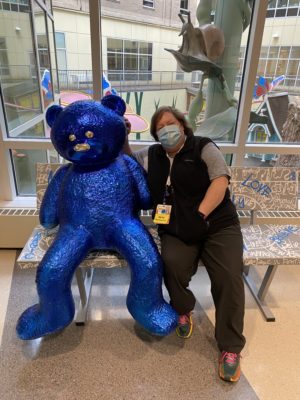
But now I’m in an inner-city hospital. Any time a child is ill, it’s a type of violence to the parent. It’s something they never anticipated, they never wanted to go through. It’s something out of order even if it’s not an end-of-life situation.
Sometimes I’m dealing with situations that are very traumatic — for example, with gun violence. At another hospital I serve, MacDonald Women’s Hospital, I sometimes meet with families who had hoped that their baby would be born healthy and would go on to live a long life, but that scenario is not happening. How do I help that family navigate through very sad times?
All of these require a lot of gentleness and a lot of letting the family and the patient tell me what they need, rather than me telling them where we’re going and what I want them to do.
Is there a tension between being proactive and being a chaplain?
I see how it could be, and I won’t say that there aren’t times that I want to fix something that’s not fixable, or to steer a situation in what I feel is a better direction. I’m just really aware that that’s not my job.
My job is to be present, to learn from the patient or the family, to do whatever I can to reduce the level of pain and stress that they’re experiencing. Or, if I can’t reduce that, to let them know that they are not alone in the levels of pain and stress that they’re experiencing.
I hope I’m providing some relief, but I can’t take all the pain and stress away. No one can take away my own pain and stress when I’m going through difficult times, and I should not expect to have a magic formula to do that for someone else.
I think gentleness is really at the core of my work. How can I be gentle if I force my way on another person? I can’t.
I imagine you’ve learned a lot from your patients.
We serve a uniquely diverse population. Cleveland is not very far away from Amish country. It is not unusual for me to go to from one room where I have an urban, Black family dealing with a crisis to the next room where I have an Amish family dealing with a crisis.
Their two worlds are so different — a world of technology on the one hand and a world that pushes away any ideas of modernity on the other. Yet, at the core of where those two families are — they’re both there out of love for their child, and they’re both there because they’re desperate for help for their child. If they’re open, they both want me to pray with them. They both want to tell their stories to me. And they both teach me about what their worlds are like.
 I learn a lot about resilience from patients and families. I learn a lot about unconditional love. And sometimes I learn about forgiveness, too, because for as much as I encounter families that are fractured, I also see families that put differences aside for the sake of the person who is on that healing journey.
One of the things I really like about chaplaincy is that you get down to what truly matters. For most people, they just want somebody to be well. They just want the baby to be born healthy. They just want this loved one to get past the illness. And anybody walking in the room who can be helpful and supportive in that process is going to be accepted.
Sometimes in the church we argue over things that are of little or no consequence. And I don’t see that in a hospital setting. We don’t have room for that in a setting like this.
Some of the work that you’ve done has been with adolescents experiencing mental health challenges. I’m wondering how you deal with that those very sensitive cases.
It’s very rewarding to be with young people who are experiencing struggles in their mental and emotional wellness. That might sound strange, but I find their hearts to be very open. I find that they share very freely, that they reach out, that they see those of us helping them as having the best of intentions. There’s not a lot of cynicism.
I expected to be pushed away. I expected not to not be trusted. But I’ve been pleasantly surprised that they really want to talk about where they are, what they’re going through and what kind of spiritual journey they’re on. I know this is a very trendy thing to say but it’s true: my job is to create the safest space I can for them.
In chaplaincy, the people who you help go out of your life and you don’t see them again. How does that affect you as a person? Does that make it harder or easier?
It can be a little bit of both. I have seen the rewards of long-term relationships. My previous chaplaincy at a retirement community was a hybrid between being a parish pastor and being a hospital chaplain. I was there for almost two decades, so I watched people who had arrived as young and active seniors grow older and sometimes pass away. I got to know their families. I watched them have grandchildren and great-grandchildren. Sometimes I performed their second marriages if they lost a spouse.
 Where I am now, I’ve got to do the best I can in the very little time I have with people in an acute-care setting. It’s a different emphasis.
There are times when I really wish I knew where this was going for them, but it’s highly unlikely for me to find out. So, I give them the best I can in the time we have. The last thing I want is for somebody to walk out with a bad taste in their mouth for any reason, because that reflects not just on me as a chaplain, but it reflects on the hospital, it reflects on the organization I work for, it reflects on ministers or spiritual care providers in general. That’s a real failure if I do something negative.
How can you, as a chaplain, be gentle with yourself in the challenging professional environment in which you work?
That’s a good question and it’s a hard one to answer. I can tell you what I know is the right thing to do — and I do it very imperfectly. The older I get, the more I recognize that, both literally and figuratively, I’ve got to put my oxygen mask on first. I’ve got to take care of myself. I can’t push myself physically, mentally, emotionally or spiritually in the way that I could 25 years ago.
I will just say I am a work in progress. All of the things that we all should be doing anyway, I’m working really hard on: eating in a healthy way, exercising and particularly walking, listening to the birds around me in a meditative way.
Your spiritual life, the prayer that you do, the reading that you do, your worship (in person or by Zoom) — those are all really important. And, for me, travel has always been important. I have to get away every so often. It’s been really challenging in the last year not being able to do that.
Your job is putting legs on the fruit of the Spirit, and I’m wondering if you have thought about what it actually means to say “the fruit of the spirit is love, joy, peace, patience, kindness, goodness, faithfulness, gentleness and self-control.” What does that mean in your work?
If you come right down to it, it’s the definition of my work. If I can manifest most, if not all, of those fruit of the Spirit, then I’ve done my job that day and I’ve done it well. And on the days that they are not as evident in me, I haven’t done my job as well.
As a fallible human being, I have my good days and my bad days. I don’t always consciously think about it through that lens, but when I walk away from a visit or a situation, I know within myself whether I have missed the mark. I don’t have to ponder that very long. I know when I haven’t said the right thing. I know when I should have been silent and not said anything at all. I know when I interrupted someone’s grieving because I started to feel uncomfortable. Any time things like that happen, that’s when I was too much in the situation and God was not enough in the situation.
Healthcare is hard. It’s painful. It’s often a journey toward something better, but sometimes it’s not. Every single day people walk out of a hospital irrevocably changed, for one reason or another, and they have to live with that. I’m always aware of that.