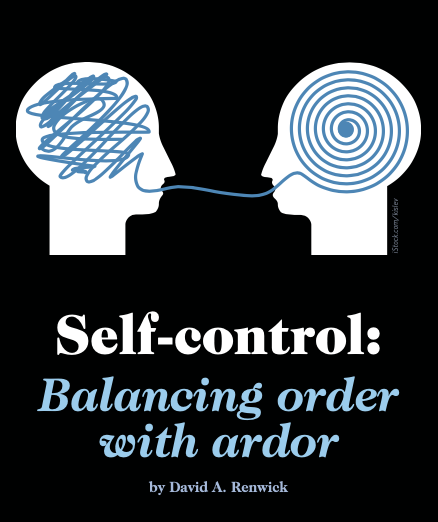
 Self-control! It sounds so very Presbyterian, doesn’t it? This is the final fruit of the Spirit listed by Paul in Galatians 5:23. Self-control! A virtue that surely fits those of us who love to do things “decently and in order.”
Of course, the issue of balancing order (a near cousin of self-control) with ardor (which many Presbyterians equate with out-of-control) has been a struggle in the church for centuries. With few exceptions, order has won the day. What more evidence of this victory do we need than to note that the Presbyterian constitution includes a book titled the Book of Order, not the Book of Ardor? At a community level, self-control is our thing.
In some communions and denominations more charismatic or effusive than ours, this victory of self-controlled order is tantamount to saying that the Holy Spirit has lost out. To some, a primary work of God’s Spirit is to empower ardor to break down deadly order, to enable God’s control to replace self-control. From this perspective, the renunciation and loss of self-control can even be seen as the essential evidence of God’s presence and work.
To be sure, it is clearly true that self-controlled order can become deadly and godless. But not always.
A quick survey of first-century Christianity, as well as of Judaism in both the first centuries before and after Christ’s incarnation, shows that the words Spirit and order or self-control were often seen as intimately related and not at all antithetical. For example, in the Jewish community of Qumran, down by the Dead Sea, there was a strong sense of discipline (like order, a cousin of self-control), and an even stronger belief that if members of the community could just get their self-control and discipline in good order, then they would be creating precisely the kind of atmosphere that would be pleasing to God. Further, the Qumran community seems to have believed that this self-control – not loss-of-control – would open the door for the Spirit of God to step in and unleash the power needed to win every battle against evil, enabling them, the “Sons of Light,” to defeat their enemies, the “Sons of Darkness.” At Qumran, if ardor was in the spiritual equation at all, then it was not primary but secondary, and clearly followed on the heels of meticulously planned order that required self-control.
 Further, it seems likely that the Qumran community picked up this idea of connecting order with the presence and activity of God’s Spirit from the Hebrew Bible itself, where the first work of the Spirit of God in Genesis 1 was to bring order out of the primordial chaos. This activity of God in relationship to order was followed in Genesis 2:17 by the restraining law (from the creative order-making God) not to eat the fruit of the tree of the knowledge of good and evil — not an easy law to keep, since the fruit was deemed to be “good for food” and was a “delight to the eyes” and was “to be desired to make one wise.” To obey this law from God took self-control: which, alas, both Adam and Eve lacked. And this lack led nowhere good: neither to flourishing nor to a deeper experience of the Spirit of God, but rather to their distancing from God, outside the garden, away from the tree of life.
Biblically speaking, such things as order and self-control are by no means contrary to the activity and presence of God. Indeed, they are profoundly related to this God — which is not to imply the extreme position that good order and self-control are God’s only desire and pattern for human activity! In the Hebrew Bible, one clear example of the other side of the coin is the case of Israel’s King Saul. 1 Samuel 10:10 and 19:23-24 say that the “Spirit of God came upon him,” causing Saul to lose all semblance of self-control and good order! And this tension between self-control, order and ardor holds true as well in the second part of our Bible, the New Testament, as seen especially in the writings of Paul.
In 1 Corinthians 12-14, for example, Paul has no problem affirming the importance and validity of the Spirit-inspired experiences of the Corinthian Christians that cause them to lose self-control and spontaneously speak in other languages (“tongues”). In fact, Paul unabashedly declares that he himself, by the Holy Spirit, speaks in tongues more than any of them
(1 Corinthians 14:5, 18). For Paul, the presence of God by the Spirit certainly inspires ardor!
 But at the same time and in the same section of Scripture, Paul subtly and with a great measure of self-control undermines any sense that ardor is the unqualified or essential essence of all experiences driven by the Spirit of God. His undermining comes in at least three ways:
- One way is by literary signaling. Like any good writer, the bottom line of Paul’s message in his three-chapter discussion on “spiritual things” is reiterated in the final summarizing words: “All things should be done decently and in order” (1 Corinthians 14:40). No kidding! This is the conclusion of the most expansive teaching about the Spirit in the New Testament. Order wins.
- A second way Paul undermines a potential claim that ardor or lack of self-control is essential to experiencing God’s presence is by emphasizing that Spirit-inspired action needs to be thoughtful. That is, Paul puts the brakes on the ardor-filled gift of the Spirit, “speaking in tongues,” by saying, in effect: “You can’t just mouth off in tongues and blame the Spirit for making you do it! In order to maintain harmony and effectiveness in the community, you have to help people understand what is going on — you have to plan to have an interpreter of tongues present” (1 Corinthians 14:13, 26-27). For Paul, the presence of the Spirit is no excuse for lack of thoughtful community planning. Both self-control and good order win.
- Third, Paul’s subtle undermining of ardor as the quintessential sign of the Spirit is solidified by a combination of both literary signaling and thoughtfulness — manifested in love.
If the last word provides a clue as to the primary issue at stake in an argument, often the center does too. So, what is the center of 1 Corinthians 12-14? Not just a few words, or a paragraph, but a whole chapter on love!
The fact that 1 Corinthians 13 is most frequently read in church at weddings (and not within a study of the fruit of the Spirit), may lead to a further surprise. This exquisite piece of writing is actually a polemic against the non-self-controlled “ardor wing” of the Corinthians church.
When Paul writes 1 Corinthians 13:1-2, “If I speak in the tongues of mortals and of angels, but do not have love, I am a noisy gong or a clanging cymbal. And if I have prophetic powers, and understand all mysteries and all knowledge, and if I have all faith, so as to remove mountains, but do not have love, I am nothing,” he is taking aim at the claim that ardor in and of itself is a sign of God’s Spirit at work. To Paul, the presence of ardor without self-control is not only not spiritual, but is worse than useless. To put it positively, as Paul lists the attributes of love in 1 Corinthians 13:4-8, there is no doubt that it’s self-control in the service of promoting good order in the Christian community – and in all relationships – that is intimately connected with the essence of love, and therefore with the essence of the work of God’s Spirit. Here’s the list. Note the overlap with some of the fruit of the Spirit in Galatians 5:22-23; and note the elements expressed in the negative:
Love is . . .
- Patient;
- Kind;
- Not envious;
- Not boastful;
- Not arrogant;
- Not rude;
- Does not insist on its own way;
- Not irritable;
- Not resentful;
- Does not rejoice in wrongdoing;
- But rejoices in the truth;
- Bears all things;
- Believes all things;
- Hopes all things;
- Endures all things;
- Does not ever end.
Nine out of the 16 elements of love in this list are expressed in the negative. Like the solitary negative command in the garden, they are all admonitions to self-control, as if to say: “For the sake of peace and good order in the community, don’t give any room for these actions or attitudes to control your life. Instead, use the power of the Spirit to control yourself — and stop!” Even beyond these negatives, it’s easy to see that the virtues of patience, bearing all things and enduring all things – and perhaps the others too (kindness, belief and hope) – also require self-control.
 In the immediate context of the fruit of the Spirit in Galatians 5, self-control is certainly an essential characteristic needed to resist and counteract the sins listed in Galatians 5:19-21 — sins that, for the most part, destroy healthy community life: “sexual immorality, moral corruption, doing whatever feels good, idolatry, drug use and casting spells, hate, fighting, obsession, losing your temper, competitive opposition, conflict, selfishness, group rivalry, jealousy, drunkenness, partying and other things like that.” We may never know the answer, but I wonder if the listing of self-control as the final fruit of the Spirit is also connected to another matter in which its absence was of pressing importance to Paul — and to the Galatians.
The other “matter” is the issue that led to the writing of the letter to the Galatians in the first place. The first two chapters of Galatians tell the story. It’s about the disruption in the fledgling church in the cosmopolitan city of Antioch, caused by the sudden withdrawal of Simon Peter, Jesus’ friend, from table-fellowship with non-Jewish Christians. Prior to his withdrawal, Peter’s custom had been to pay no attention to Jewish dietary and purity laws and to pull the Christian community together by eating with anyone in the Christian family, Jew or Gentile.
 Eating together with those outside the Jewish fold was a big deal. As a faithful Jew, Peter would never have done such a thing. But God had specifically given Peter a powerful vision, indicating that with the coming of Jesus the Messiah, a new day had dawned, and that these dietary laws, dividing Jew from Gentile, were no longer valid.
In other words, Peter knew what was right and what Jesus wanted: the binding together of people from differing religious and racial backgrounds within this new Christian community, the church. But in a single moment, when great pressure was exerted by some “men from James,” Jesus’ brother, Peter ignored this word from God and retreated to his old ways. And it split the unity of the church. It was a moment where self-control folded under emotion. No love. No thoughtfulness. Just impulse, and then the body of Christ broken. Again.
Of course, this is not Peter’s sin alone. Like Adam and Eve before him, we do the same and desperately need God’s power by the Spirit to give us as much spiritual fruit as possible — including that kind of self-control that binds together both good order and ardor.
 David A. Renwick is pastor of National Presbyterian Church in Washington, D.C.