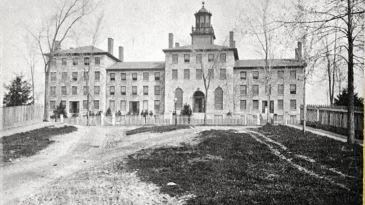
This spring, the board of Pittsburgh Theological Seminary named Asa J. Lee as the seminary’s new president and professor of theological formation for ministry.
At the time, Lee was vice president for campus administration, associate dean for community life and director of African American church studies at Wesley Theological Seminary, a United Methodist institution in Washington, D.C.
Lee is a Baptist minister married to a Methodist minister; together, he and his wife, Chenda Innis Lee, have four daughters.
The Outlook reached out to ask Lee about his background and vision for Pittsburgh Theological Seminary just before he stepped into the role of president on June 7, 2021. This interview has been edited for length and clarity.
What you would like the readers of the Outlook to know about you as a person?
I was born in England to military parents and came to this country at a young age. I was raised in a nontraditional home that valued the voices of women. There was not a male presence in my house. There were a lot of women in my home, and so I understood acutely the struggles of minoritized women, the ways in which they built community and the ways in which that formed me as an only child.
I went to an HBCU (historically black college and university), Hampton University in Hampton, Virginia, majoring in music. I played in churches, night clubs, piano bars, bar mitzvahs, birthday parties — you name it and I did it.
I heard the call (to ministry) first at 13 years old and knew what it was, and decided that that was not for me. I ran from the call, as all ministers do at one point or another. Through my teenage years, I said on several occasions, “If God wants me, God’s got to come and get me.”
So God came and got me. I spent almost 10 years working in churches as a musician, as a worship leader and as a ministry coordinator. Then I went to Wesley Seminary, where I met my wife and I subsequently went into pastoral ministry and served for 10 years in a congregation. I got my doctorate during that time and returned to Wesley because I had a strong desire to see a better connection between pulpit and pew.
The biggest thing for me, both as a pastor and as an incoming seminary president, is to understand what God is doing in the midst of the lives of people and to figure out how the church can participate with that. How are we shaping and molding and allowing people to explore what God is doing in their lives for the betterment of the world and for the ushering in of God’s loving justice in the world?
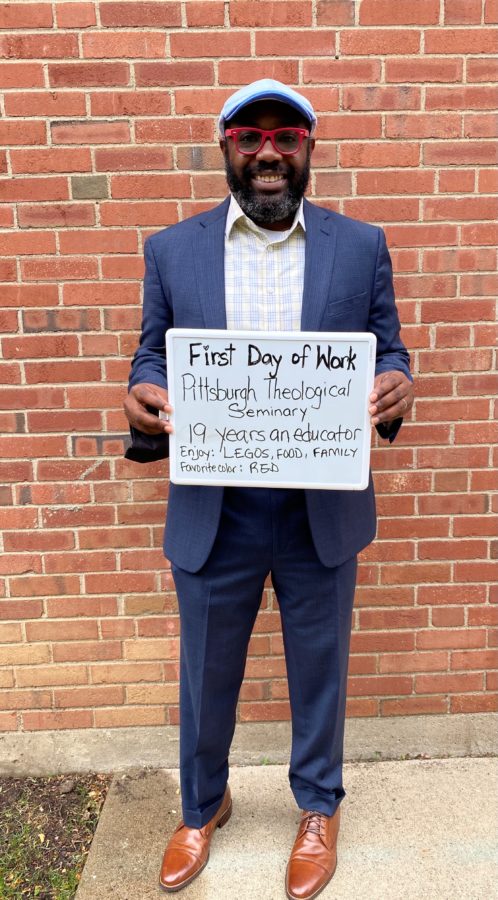 Tell us about your family.
I met my wife on the first day of seminary. We ended up in a lot of the same classes, but we did not start dating until my last year. We became close friends first.
My wife is Liberian and survived the civil war in that country. She comes from a long Methodist heritage – she is the daughter of a Methodist bishop – and earned two master’s degrees from Wesley. We’ve been married for 13 years and have four daughters.
What are you passionate about?
One day in 11th grade, the high school band director gave me permission to conduct the band. There was a section of music that some of the students didn’t really get, and the director was trying to explain it, but instead he gave me the baton and said, “You go through it.”
I tried to explain what was going on to the section, and something clicked for them, and they got it right. And this brightness happened. That moment was a high; it bubbled something up in me. To this day, I get the exact same feeling when I stand in front of a class or in a meeting and I am able to connect the dots for people.
I love helping people to connect ideas with action. I love helping people to understand complex ideas. I love helping folks see the value in connecting with a particular mission or goal or direction.
Much of my ministry has been bivocational in the sense that I’ve had one foot in the classroom and one foot in the church.
In the announcement of your new presidency, you made the following statement: “I’m excited to lead Pittsburgh Seminary into a rediscovery of its core strengths as a seminary of the Presbyterian Church (U.S.A.) and to take advantage of new opportunities on the horizons of theological education that will provide a model for theological preparation and spiritual formation to prepare students for pastoral ministry.” That strikes me as a very thought-out statement of goals.
The first part of the statement is about helping Pittsburgh rediscover itself. It’s about understanding what it looks like to be Pittsburgh Theological Seminary in a deep and generative relationship with the denomination that responds to denominational needs, but also helps the denomination to see what is going on in the midst of the lives of people discerning ministry.
 The second part of that statement is about what’s happening in theological education more broadly. Theological education, as a niche of higher education, means that many of the same challenges that are facing colleges and universities are also acutely facing theological schools. COVID-19 has certainly exacerbated these conditions, but they were already present. But having recognized the challenges, where are the opportunities? Where are the places where theological education still matters?
I think there are three ways in which this is acutely important. First, seminaries and theological schools are among the few places in our broader collective society where we still talk about issues of morality and how it connects to people’s lives and philosophy and theology.
Second, there’s an opportunity in theological education to visit and revisit mission and ministry for the life of the Body of Christ. I’ve been excited to work with programs that put pastoral leaders in conversation with civic leaders — for example, sitting a police chief in a room with a group of pastors.
I did that in Baltimore with the police chief and a group of pastors after the death of Freddie Gray. We talked not only about how pastors could help the police, but we talked about what the police were missing, what pastors could bring to the table and how we could be mutually accountable partners.
Lastly, theological schools are still fundamentally the place where we should be helping the church and students understand what God is doing in the world, and how they can offer their gifts and abilities.
I’ve often referred to seminary as a place where experimentation happens. This is part of my doctoral work. Some of us are familiar with Godly Play [a spiritual formation curriculum for children]. Seminaries ought to be the place where you can try out new ideas, try out new thinking and wrestle with these kinds of issues.
You are not a Presbyterian. What is the significance of you leading a Presbyterian seminary?
The seminary is going to be a part of the Presbyterian Church (U.S.A.) — that is not going to change. Its faculty, its staff and its board are still deeply rooted in the PC(USA).
I see my role as listening to and getting to understand the commitments of local presbyteries and synods, as well as the General Assembly, and understanding the issues facing the PC(USA).
I’ll be listening deeply and getting to know the values and the trends in the denomination, and then bringing insights back to the seminary to say: “This is what is happening, here’s how the seminary can position itself to be relevant, first and foremost to its denomination and then to its broader constituency.”
That’s a learning curve – and I recognize that – but it’s a learning curve that I’m wanting to lean into early.
I’m wondering if you could say something about diversity, equity and inclusion at Pittsburgh Seminary. What are your visions for that? What do you think the seminary’s strengths and areas of growth are?
Diversity, equity and inclusion work is always personal work. It requires a level of self-reflection, honesty and dialogue. From an institutional perspective, it means asking: “Who are we? How safe are we for Black people, Indigenous people, persons of color? How safe are we for LGBTQIA voices?” That work is ongoing at Pittsburgh. So, doing the self-reflective work is the first step.
Next, we ask: “Where do we need to educate ourselves? Where do we need to listen to each other? And where do we need to forgive? Repent?” That is a longer work. In a lot of cases, institutions want to pass a policy, pass something, and then move on to the next thing. But if you’re talking about actually building antiracist change, then it means that second phase of listening, learning and engaging is a much longer process.
 I’m grateful that the board and faculty at Pittsburgh Theological Seminary have begun that work. And I’ll be coming in as this work begins to ramp up within the staff and the student body.
This is where it becomes really difficult, because that’s the place where voices that have otherwise been centered and privileged have to hear those who have been marginalized. That’s a struggle, because that decentering is disorienting. I’m grateful that we’ve been able to do that work at Wesley. I bring that experience of leading that kind of change to Pittsburgh.
The step is sustaining that work, which is where policy comes into play.
From my vantage point, Pittsburgh Seminary is growing in diversity and it’s at a critical juncture of listening deeply and beginning conversations about what needs to change. I recognize that my presence as the chief executive officer is going to bring to the forefront some acute issues of growth, but we don’t know what those are yet. We’ll have to wrestle with that when we run into it. And we’re going to run into it. Once we run into it, then we will come back and reflect, listen and then figure out how to retool to move forward.
Presbyterian seminaries are known for academic rigor. But “academic rigor” can stand for a lot of things. It can stand for “Greek and Hebrew,” or it can stand for “resistance to change.” Sometimes traditional disciplines come into conflict with new approaches because there’s only so much time that a student has. I wonder if you can say something about your reflections on this topic.
I tend to be very suspicious of binaries. So academic rigor is usually used in opposition to practical ministry, right? Being it’s either academic ministry or practical ministry. But binaries usually lack any imagination or innovation. Practical ministry should be absolutely a fundamental part of the work of a seminary, but that’s not a rejection of academic rigor.
When I hear “academic rigor,” I think of rigidity, but seminaries are good at innovation. We can teach academic disciplines in ways that are imaginative and creative, that don’t lose any of their rigor, but at the same time fuel relevance for the practice of ministry. There’s a way to do both.
I’ve found that some of the best professors in the classroom have become stellar professors online because they’ve innovated, and they’ve not lost any of the rigor. They’ve not lost any of the real substantive energy of teaching a core discipline, but they do it in a way that’s innovative and creative. And students are able to grasp that information.
So, I don’t reject academic rigor. Nor do I say that we must do that above all else. A theological school should be rigorous, thorough, intense — that’s what makes it a credible place for wrestling with call. But to what end? Every single moment of wrestling should be for what purpose? And if the student cannot understand, and does not have a clear sense of how this wrestling intensely affects their future ministry, then we’re not doing our job as a seminary. I think that’s a very important part of balancing and merging academic rigor with an application towards ministry. O