Vaccinations may be required to attend committee meetings of the 2022 General Assembly of the Presbyterian Church (U.S.A.) – although that decision hasn’t been made yet.
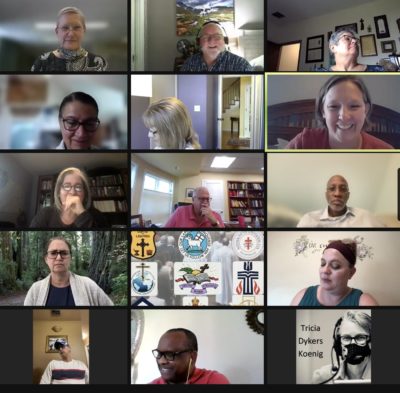
The PC(USA) also is considering alternate options for holding the 2022 General Assembly should the COVID-19 pandemic morph again – including the possibility of holding the assembly entirely virtually.
The current plan for General Assembly 2022 is a hybrid model with committee meetings in Louisville June 20 to July 3 and plenary sessions online June 18 and July 5-9. Church leaders hope that this strategy will hold, Julia Henderson, interim director of assembly operations, said during the first day of the Committee on the Office of the General Assembly’s Sept. 27-29 Zoom meeting.
Given the way the pandemic keeps changing, “we also know we could be in full lockdown again by the time the General Assembly comes around,” Henderson said. So the staff of the Office of the General Assembly (OGA) is keeping an eye on reports of COVID-19 variants being detected in other countries and considering options for how the current plans may be modified if needed.
Some possibilities:
- Holding committee meetings in person but socially distancing them by utilizing more space in the Presbyterian Center in downtown Louisville.
- Revising the committee schedule so no overlapping sessions would be held – something that had been planned to give commissioners more opportunities to interact.
- Allowing for hybrid committee participation – with commissioners and advisory delegates given choices about whether they want to attend in-person or online.
- Holding the whole assembly virtually, as was done in 2020.
The OGA staff is developing lists of pros and cons for each option, is considering the financial implications of each, and is talking to representatives of other denominations, Henderson said.
The final decision would be up to COGA, said Kerry Rice, the PC(USA)’s deputy stated clerk.
Another piece of the work: a conversation with the Administrative Services Group and leadership of the Presbyterian Youth Triennium (scheduled to be held July 24-27 in Indianapolis) about possibly convening an advisory panel with expertise, to provide guidance on how the church might respond in particular scenarios, Rice said. And the PC(USA) might contract some work out – for example, the logistics of developing an app so that commissioners and advisory delegates could report each day whether they have a fever, have lost their sense of smell or taste and so on.
Will vaccinations or COVID testing be required for commissioners and advisory delegates?
“We’re kind of leaving the door open for that as we get advice from folks who are guided by science,” Henderson said. “We really want to be right on the science first, and then we’ll figure everything else out.”
J. Herbert Nelson, the PC(USA)’s stated clerk, issued a statement Sept. 27 saying that Presbyterian theology offers no religious exemption to the COVID-19 vaccination: “The need for vaccination has been clear for months. It is utterly compelling now.”
So if someone doesn’t want to be vaccinated, “you can still claim it as an individual, but you can’t rely on Presbyterian theology or polity to back you up in that claim,” Rice said.
Based in part on that, the Presbyterian Center is getting close to requiring a vaccination mandate for all who visit or work in the building, Rice said. “That would impact all commissioners and advisory delegates,” and anyone else wanting to come to the building for the assembly.”
Rice said “we are closing in on consensus” regarding that requirement – but COGA could also act to require vaccinations or testing for all in-person General Assembly participants.
 All this uncertainty adds to the difficulty presbyteries say they are having trying to find people willing to serve as commissioners and advisory delegates, said Shannan Vance-Ocampo, a presbytery executive and chair-elect of the Presbyterian Mission Agency Board.
COGA member Leanne Masters said she wants to be sure the church considers issues of equity – such as whether some have allergies or medical reasons why they can’t be vaccinated or choose not to be.
And Eliana Maxim, COGA’s vice-chair, said she hopes whatever decisions are made are consistently applied, not just to General Assembly but to all national PC(USA) events, so “there is one uniform policy or expectation.”
COGA also discussed other proposals for the 2022 General Assembly. However, it isn’t taking formal votes on particular items until later in this meeting, on Sept. 29.
Exhibit Hall. COGA’s Events work group is recommending that the 2022 General Assembly not have an Exhibit Hall – either in-person or virtual. Some questioned whether a virtual exhibit hall works very well, and whether commissioners would have time to visit one if it were offered in-person, said COGA member Dave Davis, who leads that team.
Overture Advocates. The Process and Discernment work group is recommending that all overture advocate presentations be made virtually – either through pre-recorded presentations or in real-time virtual remarks. Those presentations usually are limited to two or three minutes each, said COGA member Andy James. Having them done virtually helps presbyteries worried about budgets and health risks from travel, and allows presentations from knowledgeable advocates who might not be available to do a presentation in person, James said. In 2020, before the decision was made to hold that assembly virtually, one overture advocate got permission to do a virtual presentation for an overture involving climate change, Henderson said – arguing that it wasn’t a good use of environmental stewardship to travel from the West Coast to Baltimore for a presentation that would only last a few minutes.
Chaplains. OGA is working on a plan to make chaplains available for commissioners and advisory delegates during the assembly, Rice said.
Mid council concerns. Jihyun Oh, director of Mid Council Ministries, and Tricia Dykers Koenig, associate director for Mid Council Relations, summarized some results from responses that presbytery and synod leaders submitted regarding their concerns and hopes for General Assembly.
Commissioners are being asked to hold open three weeks of time until committee assignments are made in February 2022. Some presbyteries say that’s making it hard to find people willing to serve. “The uncertainty is very difficult,” Dykers Koenig said, citing “a big need for communication.”
Other issues mid council leaders raised included Zoom fatigue; concerns about broadband access; a desire for shorter plenary sessions and opportunities for connection, Oh said.
Renovations. Rice updated COGA on the $2.4 million renovation underway at the first floor of the Presbyterian Center, saying the work is on track to be completed by late April, even though demolition was delayed when some subcontractors contracted COVID and couldn’t work. Work is underway to choose carpet, paint colors, cabinets and more, “making it all a little more real,” he said.
Rice stressed that the renovated facilities will be used for more than General Assembly. “The world of hybrid meetings was something we were not going to be equipped to deal with were it not for this construction project,” he said.
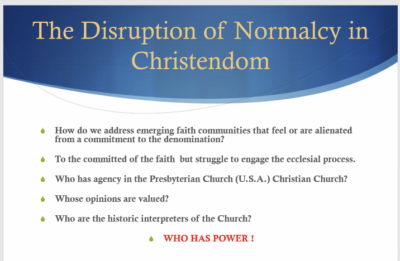
From Lament to Hope. Nelson led COGA members in a Bible study on the assembly’s theme, “From Lament to Hope,” from Hebrews 11. That chapter shows an early church struggling with questions that Presbyterians also confront now, Nelson said – questions of how the church can move forward and be a witness in a changing world, how to create community in a time of pandemic and when fewer than half of U.S. adults belong to a religious congregation.
The growth of the PC(USA) will depend on its willingness to go beyond thinking of church as a safe place, “a place to get a hug,” Nelson said. He called for the church to become a movement committed to diversity and the work of justice, willing to go out and make disciples of people “we never thought we would sprinkle water on.”
The author of Hebrews reminds Christians over and over again that “God is still at work, God is still giving us everything we need.”
And Nelson said he is raising the question of who has power in the PC(USA)? How is that power being used? Who has agency? Whose opinions are given value? Who is preparing the table with extra places– with room for the refugees at the borders, for those being detained, for those being mistreated?
On Sept. 22, a 16-year-old Louisville boy, Tyree Smith, was shot and killed in a drive-by shooting at 6:30 AM while he waited for the school bus. Two other students were injured.
“The ministry is not in the church building,” but in the world, on the streets, Nelson said. “We are called to love our neighbor” – to take the risks that Jesus took, “to invite sinners in, to invite people who are broken, to recognize our own sins.”
To sit at a common table.
Elona Street-Stewart, co-moderator with Gregory Bentley of the 2020 General Assembly, said she attended a recent truth and reconciliation event convened by the Minnesota Council of Churches, which included a presentation from a leader of the National Native American Boarding School Healing Coalition. Those conversations are hard, she said – the recognition that for many “Christendom is defined as a white Jesus and his followers,” and that the church has been complicit in marginalizing and annihilating people.
But “I have hope,” Street-Stewart said. “I have hope in the midst of my tears and the trauma. Our ancestors are trying to tell us, ‘These are your people. You are all related.’”