The COVID-19 pandemic is throwing some possible curve balls at the budget for the 2022 General Assembly with costs expected to be $539,000 more than originally budgeted.
The good news: the $8.8 million Paycheck Protection Program loan the Presbyterian Church (U.S.A.) received has been forgiven. Of that, the PC(USA), A Corporation board has designated $770,000 to go to the Office of the General Assembly. And the PC(USA) has earned about $163,000 by marketing use of the PC-Biz information hub to other denominations and groups holding online meetings.
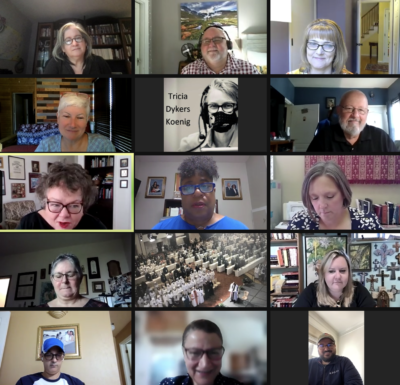
Kerry Rice, the PC(USA)’s deputy stated clerk, told the Committee on the Office of the General Assembly (COGA) during its Sept. 28 Zoom meeting that some of the higher costs are related to the pandemic.
The plan is for the 2022 General Assembly to be hybrid – with committees meeting in-person on a staggered schedule at the PC(USA) office building in downtown Louisville, and most plenary sessions online.
Hotel costs are expected to be about $167,000 higher than originally budgeted because commissioners and advisory delegates will be given single rooms rather than sharing – an effort to reduce risk of coronavirus infection, Rice said.
The revised budget includes about a $25,000 “placeholder” for COVID health checks, Rice said – meaning that organizers know they’ll have expenses but aren’t sure yet whether that might be for rapid testing or some other protocol. “The other thing that kind of keeps some of us up at night is what if there is an outbreak and we are required to quarantine participants,” Rice said.
During its Sept. 27 session, COGA heard of alternatives that might be considered if the COVID-19 pandemic requires it – including the possibility of reconfiguring the hybrid plan or moving the entire assembly online, as happened in 2020.
Presbyterian Historical Society. Part of this meeting was a joint session with the board of the Presbyterian Historical Society. Nancy J. Taylor, executive director of the Presbyterian Historical Society, provided updates on staff changes, online and research initiatives, and fundraising efforts – including efforts to document LGBTQIA+ history in the church and to collect resources related to African American church history. Small-group conversations focused on “how does uncovering, reflecting and repenting” fit into the church’s work?
“You have to know who you’ve been and where you come from, the good and the bad,” to know where you’re going, COGA member Robin Pugh said afterward.
History can be a landing pad or a launching strip – as the work of uncovering historical truths, the story of what happened, can lead to reconciliation, said Perzavia Praylow, a member of the Presbyterian Historical Society board.
PMA restructuring. At its Oct. 6-7 Zoom meeting, the Presbyterian Mission Agency Board will dig deeper into a consultants’ report that calls for a reconfiguration of the Presbyterian Mission Agency (PMA) – a way for the agency to live more deeply into its commitment to be a Matthew 25 church and to transform its work over the course of the next generation.
COGA members heard a presentation on that from Diane Moffett, PMA’s president and executive director, and from Shannan Vance-Ocampo, chair-elect of the PMA board.
“The sky’s the limit on how we envision ministry,” Vance-Ocampo said. “It’s up to the creativity of the larger church.”
Among the questions that COGA members asked:
- What kind of approval does the General Assembly need to give to this reconfiguration?
- Is there a conflict between the recommendation to decentralize the work of the PMA – with many staff members deployed outside of the PC(USA)’s offices in downtown Louisville, and the $2.4 million renovation of that facility currently underway in order to host committee meetings of the hybrid 2022 General Assembly?
Moffett responded that the 2016 General Assembly passed the Matthew 25 overture that undergirds PMA’s work, and that “we are always of service to the assembly, as the Holy Spirit moves through the body.”
Elona Street-Stewart, co-moderator with Gregory Bentley of the 2020 General Assembly, spoke of some of the challenges of creating deployed teams from the national staff who would work in local settings in partnership with people from the region on issues of advocacy and structural transformation.
One of the challenges: how does a majority white church connect with a world that’s considerably more diverse?
In Native American communities, “we’ve always had people come out to tell us they’re there to support us,” Street-Stewart said. “That’s been the history of the church. … When will that support that comes out be a support that Native people will say, ‘This looks like us. These are people who know us.’”
Moffett also spoke of “the trauma to people of color (from the PMA staff) who go out and talk with the greater church. … Some of it is really tough work.”
COGA’s fall meeting will conclude with a final session Sept. 29.