 When he was younger, I sent my son on quick jaunts with his mini grocery cart down the supermarket aisles while I waited several yards away. He loved pulling things off the shelves. I recall all of those assorted boxes of colorful fruit snacks and kid fare that miraculously appeared in the checkout line out of nowhere. So, why not let him practice fetching items from the grocery list for a little taste of independence? I grew puzzled and then frustrated when I asked for a specific item and he returned with the wrong item, or sometimes nothing at all. How did he forget what he had set out to accomplish just 10 seconds ago?
This frustration would often bubble up again at home when I’d ask him to find his shoes to get ready for school or karate class. He would acknowledge hearing me with a nod, then promptly get sidetracked on the way to or from his room by something more worthy of his attention — a cartoon on the TV, a book on the floor, a pile of Legos on a table. This went on for several years. I tallied more mom meltdowns than I care to admit while I blamed my child for being a terrible listener and direction follower. Anxiety over being late began to mount, and an undercurrent of worry grew over time. I knew raising a son is typically different from raising a daughter. I knew how smart our son is and could not understand why his effort never seemed to match his budding intellect.
 Even as our son attempted to learn to ride a bike without training wheels, we cheered him incessantly as we ran alongside him — and he became more frustrated with each attempt and even panicked before begging to stop on multiple occasions. “You can do it! Don’t give up! Don’t you want to be able to ride bikes with your friends?” No luck. No incentive worked. In fact, the harder we pushed, the faster he shut down. Other than the distractibility that most kids show, we thought we were simply raising a son wired differently from his sister. She is a people pleaser. He is not. Both are assets and liabilities in this life. So what if he loved homemade science experiments at the kitchen table and loathed being over-scheduled for physical activity? This is normal, I thought to myself. These differences are simply what make each child an individual.
Several pediatric neurologist appointments and one three-day psychological education assessment later, we had answers: Our son is on the autism spectrum, has ADHD and a processing speed disorder diagnosis. What does this mean? I felt as though we were to blame for not noticing this sooner. How many times had I made my child feel as though his effort was insufficient while trying something that was insurmountable for him at that time?
 Life can be hard for a child with a learning difference — but not impossible. The rewards are hard-won and sometimes even sweeter than they would have been otherwise. Focus and stamina is an ever-present challenge, and multistep tasks are often confusing. For some, it takes a bit longer to fully process what is being asked and how to deliver.
The answers we got that day in second grade also shed light on something entirely new. Our son’s vestibular balance affects his fine motor skills. Those botched bike rides and tears of frustration? Now I know his position in space on that bike was intimidating because he experiences balance in the same way that I might if I were trying to drink orange juice while dancing on a balance beam. We sometimes get to experience this sensation after a bad ear infection or when we get off of a ride that spins us too hard or too fast.
According to The Autism Helper website, the vestibular system is a “hidden sense.” Simply put, the vestibular system housed in our inner ear refers to our sense of movement and balance. When I move my head, the fluid in my inner ears moves around and gives information about where my head and body is in space. The vestibular system also has receptors that help my body understand the force of gravity.
The vestibular system is one of the first systems to develop in utero. Think of it as a foundation — all other senses are processed in relation to the vestibular system. When it doesn’t work properly, the way we interpret other sensations may not be accurate. When the vestibular system is well developed, we can coordinate movement efficiently. Overall, the vestibular system helps us feel safe and secure in our bodies. A child with a well-developed vestibular system will have no difficulty jumping, climbing, spinning or engaging in activities that require his feet to leave the ground.
Some children may underrespond to vestibular input. They may have low muscle tone and may fatigue quickly. They may have a hard time sitting upright or they may slump on their desks. They may bump into things and appear uncoordinated. Then there are the students who seek vestibular input. They love climbing, swinging, spinning and being turned upside down. As babies, these are the kids that loved the baby swing and needed constant movement to calm down. In the classroom, they may have a hard time sitting still in their chair or on the carpet.
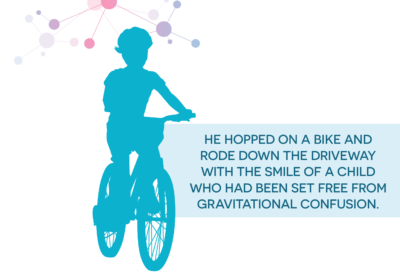 All the encouragement and persistence in the world was not going to help my son ride that bike independently until we strengthened his core and vestibular sensors. After two weeks of exercises in pediatric therapy – laying on a swing on his belly and pseudo flying on a pendulum – he hopped on a bike and rode down the driveway with the smile of a child who had been set free from gravitational confusion. I’m not entirely sure how the training helped, but my boy felt more confident and was prepared to learn.
All things aside, ADHD is the biggest hurdle for our son. So often, the hyper part of the ADHD acronym is misinterpreted. He is not hyper. But he can and often does hyper-focus. He often is hyper-aware of competing stimuli for this attention. The air conditioning unit humming to life demands consideration. The hammer of the roofing job in progress next door seems to fit a pattern. Preferred activities such as video games can capture hours of his attention while a new task that requires some executive functioning (or the ability to manage his time and life) is an enormous challenge. Tasks such as how to pack his backpack for the next day or to make sure papers are organized in a way that they can be found to turn into the teacher have to be explicitly taught and practiced until they become an automated habit.
When school went online during the pandemic, a firehose of new challenges arrived daily. We felt lucky to be weathering a pandemic as a healthy family. It seemed inappropriate to complain. Yet, there we were in tears and power struggles almost every day. Screens are not our friend when it comes to focus. Engaging a child with a unique learning profile is tough even in person. Enter incessant screen time and the distractions of home, and I am not sure what we accomplished other than just showing up some days. The sense of defeat was palpable for kids and teachers much of the time. How much learning was taking place? And where should mental health be prioritized in this new world equation? I could see the dark clouds of depression drifting in and out of the rooms of my home. I joked that we were lucky that none of us had our sob sessions on the same day. By grace and luck, we seemed to stagger them and successfully help one another up off the floor on the hard days.
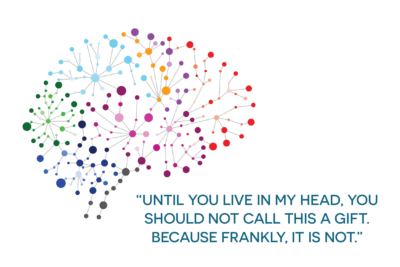 One day, during the height of a pandemic with no end in sight, my 15-year-old son looked at me and said: “Mom, stop. Stop trying to make my learning needs seem like a gift. Stop trying to sugarcoat things by telling me I am an out-of-the-box thinker. Until you live in my head, you should not call this a gift. Because frankly, it is not.” Our understanding of one another changed that day. He was right. Sometimes, we do not get to force silver linings into someone’s existence. We do not own that paintbrush. It is theirs to use. If they want to paint a dark cloud, that is absolutely their right. When we try to force a rainbow perspective on them, we are in essence invalidating their experience and struggles.
I never thought that I would see my child so happy to rise with the sun the first day we returned to in-person school. He was thrilled to be in the presence of peers and to interact with his teachers in real life again. Watching your child develop an enthusiasm for school is something I never knew would bring me such contentment. He was growing up.
I have heard the statement that “you are only as happy as your least happy child.” Happiness, I have learned, is not the goal. Happiness is an unrealistic state to maintain. Resilience, which this pandemic has given many of us whether we wanted it or not, is a far greater gift than happiness. My husband and I really try to consider the fact that our kids will live for roughly 20 years under our influence, and in that time we must prepare them to live independent lives and to deal with the excitement, terror, ecstasy and frustration that is adult life.
 While I wish I could rid the world of this virus and allow us to go back to the carefree days of sharing a milkshake with a friend or hugging freely at family reunions, I have found solace in holding onto the lessons learned. The family time at home – seeing our loved ones thrive and fail at close range – has given us a greater understanding of one another and respect for how we all get things done.
Aside from a handful of botched homemade recipes and the suffering of so many for whom we pray daily, I will take these blessings, bottle them and label them with the word gratitude. Sometimes in parenting, you are the teacher. Sometimes, you are the learner. While he may not always see it as a gift, having a son who sees the world so creatively and who refuses to conform to society’s lockstep expectations of what he should accomplish and when has inspired me to rewrite some of my own expectations of myself. I have had a good teacher — even if he still refuses to pick those towels up off the bathroom floor and often gets sidelined when running an errand to another room. He is too busy making a plan to carve out a life on his terms. I am grateful for a front-row seat.
As we weather these crazy times, look for the little gifts along the way. Model resilience and persistence. Be patient with yourself as a parent. Family life is a long game full of victories and defeats. Give your loved ones a squeeze and let them know you truly see them.
 Shannon Bevins is a wife, mother, daughter, sister, avid reader, academic coach and dog lover living in Franklin, Tennessee, with her husband, two children and two dogs.