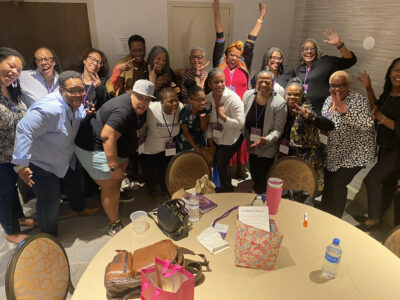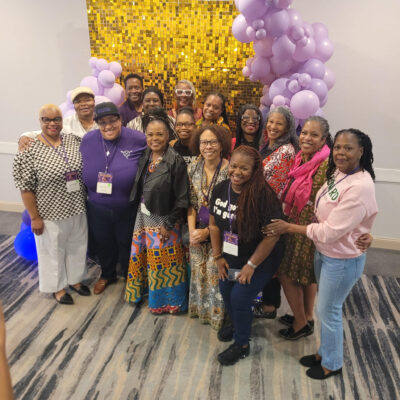
You can faintly hear Fantasia belting out “When I See You” in the background as clergy women from near and far gather and hug friends and family.
I always love going to conferences that are not necessarily Presbyterian Church (U.S.A.) but have enough of a delegation that we get to gather. The last time I was in Charlotte, for the 2022 White Privilege Conference, there was a PC(USA) contingent, and last week at the Womanist Leadership Conference sponsored by the Katie Geneva Cannon Center for Womanist Leadership, there was, again, a space to gather.
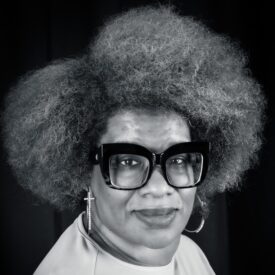
 Katie Geneva Cannon, for whom the conference and the Union Presbyterian Seminary leadership center were named, was the first Black woman to be ordained into the PC(USA). She also had her doctorate from Union Seminary in New York. Cannon saw womanism, as a “powerful approach to recognizing the human dignity and amplifying the long-ignored voice of Black women in a hostile world,” according to the Union’s website.
Womanism, inclusive racially and more complex than feminism, seeks to “restore the balance between people and the environment/nature and reconcil[e] human life with the spiritual dimension,” says womanist scholar Layli Maparyan. The seminary grew the Center for Womanist Leadership to support Black women “divinely motivated to serve as change makers in their community.”
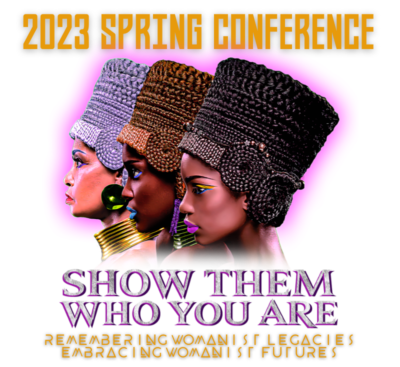
I feel privileged to be here — simply because I am not clergy. But in my many years serving, either as a deacon or ruling elder, Black Presbyterian women clergy have seen me. And when I’ve had the opportunity to be in the presence of a clergywoman who identifies as a womanist theologian, I have always been deeply, spiritually transformed. As each woman entered the room in her own womanhood, Blackness, and presence, I felt even more inspired by who and what is possible as church. This year’s theme, “Show Them Who You Are,” is already showing up in a very authentic way. Diane Givens Moffett, executive director of Presbyterian Mission Agency, closed the pre-conference gathering in prayer with the words of the late Cannon, “do the work your soul must have.”
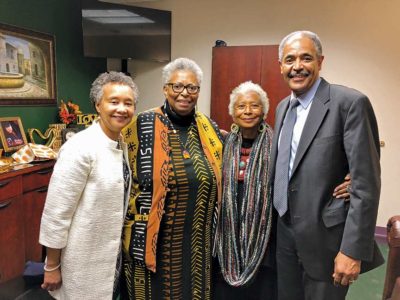
Against the backdrop of African drums, the fifth anniversary of The Katie Geneva Cannon Center for Womanist Leadership Spring Conference began in Charlotte, North Carolina. The center’s director, Melanie C. Jones, lifted up the inception of womanism. Inspired by author Alice Walker, Cannon grew “womanism” into a theological concept. Walker’s essay, “In Search of Our Mother’s Gardens: Womanist Prose Womanism,” defines womanism as feminist, Afrocentric, healing, embodied and spiritual. In the 40 years since “In Search of Our Mothers’ Gardens” was published, Cannon’s scholarship has shaped me and many clergywomen I call friends.
The author of the bestselling book Rest is Resistance: A Manifesto Tricia Hersey (“The Nap Bishop”) reminded us of the need to rest in her keynote. Speaking about Black women’s experience, ancestry and full embodiment, Hersey prompted us to remember that “our divinity was granted to us at birth.” Her words bounced through the ballroom, a symphony felt by every person present there.
It is the work of God and Spirit colliding and cascading on each of us in the room, such that even in a room full of exhaustion, there is hope.
When Fantasia takes the song to the bridge, she sings from her church roots, “Something now is taking over me.” That something for me is the Holy Spirit. It is the work of God and Spirit colliding and cascading on each of us in the room, such that even in a room full of exhaustion, there is hope. There is hope that we can be seen and heard. There is hope that we are moved to do the work that God has called us to do: to build God’s kin-dom that represents all of us.
My soul was reminded of just what it needed to be whole. For this reason, I give thanks and praise.