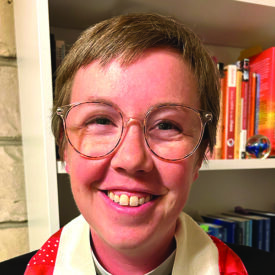
Is violence ever excusable? Is it forgivable, inevitable? How do we heal the violence committed by our respective faith traditions? Robyn Ashworth-Steen, Jermaine Ross-Allam and Laurie Lyter Bright consider the weight of violence among people of faith.
Laurie: You’re both faith leaders engaged as scholar-practitioners where faith and political praxis intersect. You’re also two of my favorite people to talk to about meaningful ideas, as we share an interest in violence, nonviolence and peacemaking. How do you see your traditions engaging with the nature of violence?
Robyn: I am writing this response on Holocaust Memorial Day, one of our darkest days of the calendar. But the trauma of this time lives on in my body and individual and collective consciousness. I am aware of how much this trauma and the violence [that was] enacted on Jewish (and many other) bodies lives on for generations. I learn these lessons, too, through the study of sacred, violent texts where brothers kill each other and women are brutally raped.
I am part of a progressive stream of Judaism, with the first female rabbi being ordained privately in 1935. She was later killed in a concentration camp. My progressive tradition fought for equal marriage, gender equality and much more. It progresses and sometimes regresses. I attempt through my teaching, community work and academic scholarship to address systems of harm within biblical texts so that we are critical, responsible, activist readers of those texts and, crucially, of the worlds that are built in their name.
Laurie: Likewise, Christianity leaves a long legacy of violence — both caused and endured by Christians.
Jermaine: From its birth in the 16th century, the Reformed tradition has maintained its identity as part of the magisterial tradition of global Christianities. Magisterial, in this case, involves the intention to sustain multiple relations to the military, economic and social orders through which forms of inequality have almost eclipsed egalitarian community.
Presbyterians (among others) have used violence through the institution of chattel slavery, justifying its indulgence based on Christian religion. Other Presbyterians in the same period sought to create an environment in the United States where a civil war would save White individuals, families and institutions from the economic power of slaveholders to curtail their civil liberties, and [where such a war would] restrict the economic dominance of Northern industrial capitalists.
The Book of Common Worship includes prayers imploring the “Righteous God” understood to “rule the nations” to “guard brave men and women … in battle for their country.” Though the prayer presumes that they “must be at war” (emphasis mine), it asks the “Righteous God” to “let them live for peace.” The relation of living for peace to the presumption of war as a necessity raises questions about the sovereignty of God that the Reformed tradition must continue to resolve.
Robyn: I see how deeply the poisonous vein of misogyny runs in our tradition and throughout time and space more generally. I am angered by spaces that refuse to change when met with new ideas or new people. I am heartbroken, devastated and unable to find the words to speak about the violence in Israel, Gaza and the West Bank. The violence, the inability to talk, the inherited trauma, the exclusion, the fear, the racism, the extremism — all of it is overwhelming. And yet I know I am not free to desist from the work of turning towards the pain and taking action in any way I can. One of my beloved teachers, Rabbi Sheila Shulman, may her memory be a blessing, wrote, “In short, what I am so angry about is the betrayal, again and again. Of what I love.”
Laurie: Do you believe violence is inevitable? Excusable? Forgivable? Have we always been like this, and will we always be?
Jermaine: In light of the Haitian revolution and other violent decolonial struggles around the world from the 17th to the 21st century, I concur with Calvin – to a point – that under certain conditions, the capacity to employ force “to avenge the afflictions of the pious, at the command of God, … I [should neither] afflict nor hurt.” Even if violence is necessary and excusable, it damages both the doer and receiver until a new balance is negotiated and implemented and [until] rituals of healing, reparations and atonement are performed along with what the United Nations refers to as guarantees of nonrepetition.
Robyn: I have been trained to read my sacred texts closely and critically as early as my Bat Mitzvah at 13 years old. A Jewish hermeneutic means bringing attention to each stroke of the quill, understanding that every breath of a word has significance and that a text is multilayered. I see, more and more, the violence within the texts, showcasing the very worst of human nature.
The power of Jewish theology underscores this concept. We are created in the image of God and are good, very good, in fact. We have the yetzer hara — the evil inclination. We also have the yetzer tov – the good inclination – and both must be balanced. But often, the yetzer hara can overpower the good. We all have the potential for evil, for extreme violence. Recognizing this [potential] mitigates the risk of us dehumanizing others and encourages compassion and curiosity in the face of complexity or fear.
Laurie: Do you see violence as an inevitability under the conditions of the world as it looks today or as a part of the human condition? Do you imagine a different world?
Jermaine: Violence is not an inevitability. It is, however, a necessary evil until the Holy Spirit unleashes power sufficient to inspire the leaders and benefactors of unequal societies to renegotiate the social contract. Such a renegotiation should focus on establishing circumstances where all beings experience more opportunities to offer themselves fully in service to their Creator — without arbitrary interference and suppression from cultures and institutions that deny the historical debt of reparations, [that] pillage nature [and that] subject Indigenous peoples to settler colonialism, apartheid, genocide and land theft.
Robyn: One ancient Mishnah (or teaching from around 200 CE) is now well known to any Jewish child who attends Jewish summer camps: “[Rabbi Tarfon] used to say: It is not your duty to finish the work, but neither are you at liberty to neglect it.” From a young age, [you hear] the teaching . . . that you are responsible even if you cannot fix it. The entirety of the Tanakh lives out the tension implicit in this Mishnah: there is the World As It Is and the World As It Could Be.
I struggle to go as far as saying violence is an inevitability of the human condition because [then] I would have to forgo that core teaching that people are ultimately good. And I struggle to say that violence is in any way necessary. Perhaps a way to respond to the question is with a story, a deeply Jewish response I know [here retold and regendered from Avot D’Rabbi Natan 31b]:
A woman is planting a tender, young sapling tree, and suddenly, there is a commotion on the street outside the house. People are running everywhere. “What’s happening?” she asks someone as they run past.
Breathlessly, the person shouts back – “Haven’t you heard? The Messiah is here!”
The Messiah! The gardener throws her tools down.
“Stop,” a voice shouts. It’s the local rabbi. “You must stay and complete the planting. Only then can you go and greet the Messiah. For Messiahs will come and go, but planting must continue.”
If I were to see violence as inevitable, I would throw down my gardening tools, and I am not prepared to do that.
Laurie: If violence is us waiting on both the Divine and each other to learn a new way of being, how do you understand violence as it relates to the idea of sin?
Jermaine: “Violence” refers to the sin by which individuals, groups and institutions create, deploy, collaborate with or cower before that which is meant to reduce human beings to a condition “as much like brutes as possible.” The goal is “blind[ing] the eyes of your mind,” “embitter[ing] the sweet waters of life” and “shutt[ing] out the light which shines from the word of God” until “American slavery [has] done its perfect work.”
Those words from Henry Highland Garnet [and his 1843 address “to the slaves of the U.S.”], who was a 19th-century Presbyterian minister and statesman, should remind us that early American chattel slavery and contemporary wage slavery are interrelated forms of full-spectrum violence.
Violence is the sin of those whose spiritual and economic integration into the political economy of this age – to paraphrase Romans 12:1-2 – explains their choice to offer other people’s bodies as living sacrifices, thereby refusing to worship God through the renewal of our collective mind.
Robyn: I am moved by the construction of violence as sin and, as you have said, a sin of choice. Hannah Arendt’s theology taught that every moment is imbued with natality, the chance for something to be born, for life or death, and we can choose. To deny such is to deny our responsibility and agency. Using my Jewish/religious lens, I may use the words of idolatry. To sin is to commit idolatry: forgetting our oneness and instead creating hierarchies and violent separations.
According to the Talmudic rabbis, there are times when violence is allowed. Yet they make important rulings that seem to stand the test of time. You cannot kill another if you are in the strange and terrible position of being made to kill them to save your own life (b.Sanhedrin 74a). The rabbis instituted the principle of pikuach nefesh — preserving life, as embedded in the Torah. You shall “live by them,” [says] the Torah (Leviticus 18:5) — not die by them. Jewish teachings recognize the primacy of life: “Whoever destroys one soul, it is as though they had destroyed the entire world. And whosoever saves a life, it is as though they had saved the entire world: (y.Sanhedrin 4:9).
Laurie: So if the root of our respective traditions lies in protecting and uplifting life, how do we heal the violence done in the name of our faith traditions?
Jermaine: I agree with historian William Yoo’s assessment [in his 2025 book, Reckoning with History: Settler Colonialism, Slavery, and the Making of American Christianity that “settler colonialism and slavery shaped American Christianity in deep, haunting, distinctive, and enduring ways.” I believe this inheritance makes both [the] colonizing and [the] colonized U.S. American Christians into dangerous sources of ideological and physical violence against human and nonhuman beings in the United States and beyond.
Christians perpetuate violence when we ignore and deny our heritage and its legacies and when we indulge in counterproductive games that revel in displays of shaming and blaming that reduce the number of people willing to complete work on tough problems.
To repair damages inflicted through colonial legacies, neoliberal economic policies and social engineering techniques, liberal and progressive Christians, in particular, must decide to end cycles of racist and colonial violence and the social performances that inspire the public to believe nothing essential will ever change. And we must expect to encounter physical and ideological violence in the process while making advance determinations about what can and must be done right now to reduce … violence in [the] pursuit of interdependent and mutually beneficial forms of existence.
Robyn: I think of the 10 plagues that led to the Exodus from Egypt, a time of redemption that inspired many in their fight for liberation. Yet I cry each Pesach/Passover when I come face to face with the plague of the firstborn. At whose price is this freedom [won]?
I have no simple answers, but [I] commit to always being in the struggle, asking the questions, practicing nonviolence in my communication, thoughts and actions, and working towards the World As It Should Be whilst living in the World As It Is.
Jermaine: All human projects should include nonviolence as an intention and objective. Nonviolence, however, should never prevent individuals or groups from protecting the pious (as defined by [John] Calvin, Garnet, and [James] Cone) from arbitrary oppression and [from] guaranteeing [that] systemic and historic harms are not repeated. I believe that the most underused method of nonviolence is the cultivated, strategic, collective and enduring choice to “labor for the peace of the human race, and remember that you are … millions!” [in the words of Garnet’s address to the slaves of the U.S.].
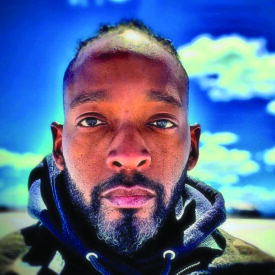

The Rev. Jermaine Ross-Allam is the inaugural director of the Center for the Repair of Historical Harms for the Presbyterian Church (U.S.A.) at the Interim Unified Agency and a Ph.D. candidate in social ethics at Union Theological Seminary in Manhattan.
Rabbi Robyn Ashworth-Steen is a former human rights lawyer and the first female rabbi of Manchester, U.K. She is studying for a Ph.D. in rabbinic leadership and biblical studies at the University of Leeds under an Arts and Humanities Research Council scholarship funded through the White Rose College of the Arts and Humanities.